Author Archives: Michael Froomkin

More Shrill, Please

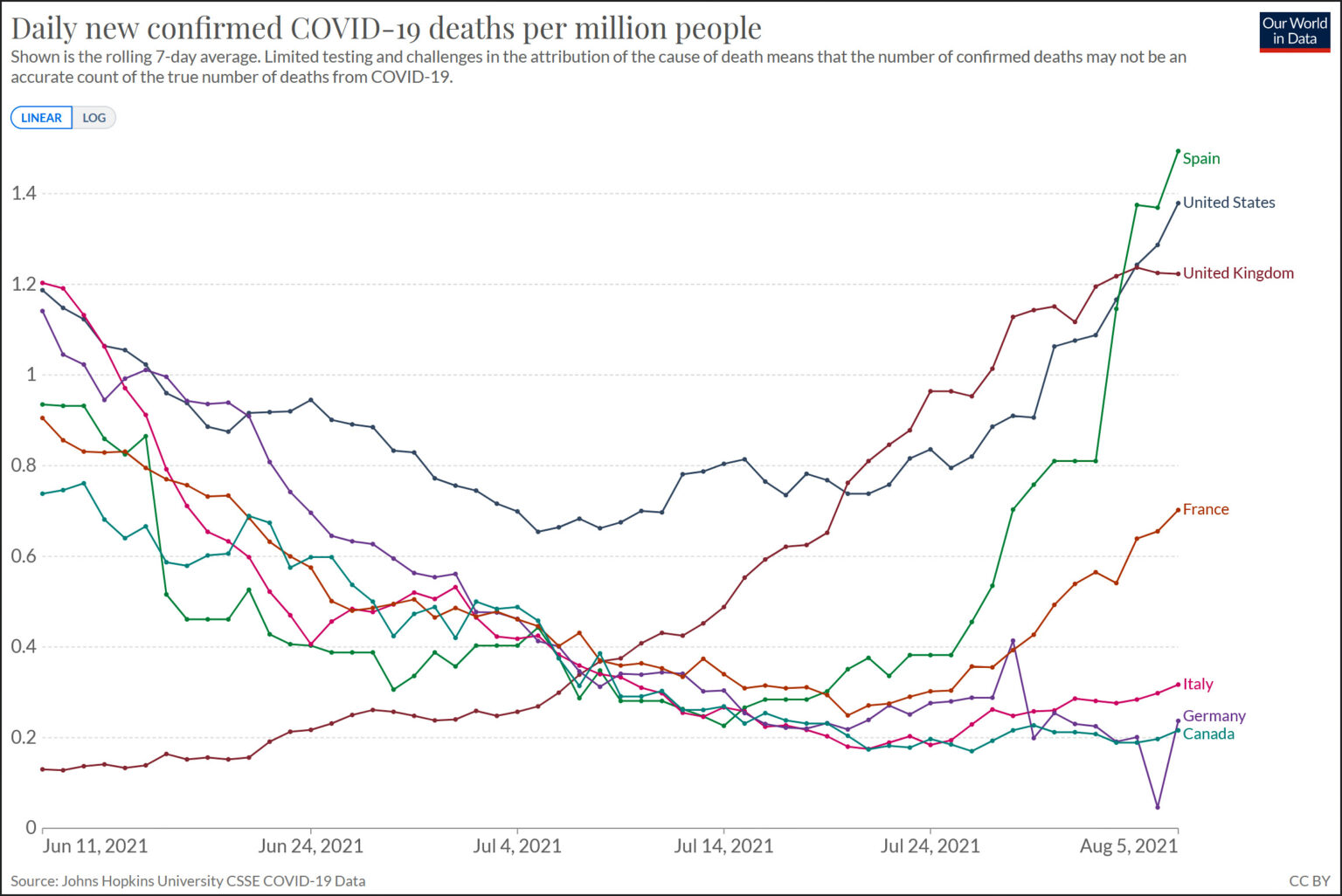
covid deaths 2021

USA #2 in Covid Deaths per million in 2021 (Johns Hopkins via Kevin Drum). Click for larger image.

Charles M. Blow is shrill today,

It is a luxury to be irresponsible in a society where others will be responsible for you, where you simply assume that you are safer because others take the appropriate precautions to be safe: You do not need to get the shot because others have.

But the Delta variant is testing that faith.

You will not be safe as an unvaccinated person riding on the coattails of the vaccinated. Delta is extremely transmissible and unremitting. It is stronger than its progenitor.

As the Delta variant surges there is an uptick in the pace of vaccinations in the country. It’s almost like religion: Many disbelievers will call out to whatever God there may be when the reaper is at the door. Fear of ideological defeat is no match for the fear of imminent death. And yet, it shouldn’t have taken another surge of sickness and death for good sense to set in.

Why were Americans turning away a vaccine that many people in other parts of the world were literally dying for? Many did so because of their fidelity to the lie and their fidelity to the liar. They did it because they were — and still are — slavishly devoted to Trump, and because many politicians and conservative commentators helped Trump propagate his lies.

It was all lunacy. It is all lunacy. This should never have happened. There are people dead today — a lot of them! — who should still be alive and who would be if people in the heights of government and the heights of the media had not fed them lies about the virus.

But apparently, after you get so used to so much blood on your hands, you forget — or make yourself forget — that you weren’t born with red palms.

I think we need much more of this. It is time to call out the politicians and TV/Radio stars who inveigled against the COVID vaccine — and most especially those vaccinated themselves — and say, in the sort of plain speaking that responsible people in public debate have tended to avoid, that opinion-makers who led people to mistrust the COVID vaccine are killers.

In particular, it is past time to call out, in the harshest terms, those Governors who–while claiming they are protecting freedom and choice–prohibit localities in their states from imposing mask mandates and other COVID precautions  That includes Texas Governor Greg Abbott and of course our own Florida Governor Ron DeSantis.

That is not protecting choice, that is protecting irresponsible and potentially deadly behavior.  It is no more responsible than telling people it’s OK to drive on the wrong side of the road, and those traffic-cop supporters are against freedom. We’d call that out, wouldn’t we?

Posted in COVID-19 | 8 Comments

Oh Rats

First it was zoo animals like large cats, bears and gorillas that could get COVID. Then if was house cats. Then it was wild deer who might be COVID carriers.

Now it’s rats. And there are millions of rats in large cities.


Posted in COVID-19 | 4 Comments

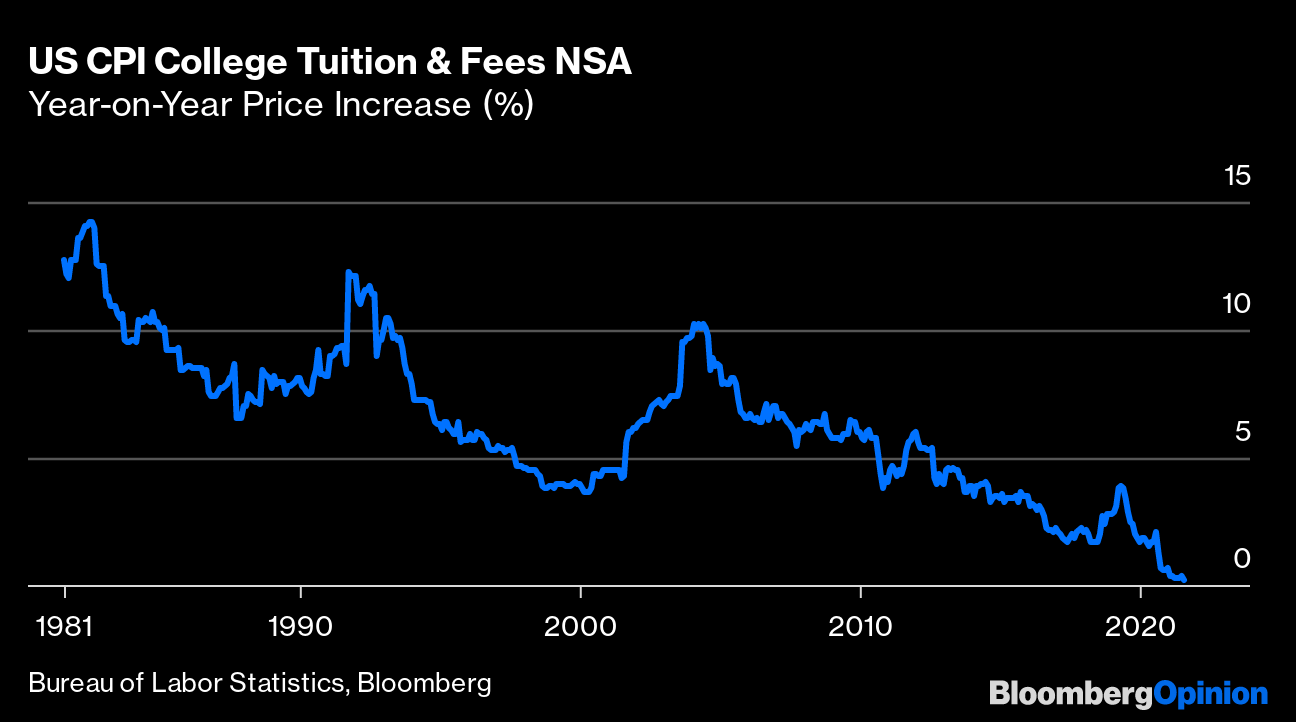
Intellectual Cicada? Or, the WSJ Returns to the Theme that Law School Tuition is Too Damn High

I don’t know if this is an eight-year thing, like some sort of intellectual cicada, but we’ve been here before. Back in 2013, major newspapers published a bunch of articles purporting to show that a J.D. was a bad investment financially. This led to a purported (and in my view slightly over-done) rebuttal, The Economic Value of a Law Degree, by Michael Simkovic and Frank McIntyre; Simkovic in particular then took to the blogs to defend his corner.

Now, we’re back to it again: today the Wall Street Journal published Law School Loses Luster as Debts Mount and Salaries Stagnate, which generalizes from undoubtedley true tales of people who borrowed too much ($300,000 in some cases, a chunk being undergraduate debt), and were not able to find jobs after law school that allowed them to pay it back in a reasonable time, or at all.

And, like clockwork, here’s Michael Simkovic with a reply, Wall Street Journal blames law schools for COVID economy (Michael Simkovic), the core of which is the economist’s perennial question: compared to what? Simkovic basically argues that, yes, more recent law school grads have had it tough, but less tough than people who didn’t get law degrees.

In fact, the story last time was more complicated than it appeared from the newspapers. And yes, law school tuition is too damn high, but that’s the rack rate and law schools discounted a lot back then and do even more of it now. More generally, at least eight years ago, whether a J.D. was worth it turned out to be much more complex issue than journalists seem to be willing to accept.

I wrote a bunch of blog posts trying to sort through the mess then, and I think they’re still relevant now. A key conclusion was that for law graduates who paid full freight and ended up in the bottom quartile of the law-graduate income distribution [NB: that is not the same as being in the bottom quarter of the class in a given school–this is a national earnings number, and one I suspect skews hard towards grads from bottom-feeding law schools] law school might be a bad financial investment. Another point was the obvious one, that when you start law school it’s pretty hard to know if you will be one of those people, and some of the folks who borrow a ton might be the very people with an inflated estimate of their prospects and abilities.

Here are some links to my posts in the first round:

In his latest, Simkovic notes two key facts that he says undermine the WSJ article’s analysis. First, during the COVID recession, there has been a program of national forbearance on loan repayment. Second,

During this period, law graduates and other highly educated workers have faired relatively well, at least judging from the imperfect data that is currently available (see also here and here). Lawyers continue to earn high salaries, their employment numbers have not appreciably declined, and unemployment rates in legal occupations, at 3 percent, are lower than in most fields.

At first glance, this seems plausible. But it does not change three facts. First, there were and are a group of people who borrow a lot, especially those with substantial debt from college. A subset of that group do not get the high-paying jobs they were counting on after law school (and an even smaller subset can’t find legal work at all) and find themselves in various forms of financial difficulties ranging from not making payments to a long-term debt overhang that limits future choices in life. Second, these sub-groups are a small minority of law graduates, although the number for whom a J.D. does not turn out to be profitable could be up to a quarter of all graduates, depending on various assumptions. Third, current law school practices do not protect this group from what you might call the risk of buyer’s remorse–of course, that sort of protection against one’s own life choices is generally rare.

It’s possible to imagine some partial solutions. For example, I’d like to see educational debt more easily discharged in bankruptcy; right now discharge is much too hard.

And, there might be things law schools could do on their own too, but they are not cheap. For example, wouldn’t it be cool if some law school offered students the option of a substantial refund–say 50%?–to students who (1) had a high debt load and (2) did very poorly in their first semester or maybe their first year and (3) decided to drop out after they got their grades. It’s true that we don’t know that low grades mean low salaries–indeed there are many anecdotes of people doing badly in law school and then making a mint as a trial lawyer or an entrepreneur–but that has to be a higher-risk strategy for a student. Who knows, maybe the law school could ask for a small surcharge in exchange for this form of insurance. But I dream.

Posted in Law School | 18 Comments

Revised Draft of ‘Fixing the Senate’

We’ve posted a revised draft of Fixing the Senate: A User’s Guide to SSRN. Comments are welcomed.

Here, again, is the abstract:

The Senate is the most undemocratic part of the U.S. Constitution – worse even than the Electoral College, although the two are related, and some versions of fixing the Senate would ameliorate the Electoral College also. Unfortunately, each state’s “equal Suffrage” in the Senate is protected by a unique constitutional entrenchment clause. The Entrenchment Clause creates a genuine bar to reform, but that bar is not insurmountable. We argue first that the constitutional proscription on abolishing the Senate has been overstated, but that in any case there are constitutional reform options that range from abolishing the Senate to various degrees of disempowering it. We then argue that there are several promising reforms that could move in the direction of democratizing the Senate without constitutional amendment. In particular: admitting new states, breaking up the largest states, and a new Constitutional Convention. This paper canvasses benefits, costs, effectiveness, and likely feasibility of each of these methods by which one might seek to make the Senate more representative despite the entrenchment clause. Several of the proposals create an opportunity for Supreme Court review and perhaps obstruction, raising questions about the relationship between Senate reform and Supreme Court reform.

Posted in Writings | 14 Comments

On the Legality of Mandatory Vaccinations Rules for Highly Communicable Diseases

I presume it’s a no-brainer in most states that if a private employer wants to require that employees be vaccinated or wear masks on the jobs then the employer can do this unless the employee has a legitimate medical reason not to, in which case there would be an ADA issue. If the objection is religious (e.g. Christian Scientists), there would be a claim for a reasonable accommodation if one can be arranged.

But what if it’s the government making the order? Leaving aside for a minute the issue of the policy wisdom of a governmental mandatory vaccine order, does the Constitution permit the government, state or federal, to require obedience to a state’s duly promulgated mandatory vaccination rule, assuming the rule has exceptions for medical and religious reasons?

Comes now the 7th Circuit, in a 3-0  opinion written by no less than Judge Easterbrook, to say in Klaassen v. Trustees of Indiana Univ. that this is not a hard case at all:

Given Jacobson v. Massachusetts, 197 U.S. 11 (1905), which holds that a state may require all members of the public to be vaccinated against smallpox, there can’t be a constitutional problem with vaccination against SARS-CoV-2. Plaintiffs assert that the rational-basis standard used in Jacobson does not offer enough protection for their interests and that courts should not be as deferential to the decisions of public bodies as Jacobson was, but a court of appeals must apply the law established by the Supreme Court.

Plaintiffs invoke substantive due process. Under Washington v. Glucksberg (1997), and other decisions, such an argument depends on the existence of a fundamental right ingrained in the American legal tradition. Yet Jacobson, which sustained a criminal conviction for refusing to be vaccinated, shows that plaintiffs lack such a right. To the contrary, vaccination requirements, like other public-health measures, have been common in this nation.

Again, wisdom and legality are not the same thing, but as far as legality is concerned this is I think absolutely correct on the law as it relates to mandatory vaccination rules. 

I would venture to guess that the federal government could justify a similar rule under the commerce power. I would also venture to guess that the extension of the vaccination rule to a state (or federal) masking rule for the duration of an epidemic would not be very difficult.

Posted in Civil Liberties, COVID-19, Law: Constitutional Law | 5 Comments

Oh Deer

© 2010 James Marvin Phelps.
Licensed via CC BY-NC 2.0

Deer get COVID — and in Michigan at least, lots of deer have been exposed to COVID.

Does this mean deer are the new bats? Is this a reservoir of illness that can be transmitted to humans? Another incubator for variants? Is Bambi going to be a horror story?

It seems no one knows…

Posted in COVID-19 | 1 Comment