Author Archives: Michael Froomkin

We Robot 2021 Will Be Virtual After All

I was very sorry to have to make this announcement:

We had hoped very much to have a live event, but circumstances make it clear that it’s not to be. We’d looked forward to welcoming you back to Coral Gables, but we’ve decided that due to safety concerns we have to take We Robot to a fully virtual format again.

Starting with its first edition here in Miami, We Robot has sought — we think successfully — to create and encourage interdisciplinary conversations about robotics (and AI) law and policy. We now have a decade’s worth of success at evolving a common vocabulary and a body of work which includes bedrock scholarship for the rapidly expanding fields represented at the conference. We have fostered, and continue to foster connections between a diverse, international, and interdisciplinary group of scholars, ranging from graduate students to senior professors to persons in government and industry. And — not least — we’ve had a lot of fun doing it.

We’re currently exploring various conference tools that we hope will make it easy not only to have an engaging event with significant audience participation, but also will facilitate the side conversations that are part of what makes We Robot the exciting event it has always been. Watch our homepage for the latest news.

We will soon be posting drafts of the papers that will be presented at We Robot. We may be going virtual, but we’re not changing the format: you will have a chance to read the papers before the conference, and indeed we hope that you will do so and come armed with your thoughts and questions. Other than on panels, authors will not present their own papers – instead our discussant will give a quick summary and critique, and then we’ll open it up to questions from the audience. For the panels, the authors speak briefly, then we go to Q&A. Links to the papers will appear on the program page of the website and in a series of blog posts on the front page of the site.

The good news that by going virtual we are no longer capacity constrained. We’re also reducing the price structure of the event. Registration for the workshop day will be only $25; registration for the two-day main conference will be $49 for everyone except for all students, and for UMiami faculty, for whom it will be $25 including the workshop. We do have some fee waivers available if these fees are a hardship for you. If you have already registered you will be notified directly about processing any refunds that may be due.

Although we will not be able to see you in person, we look forward very much to your virtual participation in We Robot 2021. The heart of We Robot has always been in participation by its attendees, and we will do all we can to preserve that.

See you soon–virtually.

[Cross-posted from the We Robot 2021 blog]

Posted in Robots, Talks & Conferences | 3 Comments

Greenbacks vs Gunboats

Money down the drain

© 2011 TaxRebate.org.uk.
Licensed via CC BY 2.0 license.

So we spent about $2.26 trillion over two decades in Afghanistan–not to mention the US, allied, and Afghani lives lost or damaged by injuries, and the cost of various sorts of devastation to the Afghan people, and future costs of lifetime care for veterans and future interest on money the US borrowed for the war–and all we got is a Fall of Saigon on steroids.

I may be a broken record here (see bulleted links below), but if you consider that the population of Afghanistan is circa 27 million (it was less 20 years ago, but let’s take that as our back of the envelope number), then we could have paid every Afghan circa $4,185 a year for twenty years instead of invading.

That $4,185 a year is less than the average salary of $18,500 per year [a number I suspect reflects urbanized participants in the modern market economy plus some oligarchs who raise the average], but well above the modal salary of $1,000 per year. If we take the Afghan GNP to be circa $19.5 bn per year, that GNP works out to about $722 per Afghani per year. So our annual $4,185 for every woman, man, and child is about 5.8 times the average GNP per person per year. [While these numbers may seem odd, they may be due to an agrarian country with a child-oriented demographic skew.]

I would bet that the prospect of payments over four times the modal salary and 5.8 times the average GNP per person could have bought you quite a lot more than what we got–had we been able to find a way to pay it to the average Afghani. Those would have been terrific bribes in a country that is not unused to the concept. Might even have bough some serious political reform; it certainly would have paid for a lot of education for girls (and boys) and for construction, driven by bottom-up demand rather than erratic top-down supply.

But that’s not how we roll.

Incidentally, that $2.26 trillion equals about $788 annually, for twenty years, per US taxpayer (using the current 143.3 million number as a ballpark divisor).  I find it much easier to grasp $3,152 last year for the four taxpayers in my immediate family as representing US’s out of pocket costs than some number of hundreds of billions, not to mention the trillions over time.

Previously:

Posted in Politics: International | 1 Comment

It’s Hot Here

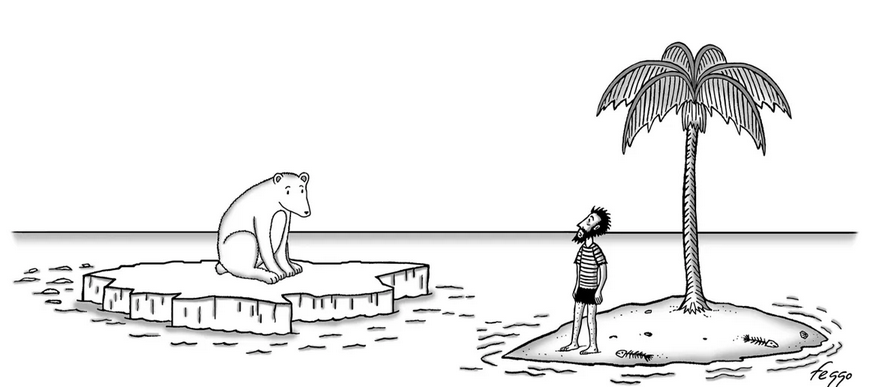
One of the finalists in this week’s New Yorker cartoon caption contest is close to the bone:

“I know how you feel. This used to be Florida.”
Michael Migliaccio, Croton-on-Hudson, N.Y.

Posted in Completely Different, Florida | 3 Comments

College Tuition Hits a Ceiling?

Colleges and Universities (I would imagine, although that’s not what’s measured in the graph below) have basically stopped raising tuition.

The 0.2% increase is the lowest in 40 years, and below the rate of overall inflation, making it a price decrease in real terms.

Whether this is due to COVID reducing demand, or a realization that they’ve reached a price ceiling I have no idea, but it’s a big and welcome change.

Posted in Law School | Comments Off on College Tuition Hits a Ceiling?

DeSantis Basks in His New Popularity

They love, they really…well, hate him, actually.

And if you think he’s unpopular now, wait until a child dies of COVID in a school that wanted a mask rule but wasn’t allowed to have it because DeSantis and his team forbade it. I hope that never happens, but if it does, I hope it’s the centerpiece of a commercial playing every hour on every major station in the next election.

Posted in 2022 Election, COVID-19, Florida | 1 Comment

How Does He Sleep at Night?

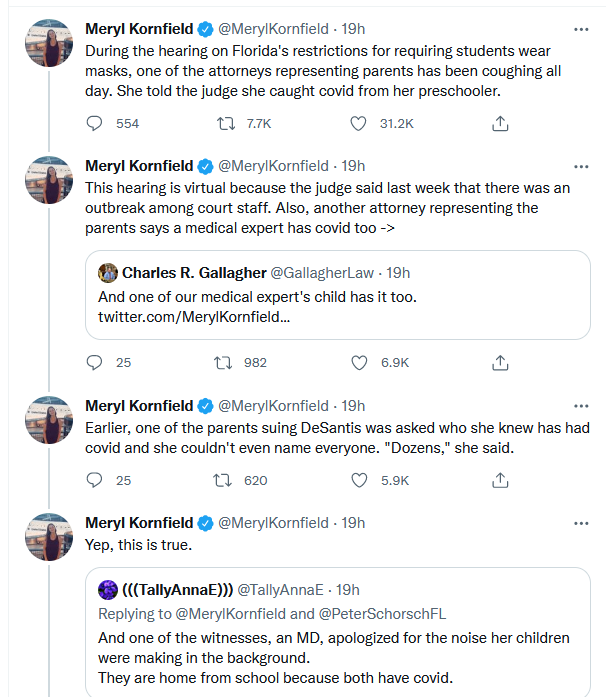
This is Florida:

And this is Florida Governor Ron DeSantis, as ably summarized by Paul Waldman: fight science, keep people from stopping COVID, ignore the casualty count, brag (to the survivors) that you enraged the liberals:

Any politician can be an Internet troll concerned with nothing so much as Owning the Libs, and many in DeSantis’s party think that’s their most fruitful path to success. But to really capture the hearts of the party base, you have to show your willingness to do actual harm to people’s lives as you wage war against the other side. And that’s where DeSantis is excelling.

Not that he’s above trolling. DeSantis sells T-shirts attacking Anthony S. Fauci and is now blaming the covid crisis in his state on undocumented immigrants in Texas; presumably we’re supposed to believe they cross the border near El Paso, walk to Corpus Christi, then dive in the Gulf of Mexico and swim to Tampa, a superhuman covid triathlon that is now filling Florida’s hospitals.

That kind of idiocy aside, no governor in America has done so much to make the spread of covid more likely. DeSantis signed a law nullifying local public health measures and banning private companies from requiring customers to show proof of vaccination. In a case brought by Norwegian Cruise Line, which hopes to prevent its cruises from becoming floating superspreader events, a judge just blocked the law’s implementation.

And in an escalating battle with local officials, he instructed school districts not to require masks and even threatened to withhold funding from any district that does so.

Each of these moves creates conflict and headlines, and each one is guaranteed to produce outrage on the part of liberals and anyone else who actually would like to see the pandemic end, which enables DeSantis to position himself as a chief antagonist in the politicized struggle over covid.

To be clear, DeSantis has encouraged people to get vaccinated. But the bulk of his public focus has been on attacking efforts to actually slow the spread of the virus. “We can either have a free society or we can have a biomedical security state, and I can tell you, Florida, we’re a free state,” he says

With a state government so determined not just to do as little as possible itself to prevent the spread of the virus but to actively prevent anyone else from doing anything either, it isn’t surprising that the delta variant found particularly friendly ground in Florida. It’s now experiencing its worst covid surge since the pandemic began last year; last week the state registered an average of 19,000 new covid cases and 1,800 new hospitalizations every day. It accounts for an incredible one in five cases, hospitalizations and deaths in the entire country.

Yet the fact that Florida has become Delta Ground Zero has apparently only increased DeSantis’s determination to allow covid to continue spreading.

Certainly, to the extent that the plan is to enrage folks like me, the plan is working very well. And, true, the dead don’t vote. (They do have families.)

But hasn’t the time come to say, “You’ve done enough. Have you no sense of decency, sir? At long last, have you left no sense of decency?”

Posted in 2022 Election, COVID-19, Florida | 17 Comments