Author Archives: Michael Froomkin

It’s Not Just Florida

I do make a certain amount of fun about the weird stuff that happens in South Florida, so it's good to be reminded that equally weird stuff happens elsewhere, including deep in the heartland.

Take this story about John I. Rocko, B.A. in Criminology. According to the Toronto Blade, Police dog's bachelor's degree prods legal howling about chief, it seems that Mr. Rocko is in fact…a police dog. One with higher grades on his B.A. from mail-order degree mill Concordia University than his owner, Chief John McGuire of the Fostoria (Ohio) Police Department received:

While their courseloads were nearly identical, the dog received an A+ in “Structure and Process of the American Court System”; Chief McGuire got a B- in the same class, the transcripts show.

Who got Rocko the Police Dog a $499 B.A. isn't clear, nor are all the legal issues in the case that gave rise to the revelation — they seem to center around the allegation that the Chief's reliance on this dubious credential is one of several reasons why he was validly suspended at the time he purported to arrest the defendant.

Incidentally, a visit to the Concordia web site is enough to make you more than a little nervous. I was quite taken aback by this published testimonial:

Dear Sirs,

I am impressed and delighted with the results of my investment as I have just received my Bachelor of Science degree in Nuclear Science. The transcripts exceed my expectations, my employer recognized the entire course curriculum as almost identical to his own traditional college transcripts. His initial skepticism about distance learning schools immediately disappeared when he got to verify the copies of your governmental registration papers that were included in my credentials package. Your program must be the fulfilment of every professional’s dream. Thank you so much for this fantastic opportunity.

-Francis D.

I sure hope that's a fake, for the idea of a nuclear engineer running some power plant out there on the basis of a mail-order degree is enough to keep you awake at night.

Posted in Law: Criminal Law | Comments Off on It’s Not Just Florida

Sometimes Miami Law Is Just Like on TV

I like to tell prospective and incoming law students that real-life law is nothing like what you see on TV. But the trouble is, we live in Miami, a place where much more often than it should be real-life law is just as wacky as what you see on TV.

Take for example this account of the past five days in the annals of Miami Law:

(1) a murder trial in which the witnesses give credible evidence that detectives threatened them (including in one case threatening to take the witness's kids into care) in order to get them to give perjured testimony incriminating the defendant — but the increasingly pathetic-looking Miami-Dade State Attorney's Office says it has no intention of investigating whether the cops are bent;

(2) another murder case that lacked a body now features a lead detective who, on the witness stand, was made to admit to sleeping with a key witness.

(3) A local lawyer who runs a massive ticket-fixing business shot and killed an armed mugger by using the handgun he keeps in the glove compartment of his black Mercedes.

In other local traffic news, six-year-old girl foils carjacker by beating on him


“I smacked him on the head with my book”.

(4) Local Hollywood Police Chief James Scarberry blew a three-year-long FBI sting operation into corruption by officers on his force by blabbing about it to at other cops and local politicians. Not surprisingly, word quickly got out to the prime suspects who immediately tried to resign, stopping the investigation into their associates in its tracks and wasting a giant amount of police work. When first confronted about it the Chief told the press a series of lies, which he's gradually been recanting.

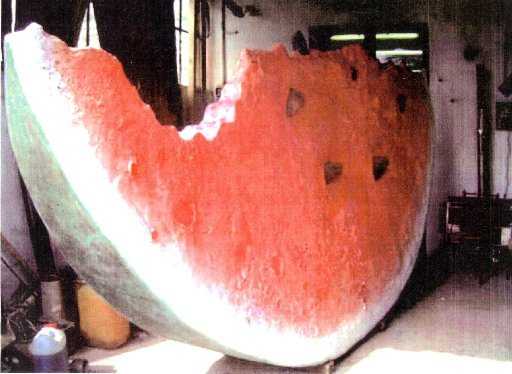
(5) A prominent local builder was jailed yesterday, charged with embezzling public funds to buy a sculpture of a giant watermelon slice. He very vigorously contests the charges, and was photographed giving the finger to a reporter.


Local slice of life

(6) Cops arrest blogging photojournalist for taking crime scene photos.

(Post inspired by Justice Building Blog.)

Posted in Law: Criminal Law, Law: Practice, Miami | 2 Comments

His Master’s Voice

My brother's column today notes that White House Spokesman Tony Snow sure lies a lot.

Posted in Politics: The Party of Sleaze | Comments Off on His Master’s Voice

The Right Wing’s New Bete Noire

It seems that the right wing of the GOP has a new bête noire named Rudy McRomney.

Posted in Politics: US: 2008 Elections | Comments Off on The Right Wing’s New Bete Noire

Still a Rock Star

Bill Clinton came to town Thursday and gave the Spring Convocation address. It was a great performance. And given that Al Gore came by a day earlier and presented the “Inconvenient Truth”, it's been a busy week.

Clinton's facility with language and his ability to persuade an audience of his passionate belief never fails to impress, and today was no exception. (The audience interrupted with applause more than twenty times.) He spoke for about 45 minutes, then sat on stage in a nice upholstered armchair next to UM President Donna Shalala and answered some student questions that she had pre-selected.

Clinton's main talk, which he said was an abbreviated from of a lecture he's been giving around the world, centered around five questions that he said everyone should try to answer for themselves (everything that follows is summary or close paraphrase; but it's not necessarily actual quotation unless I use quote marks):

1. What is the fundamental character of the 21st Century?

Many might say globalization, but “I prefer 'interdependence.'”

2. It it a good or a bad thing?

Both. Many benefits – diversity, variety, exchange of ideas, economic development for the third world. But also some “not-so-good” aspects including (1) It's unequal: great inequality (e.g. one billion people living on under $1 per day)
(2) It's unstable: we may actually be less vulnerable today than in the 20th Century, but with modern communication/life more people feel the effects of hijackings and bombings
(3) It's unsustainable: climate change is ongoing and we are depleting critical resources including water, soil, biodiversity, oil & natural gas, fisheries.

3. How should we change it?

Work from interdependence to integrated communities – work locally, nationally and eventually internationally. “The humanity we share … is more important than our differences”

4. How can we do that?

First, we need a security policy in a dangerous age.
Must deal with climate change. Climate change and avian flu are security issues.
Also need to understand that it is “never possible to kill, jail or occupy all of your adversaries.” (Applause)
Third, need a world with “more partners and fewer enemies” (Applause)

Here Clinton cited North Korea, [where the current administration has just conducted a return to a Clintonian policy] as an example of the advantages of talking.

Diplomacy, he said, is “always cheaper then going to war” (Applause)

Clinton then told several stories about making friends and doing good abroad: bringing aid to Indonesia after the tsunami, causing US popularity which had been much lower than bin Laden's rise to eclipse him. (Applause) And about fixing broken markets in pharmaceuticals that allowed Indonesia to cut its spending on essential medicines.

But, Clinton warned, it's not just foreign countries that need aid or need to het their houses in order. We also need “home improvement” or many will “wonder why we are taking care of others and not of our own” (Applause).

5. Who's supposed to do all this?

Everyone. Everyone should give time or money as they are able (Applause)

President Clinton then detoured into a personal discussion of his role reversal with Senator Clinton (there was only very scattered applause at this point). She got elected just as he left office. I've become part of the NGO sector.

One project he's pursued is lowering drug prices for the third world: in the Bahamas he was able by presenting suppliers with data about prices elsewhere to get them to lower costs for a year's worth of generic anti HIV drugs from $3500 to $500. And in time, to $140 then $100 per year. Markets, he said, were not functioning properly. By arranging for purchases in bulk, by guaranteeing payment [and, he implied, by being Clinton], his foundation was able to get large price cuts. Similar successes in Rwanda and Malawi. The foundation will help buy drugs in many countries, but if they want more help, they must agree to strict structural conditions so aid will not be wasted by corruption or inefficiency.

[If I have the time, I'll try to write up the second half of the presentation, the Q&A, some time tomorrow.]

Posted in U.Miami | 1 Comment

Sign of the Times

This piece of direct mail adverting fell through the mail slot yesterday:

Posted in Econ & Money | 1 Comment