A toddler threw a self-pitying tantrum on live television on Monday night. Unfortunately he was 73 years old, wearing a long red tie and running the world’s most powerful country.
Donald Trump, starved of campaign rallies, Mar-a-Lago weekends and golf, and goaded by a bombshell newspaper report, couldn’t take it any more. Years of accreted grievance and resentment towards the media came gushing out in a torrent. He ranted, he raved, he melted down and he blew up the internet with one of the most jaw-dropping performances of his presidency.
This was, as he likes to put it, “a 10”.
Trump’s Easter had evidently been ruined by a damning 5,500-word New York Times investigation showing that Trump squandered precious time in January and February as numerous government figures were sounding the alarm about the coronavirus.
With more than 23,000 American lives lost in such circumstances, some presidents might now be considering resignation. Not Trump. He arrived in the west wing briefing room determined to tell the world, or at least his base, that he was not to blame. Instead it was a new and bloody phase of his war against the “enemy of the people”: the media. Families grieving loved ones lost to the virus were in for cold comfort here.
Monday’s coronavirus press conference was a total disaster. It was a train wreck, launch failure, explosion of stupid. “Everything we did was right,” Trump said, straight faced, one day after Dr. Anthony Fauci admitted on CNN that no, not everything we did was right.
But worst, is this gaffe. When asked what authority the president has to open the nation, when state governors are already forming coalitions, Trump responded, “I have the ultimate authority.”
This straightforward answer exposes many of Trump’s worst instincts, and his total misunderstanding of his role as POTUS. All of Trump’s talk about working with governors belies his true belief that he alone has the authority.
Of course, if all you read was the NY Times, you’d never know the nation just witnessed a train wreck. All they have is a sober news analysis which leads as follows:
The president’s insistence that only he can decide if the country should reopen for business was disputed by constitutional scholars and contrasted with his earlier message that it was not for the federal government to take the lead in fighting the virus.
It is an important point that needed making, but it hardly seems the whole story.
I remember when the major casualties of the OPEC oil cartel were Japan, the US, and Europe. I remember the oil shock, aka the oil crisis of 1973. I’m still stuck in a world in which higher oil prices are not in the short-term interests of the average US consumer, although given the effects on global warming and the need to transition away from carbon fuels, I understand that the longer-term picture is much more complicated.
Still, it creates mental whiplash when I read that the head of the US Government, some guy by the name of Donald Trump, just brokered a deal with the Saudis and the Russians, two of his favorite autocrats, to lower oil production by almost 10% in order to raise oil prices. Of course this also helps out his over-leveraged buddies in the US fracking business. It isn’t, I’m quite sure, motivated by concern for the environment.
Excellent essay by Ross Anderson on Contact Tracing in the Real World, especially apposite in light of a number of government and private tracker apps being floated and even implemented.
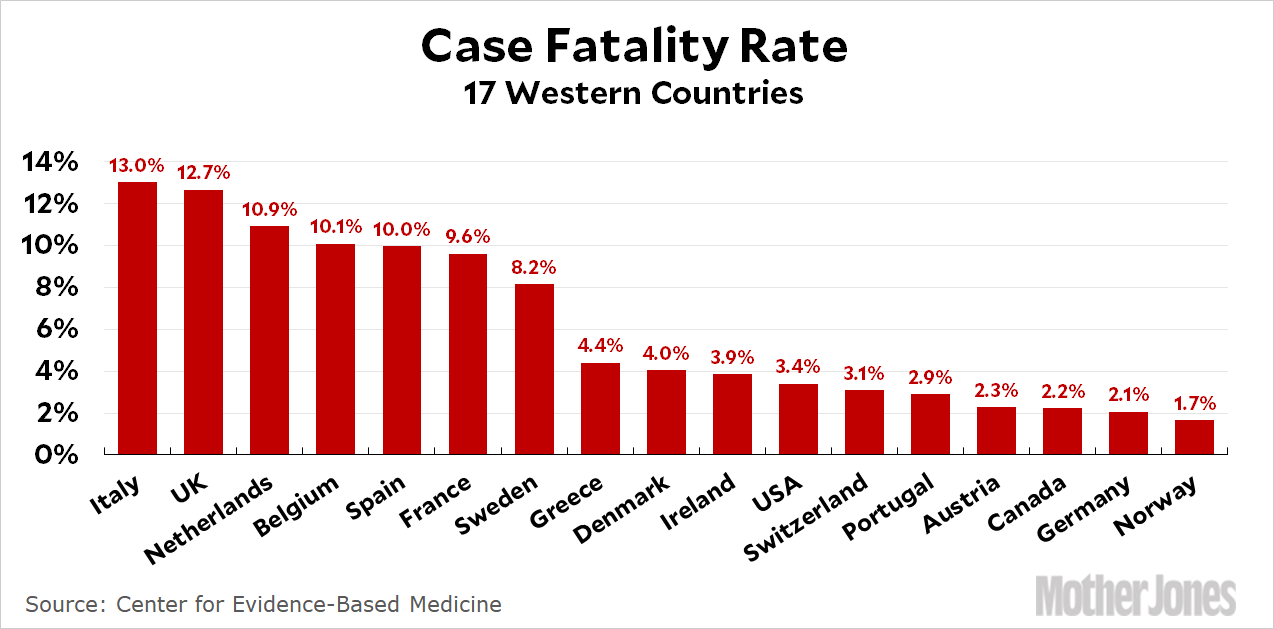
The US, along with a small number of other countries, seems to have a much lower COVID fatality rate than others. Why?
Normally I try to post about stuff where I believe, however mistakenly, that I understand what is going on. In this case, however, I’m just plain mystified.
Kevin Drum Jones recently published this chart on COVID-19 mortality rates by country:
Start with testing. The US has, at least until very recently, done quite a poor job of testing compared some other countries. But a failure to test would tend, on its own, to increase, not decrease, the reported mortality rate, since in general one assumes that the people not tested are either asymptomatic or mild cases, and thus don’t go in to crowded or inaccessible testing locations.
Nor is it easy to explain the national differences by failures in reporting coronavirus fatalities. There is no doubt that the US has vastly undercounted COVID deaths, not least in hotspots like New York City. Some of these are deaths at home which don’t result in testing. Others are deaths attributed to other causes. We know this is happening because the non-coronavirus death rates are soaring. (Update: More info on that in NYT.) On its own, this accounting failure would tend to lower the COVID death rate, which you might think would explain why the US rate looks lower than it ‘really’ is. The problem, though, is that there is no particular reason to think the US, much less all the countries on the right hand side of that chart above, have been undercounting any worse than, say, Italy or Spain, where we also have reason to believe there is a lot of undercounting going on. Maybe it will turn out their reporting systems were better than we think, but I kinda doubt it, especially in the case of Italy.
The differences don’t seem correlated with the quality of the health system, nor with whether it is centralized or decentralized. The US notoriously delivers poorer health outcomes — normally — than a number of the OECD countries. The Swiss do very well, but no so much the Portuguese, and the Greek health system is notoriously poor (on median, anyway).
Nor is overall national wealth a great predictor. There are richer and less-rich countries on both sides of the fatality-rate divide; all all industrialized and reasonably well off by international standards, but Portugal, Greece, and Ireland were all hurting economically (remember ‘PIGS’ in the debt crisis and post crisis-austerity?) a lot worse than many others on the list of higher fatality rates.
I wondered if, since poverty is a risk factor, whether Gini coefficients might explain something. Maybe countries with large pockets of poorer people are doing worse? But it looks like that’s not the explanation either:
In the grand scheme of things the two numbers are close to equal, and in fact almost exactly equal if you throw out the USA as an outlier. So either way, that’s not it.
Of course, it may be that all our data is just so bad, or national reporting systems so different, that the whole question is, for the time being at least, futile. Who knows?
On Wednesday, the University of Miami in an email announced “financial mitigation actions,” effective immediately, to reduce expenses across the university, including its healthcare system, UHealth.
“Today’s highly uncertain economic environment poses serious financial implications for our University, as well as for our health care system, UHealth,” the email read. “These are unprecedented times, which require significant measures.”
Those measures include a hiring freeze, a postponement of merit-based pay raises, significantly reduced or eliminated non-essential, non-salary expenses, delaying planned construction projects until 2022, tapping into unrestricted donor funds and expanding its freshman class from about 2,200 to 2,350.
The email, written by Jeffrey L. Duerk, executive vice president for academic affairs and provost, and Jacqueline Travisano, executive vice president for business and finance and chief operating officer, signaled more cuts could come.
That this University, much like all others, faces financial problems is a given: From a financial flows point of view we’re a large hospital with a smallish university attached. And hospitals are being hammered two ways: large, unexpected, COVID-19-related costs, and a collapse of other sorts of revenue as patients put off elective and even necessary surgery. So it seems likely we are in for it.
That said, is it realistic for the College to plan on a larger entering Freshman class? I worry that (sensible) people will still be avoiding crowds — and maybe everyone — in early Fall, and indeed until we have a reliable vaccine. And the most optimistic estimates I’ve seen for a reliable vaccine put FDA approval in early 2021; even then, production will doubtless take time also.
Posted inCOVID-19, U.Miami|Comments Off on UMiami Prepares for COVID Cuts