Author Archives: Michael Froomkin

Smile, Someone’s Watching

Seems like UM has decided to install a web of spy security cameras on campus.

IQinVision, market leader in high-performance HD megapixel IP cameras, today announced the University of Miami, Florida, has installed over 350 IQinVision megapixel cameras throughout its main campus in order to create a safer environment for students, staff, and visitors. The University of Miami is a private research university with more than 15,000 students.

The university had maintained video surveillance for a number of years, but as Jose Ruano, Executive Director of IT Security, explained, “Our challenge was that a university is very de-centralized. We had so many legacy analog systems, and we were looking to bring it all together into a unified system that we could manage in a centralized manner.” Campus Police are responsible for monitoring video and investigating any incidents, but as Ruano pointed out this was made very difficult by the many disparate systems.

In order to integrate all the different video systems into a single unified system, Ruano and colleague Steve Weatherly, Senior Security Engineer, knew the university needed to upgrade to IP. “It was much more economical to upgrade our cameras and run them over the IP network than laying coax,” recalled Weatherly

(via IPSecurityWatch.com – Article – University of Miami installs over 350 megapixel cameras.)

I wonder whether the U. has thought this through carefully:

  • Are there rules about siting them so they cannot see into dorm rooms or offices? (This is particularly important for cameras that can be aimed or operated remotely)
  • Who has access to the feeds?
  • How long are the images stored?
  • Are there policies in place as to how to respond to subpoena requests? Will people captured in the images be given notice before their images are shared?

Any other issues I should put on my list before I go asking questions?

Posted in U.Miami | 3 Comments

Free Drinks!

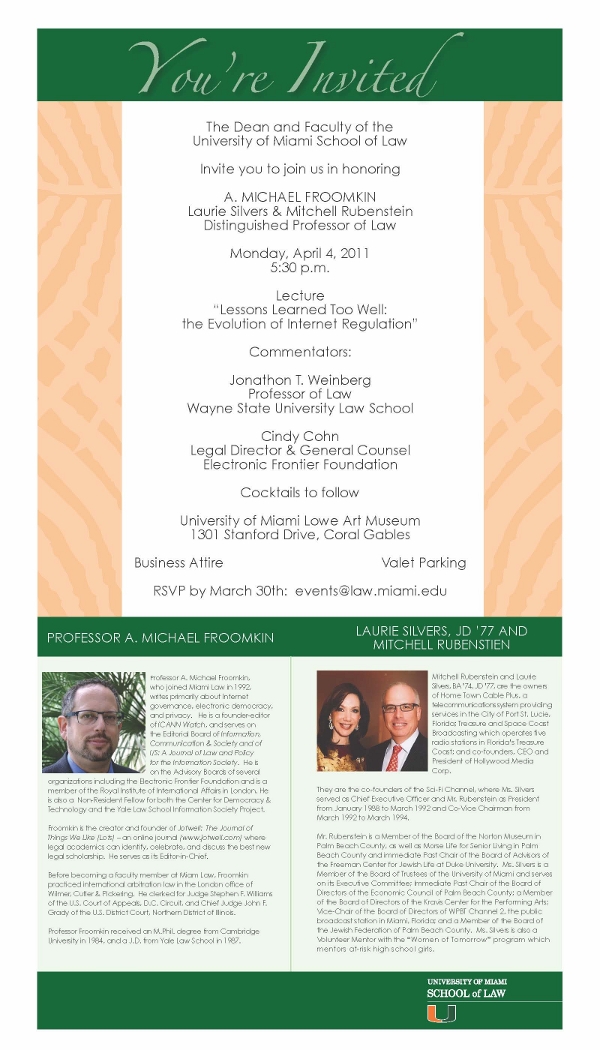
All you have to do is listen to a lecture first, starting at 5:30 on Monday, April 4, at the Lowe Art Museum. RSVP by March 30th to events@law.miami.edu.

Froomkin Lecture Invitation (click for larger image)

Click for a larger (.pdf) image.  

Posted in Personal, Talks & Conferences | 3 Comments

Good Advice for Persuasive Writers

I thought there was a lot of merit to most of the ideas in this discussion of persuasive legal writing at SCOTUSblog.

I particularly agree with this part:

What makes persuasive writing so hard?

To succeed, you have to imagine a highly skeptical, highly impatient reader who will never care as much about your case or appeal as you do—and then ask yourself how you can somehow grab that reader’s attention and sustain it page after page.

I just don’t think that most advocates—legal or otherwise—imagine an actual person reading their work, let alone think about how to sway that person to their cause. That may be one of the reasons briefs used to be better when lawyers dictated them.  Dictation is at least one step closer to actual communication.

You also have to channel whatever passion you feel into clarity and creativity, not into the anger and self-righteousness that drive so many motions and briefs.

Finally, the apparatus of brief-writing—the citations, record cites, defined terms, footnotes, and case discussions—can easily mask flaws in the prose and in the logic itself.

In your book, you write that advocates should “show, not tell,” in their facts statement, letting choice details speak for themselves.  Why is it important to let the reader come to her own conclusions about the facts?

The people who read lawyers’ work—judges and other lawyers—are highly educated and often cynical.  If your fact section sounds like argument, they’ll dismiss it as spin.  Fiction readers don’t want to be told that March 1 was a warm day in Washington, DC.  They want to be shown that the plaintiff’s clothing stuck to his skin just seconds after he stepped outside his apartment. Judges are similar. They don’t want to be told in a fact section that the defendant engaged in dilatory tactics throughout discovery. They want to be shown that on four occasions, defendant missed a discovery deadline and then provided incomplete responses requiring weeks of further delay.

Bottom line: We are inclined to believe our own conclusions, but we resist conclusions that someone else is trying to shove down our throat.

Surely that last point applies more generally?

[Title corrected]

Posted in Law: Practice | Comments Off on Good Advice for Persuasive Writers

Our Brave Men in Law Enforcement

Sheriff uses tank to knock down part of house and arrest unarmed man…on suspicion of …wait for it…cockfighting.

Yes, it was crazy Sheriff Joe Arpaio of Pheonix, Arizona. The fact that they had a guy along riding in the tank and filming for a TV show had nothing to do with it.

But they did kill 115 chickens on the spot, so all that force might have been necessary: “We’re going to err on the side of caution.” a spokesman explained.

Video about the raid, and more about what I take to be the “tank” (pictured) — which looks more like an over-armored APC to my untrained eye — here.

You know, when Heller or Pynchon wrote stuff like this, I read it as surrealism, not clairvoyance.

(Spotted via Daily Kos.)

Posted in Law: Criminal Law | 1 Comment

Florida as Journalistic Paradise

The editor of the Sarasota Herald-Tribune, on Florida’s Gulf Coast, is reported (!) to have issued what is widely being called the world’s greatest journalism job announcement touting the virtues of their newsroom — and the joy of reporting in the target-rich environment which is Florida.

We want to add some talent to the Sarasota Herald-Tribune investigative team. Every serious candidate should have a proven track record of conceiving, reporting and writing stellar investigative pieces that provoke change. However, our ideal candidate has also cursed out an editor, had spokespeople hang up on them in anger and threatened to resign at least once because some fool wanted to screw around with their perfect lede.

We do a mix of quick hit investigative work when events call for it and mini-projects that might run for a few days. But every year we like to put together a project way too ambitious for a paper our size because we dream that one day Walt Bogdanich will have to say: “I can’t believe the Sarasota Whatever-Tribune cost me my 20th Pulitzer.” As many of you already know, those kinds of projects can be hellish, soul-sucking, doubt-inducing affairs. But if you’re the type of sicko who likes holing up in a tiny, closed office with reporters of questionable hygiene to build databases from scratch by hand-entering thousands of pages of documents to take on powerful people and institutions that wish you were dead, all for the glorious reward of having readers pick up the paper and glance at your potential prize-winning epic as they flip their way to the Jumble … well, if that sounds like journalism Heaven, then you’re our kind of sicko.

For those unaware of Florida’s reputation, it’s arguably the best news state in the country and not just because of the great public records laws. We have all kinds of corruption, violence and scumbaggery. The 9/11 terrorists trained here. Bush read My Pet Goat here. Our elections are colossal clusterfucks. Our new governor once ran a health care company that got hit with a record fine because of rampant Medicare fraud. We have hurricanes, wildfires, tar balls, bedbugs, diseased citrus trees and an entire town overrun by giant roaches (only one of those things is made up). And we have Disney World and beaches, so bring the whole family.

The Political Animal (Steve Benen) posting that I linked to above has other reasons why Florida is so great for journalism.

I’m reminded of a comment — that I want to attribute to Dave Barry because even if he didn’t say it, it sounds like he should have — that Florida is what you get when you pick up the country and shake it: all the nuts fall down to the bottom.

Plus, I can’t help wondering why the Herald is so lame.

(Thanks to Ann Bartow for the original link to another version of this announcement.  It’s everywhere.)

Posted in Dan Froomkin, The Media | Comments Off on Florida as Journalistic Paradise

You Can’t Hide

Uncovering spoken phrases in *encrypted* VoIP conversations

We evaluate our techniques on a standard speech recognition corpus containing over 2,000 phonetically rich phrases spoken by 630 distinct speakers from across the continental United States. Our results indicate that we can identify phrases within encrypted calls with an average accuracy of 50%, and with accuracy greater than 90% for some phrases. Clearly, such an attack calls into question the efficacy of current VoIP encryption standards.

(via Dave Farber’s list).

Combine that fact with this alleged fact:

Several reports have emerged that China is cutting off phone calls mid-sentence when contentious words like ‘protest’ are used.

Posted in Civil Liberties, Cryptography | Comments Off on You Can’t Hide