Author Archives: Michael Froomkin

L’Affaire DSK Summarized

Despite my trawling the French media, the best short explanation I’ve seen of key aspects of the case is, in all places, a philosopher’s blog. Robert Paul Wolff happens to be visiting Paris, and he offers this great DSK summary.

Key bits:

There are essentially four possibilities. First, things may have gone exactly as the young hotel maid says. Second, the entire thing may have been a complete lie, a frame up, a non-event. Third [this one is attractive to French commentators, who know DSK’s reputation], the maid may have come into the room [either intent upon carrying out a sting or not], and DSK, aware of his reputation and fearful that he was being set up by his political enemies, fled precipitously to avoid being found in a potentially compromising situation. And Fourth, sex may have occurred, presumably at DSK’s instigation, but it was sufficiently “consensual” not to constitute attempted rape or sequestration or any of the other things with which he has been charged [this one is being floated by DSK’s defense lawyers.]

So, here is where things stand. If the evidence of the keys shows that DSK checked out before the maid used her key to enter the room, or so soon afterward as not to allow time for anything at all to have happened, then clearly the whole thing is a lie, a sting, a put-up job. If the timeline of the keys makes it possible that the accusations are true, but if the electronic evidence shows that the door stood open for, let us say, half an hour, then the maid’s story of DSK shutting her in shortly after she entered the room is false, and possibilities two or three above are suggested. If all of this electronic evidence is compatible with the truth of the accusations, then the question will be whether there any DNA or other physical evidence supporting the accusations. If there is clear evidence of physical contact [not necessarily semen, but possibly that], then either we have an attack or we have “consensual” sex.

That is where things stand until we have more evidence, but I have to say that on the face of it, the story about a sting is pretty implausible.

And, sadly, this:

Incidentally, in all of the French newspaper coverage, much of which now focuses on the superiority of the French over the American judicial system and on the appalling assault on the dignity of DSK constituted by the pictures of him in handcuffs, I was unable to find a single word of sympathy of any sort for the hotel maid. She is a poor, Black, working-class woman, and as far as the sophisticated left wing journalists, academic commentators, and psychoanalysts are concerned, she does not exist.

Posted in Law: Criminal Law | 1 Comment

Kevin Drum: Unemployment Falls Off the Radar

Chart of the day — major newspapers barely mention unemployment any more.

In each of our five biggest newspapers, in the entire newspaper, there are now two mentions of unemployment per week. So that’s that. Nobody cares anymore. Politicians don’t talk about unemployment and the press doesn’t report about it. If you’re out of work — and 9% of the country still is — you’re on your own.

Posted in Econ & Money, The Media | Comments Off on Kevin Drum: Unemployment Falls Off the Radar

Wisconsin Court of Appeals Cites My ‘Death of Privacy?’ Paper

In State v. WALLI, 2011 WL 1775995 (Wis.App., May 11, 2011), the Wisconsin Court of Appeals, 2nd District, cites to my The Death of Privacy? article.

The case was a fairly routine-looking DUI, but the Court of Appeal decided to use it as a vehicle to settle a more general question of law:

Because the first step in this analysis requires us to review the trial court’s findings of historical facts and, in this case, those findings are based in part on a video recording of the event, this court, sua sponte, issued an order converting this appeal from a one-judge appeal to a three-judge appeal and requested the attorney general to file a supplemental brief on the appropriate standard of review. With the near ubiquitousness of squad car video cameras, surveillance cameras and traffic cameras, appellate courts will be deciding more and more cases where some of the evidence is preserved on recordings.

(footnotes omitted). Death of Privacy? got cited for the ubiquitousness point, which is fair enough, although not exactly central to the main issue the court was concerned about.

The standard of review for decisions based on recorded evidence is debatable because a reviewing court ought to be as able to review recordings as is the trial court; the same cannot be (or at least, is not) said about testimonial evidence, since the trial court sees the live witness while the reviewing court sees only the ‘cold’ written record. Traditionally Anglo-American legal systems tend to give a great deal of weight to the seeing of live witnesses by triers of fact, whether or not this in fact enhances accuracy; civil law systems, I gather, do not have the same fetish.

States differ on the appropriate standard of review in such cases, but the Wisconsin Court decided that “clearly erroneous” was indeed the test it would apply when a trial court makes an evidential determination based on a combination of testimony and recorded evidence rather then the far less deferential “de novo” standard urged by the appellant. The perhaps more interesting issue of what standard of review would apply if all the evidence were recorded is not decided in this case, at least not explicitly.

Posted in Law: Criminal Law, Law: Privacy | 2 Comments

Joys of Natural Gas

A big truck pulled up in front of the house about an hour ago, and a man rang the door bell to tell me that they werCreative commons photo via http://www.flickr.com/photos/cliff_robin/e here to fix the gas leak.

Gas leak? Gas leak??? This was news to me. It seems that Florida City Gas hires some firm to go around and inspect gas meters for leaks, and they found one at our house. No, judging from the yellow cable ties on our pipes, they found two. I can’t hear or smell anything, so it can’t be that serious, but still.

And no one told us. The workmen said they should have rung the bell, and if no one was home they should have left a note. There was no note. They should have told me, but not to worry, it is — they are — very small.

The work team was quick. In half an hour or less they were done. And then the fun began. The work crew can turn off gas supplies, which they needed to do in order to effect their repair. But they are not able or empowered to turn the gas back on. That, says the blue card, requires a call to an 800 number. Fortunately, since my office is undergoing a treatment that the Vice Dean described in a recent memo as akin to “elephants wielding gigantic tree trunks” ranging through the floor, I am at home today, and able to call now rather than at dinner time, when one might just want to cook something.

So I call the 800 number. The automated voice system wants me to punch many numbers, and I do, navigating to the third level in the menu. Then a robo voice tells me I’ll have to be on hold for a bit as they have a lot of calls. I get a moment of muzak, then a click, then silence. More clicks. Silence. Then the dreaded Bell System voice says, “If you’d like to make a call, please hang up…” Yes, I’ve been disconnected.

So I repeat the whole process and get … a human being! He makes me repeat all the info that the automated system already knew. Then he tells me he’ll have to put me on hold to transfer me to another department. Before he does, I explain I’ve been cut off once already — but it seems they know about the problem, they’ve been having lots of trouble with the system, and he promises to call me back if I’m cut off. I also mention that I’m a little perturbed by no one telling me about the leak. He is solicitous, but all he can say is that he’ll make a note of it.

In due course I’m transferred to Jeanne, who has a slow southern voice and very brisk efficiency. Once again I have to explain where the house is (they send me gas, don’t they know where I am?). She wants to know the name of my subdivision too, the first time anyone has asked me this in more than 18 years. Riviera?

As regards my concern that no one told me about the leak, Jeanne is utterly unimpressed. “I think the most important thing is that they told us, so we could come out and fix it.” I agree, but ask if she doesn’t think that maybe I, the resident, should be told too? “No,” says Jeanne. And that is that.

They promise to have the gas back on well before dinner time.

(Creative Commons photo – c.a.muller.)

Posted in Coral Gables | 4 Comments

They Should Teach Filing in Law School

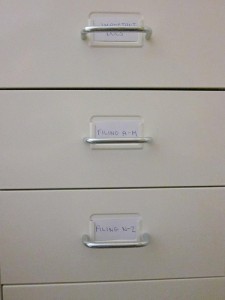
Usually my work is fun, as it involves thinking about interesting problems. This is one the great joys of being a law professor. But much of my work has not been fun this past ten days or so. The law school is doing renovations on my floor over the summer, and in service of this project all my file cabinets were due to be removed last Friday. (See The Paperless Office (Like it Or Not).) I spent most of last week doing triage and tagging with the help of one very game research assistant. In the end I threw away about half of it, filling several recycle bins. It was a very nostalgic process, especially regarding my earliest cryptography, e-cash, and internet work: I had a chance to interact with some amazing people, far too many of whom I have lost track of since. But back to the files. I marked about 40% of the bulk for temporary storage. I took the rest — twelve banker’s boxes — home and am now trying to figure out where to put them. That takes some tidying and reorganization too.

There is, however, one aspect of this problem that does require at least a little thought: I’ve also been trying to create a schema for a paperless filing system since the tentative plan is that the file cabinets are not coming back. As one does I spent some time on Google looking for advice. Most of it was unhelpful, as it involved spending large sums of money on various proprietary document management tools. But I did find a few pieces of what looked like useful advice, especially Exadox’s Folder and File Naming Convention – 10 Rules for Best Practice. They wanted me to buy something too, but never mind that.

So here are the rules I’ve distilled for my use:

  • Every document MUST have a descriptive name.
  • Use short and simple folder names and folder structures and focus on using long and information-rich filenames.
  • Use the underscore (_) as element delimiter. Use the hyphen (-) to delimit words within an element – NOT spaces. E.g. Smith-John_recommendation-letter.pdf
  • Elements should be ordered from general to specific detail of importance as much as possible. The order of importance rule holds true when elements include date and time stamps. Dates should be ordered: YEAR, MONTH, DAY. (e.g. YYMMDD)
  • Personal names within an element should have family name first followed by first names or initials.
  • Documents with multiple versions (or likely to have multiple versions) should have as their FINAL element _V followed by at least 2 digits. To distinguish between working drafts (i.e. minor revisions) use Vx-01->Vx-99 range and for final draft (i.e. major version release) use V1-00-> V9-xx. (where x =0-9). If you go to more major versions, use the alphabet, ie VA-01, VB-01 etc.
  • Aim for a flat file structure–avoid the temptation to create layers and layers of sub-folders as things that are not visible will get lost

I’ve also defined an initial file structure based on asking my secretary for her ideas, and then adding my own ideas based on some time looking through the things found in the drive space she and I share. (I also have my own private space that could really stand to be organized better, but one thing at a time.) The top level of this structure divides the world into Admin, Courses, Research, and Projects. The admin folder has ten sub-folders, only a few of which have sub-folders of their own. None of the other three major sections currently has sub-sub-folders. So it is a very flat structure.

There is one good aspect of all this, however. I think that grading is going to seem joyous by comparison.

Posted in Law School | 2 Comments

Statutory Interpretation for Biologists

Tongue no doubt firmly in cheek, a biologist suggests that the Florida legislature accidentally legislated celibacy this week.

Among (many) other things, the statute in question says that

A person may not:

Knowingly engage in any sexual conduct or sexual contact with an animal;

(In its infinite wisdom, the Florida Legislature had never before the current moment gotten around to legislating on this important subject.)

People are animals, hence sex with humans must be banned, right?

Any blog post that makes fun of this year’s unusually dire Florida Legislature is OK with me, but I have to put in a few words for the law here, even at the price of spoiling the joke.

Yes, it’s time to roll out Nix v. Heddon, 149 U.S. 304 (1893), in which the Supreme Court of the United States had to decide whether at tomato is a fruit or a vegetable for purposes of the Tariff Act of March 3, 1883. There were good arguments for ‘fruit’: after all, to a biologist, a tomato is clearly a fruit. But the Supreme Court made short work of that claim:

Botanically speaking, tomatoes are the fruit of a vine, just as are cucumbers, squashes, beans, and peas. But in the common language of the people, whether sellers or consumers of provisions, all these are vegetables which are grown in kitchen gardens, and which, whether eaten cooked or raw, are, like potatoes, carrots, parsnips, turnips, beets, cauliflower, cabbage, celery, and lettuce, usually served at dinner in, with, or after the soup, fish, or meats which constitute the principal part of the repast, and not, like fruits generally, as dessert.

In short, in figuring out legislative intent in the absence of a definition in the statute itself, courts look to the ordinary, common, meaning of words and not their scientific meaning unless something in the context suggests otherwise. In SB 344, it’s pretty clear that when the Florida legislature — yes, even this year’s model — says “animals” it is not referring to us nor even to itself.

Posted in Florida, Law: Everything Else, Law: The Supremes | 6 Comments