
Are You Better OFF? By Meidas Touch
And, just out — this too:
Are You Better OFF? By Meidas Touch
And, just out — this too:
Miami is hardened for wind. Most tropical storms just beat up vegetation and some power lines. You don’t want to be out walking or driving in it, and it makes some noise, but in most cases things are mostly OK the next morning. It’s when it gets to hurricane-force winds that I start to worry.
And hurricane force winds are a possibility here, although not it seems a strong possibility.
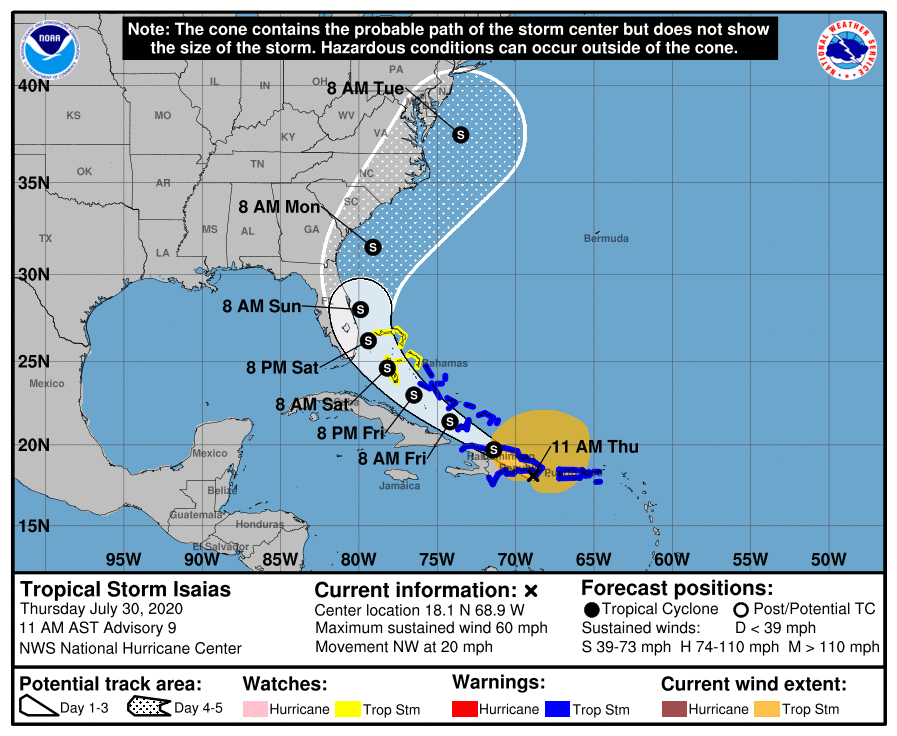 National Weather Service says:
By late Friday, a mid-latitude trough moving into the east-central United States is expected to weaken the western portion of the ridge. This pattern should cause the cyclone to turn northwestward to north-northwestward on Saturday when it is near the northwestern Bahamas and South Florida. As the trough slides eastward over the United States, this should steer Isaias northward and northeastward early next week. Although the bulk of the track guidance agrees on this overall scenario, the confidence in the track forecast remains lower than usual due to the expected land interaction and possible center reformation in the short term. The new NHC track forecast is a blend of the HFIP corrected consensus and the TCVA multi-model consensus, and is similar to the previous advisory.
The intensity forecast remains challenging. The structure of the storm is likely to be disrupted by its passage near or over Hispaniola today, and some weakening is likely. Once the system moves away from the Greater Antilles gradual strengthening is anticipated. The global models and the SHIPS guidance suggest that Isaias will encounter an area of moderate southwesterly shear over the weekend, and the NHC intensity forecast is again leveled off at that time. There are models that continue to suggest Isaias could become a hurricane when it is near the U.S., but given the continued uncertainty, the NHC intensity forecast remains near the intensity consensus.
Also, the track has moved East some in the past day or two; that could continue too….
Of course, there’s a lot of food in the freezer right now, so it would be a lousy time to lose power.
 Primary Day–and the date for the first and sometimes final round of non-partisan elections–is Tuesday August 18. But Vote-by-Mail-in ballots are out in people’s hands, so it’s time for another edition of my downballot recommendations. I am going to discuss all the races on my ballot, but I suspect most readers have their own views on the Miami-Dade County Mayor’s race, and even the Commission races, so I won’t dwell on those. Instead, as usual, my focus will be on the judicial and other races which – although very important – get little press coverage and so easily fly beneath the radar.
I should start by admitting, though, that collecting info has been tougher this year than I think any time since I started doing this due to a combination of the COVID crisis reducing campaigning, and the fact that I’ve had my own little health issues to contend with. Still, I’ve done some research, and I hope you will find it helpful.
Today’s post will deal with all the non-judicial races. I’ll have the judicial races—which readers tell me is what they really want to read about anyway—up Real Soon Now™.
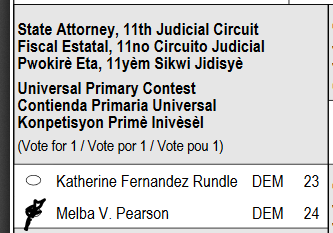
The State Attorney is the chief local prosecutor. This is a tremendously important race, especially now. The incumbent, Kathleen Fernandez Rundle, has not in all the years I’ve been paying attention ever faced a serious opponent anywhere near the caliber of challenger Melba Pearson. It’s also a fact that in all the years that Kathleen Fernandez Rundle has been our County Attorney she has never – no, never, not one single time – initiated a prosecution against a police officer for an officer-involved shooting. Trust me, we in South Florida do not live in a paradise where the police never shoot when they should not.
Similarly, in the gruesome case of Miami Dade Correctional Institution inmate Darren Rainey — whom three corrections officials stuffed into a hot shower for a couple of hours and then scalded to death, Ms. Rundle was unable to figure a single charge that might have indicated this sort of torture-murder would not be tolerated in our prisons. Not surprisingly, the Corrections abuse continues with the help of legal coverups by the State Attorney’s office.
Kathleen Fernandez Rundle has not just been slow to bail reform, she’s been utterly absent, at least until it appeared she would face a real challenger in an election.
And, oh yes, there’s a secret (charitable) fund defendants can pay to in order to have charges dropped — basically a charitable slush fund operated by the State Attorney’s office.
It’s all so bad that the Miami-Dade Democratic party recently voted to ask Rundle to abandon her bid for re-election.
Melba Pearson will fix these problems and more. Pearson is deputy director of the American Civil Liberties Union of Florida (where she was involved in passing Amendment Four, the felon voting restoration project) and was a prosecutor in the Miami-Dade State Attorney’s Office for more than fifteen years, ending as a section chief. She promises to end the use of cash bail for all misdemeanors and nonviolent felonies. Pearson says she is committed to ending the direct filing of juveniles into the adult court system. She promises reforms that “will focus on identifying the root cause of the crime, such as mental illness, homelessness or substance abuse, and helping those offenders rehabilitate and stay out of the criminal justice system.”
If you haven’t guessed yet, I think that, despite Kathleen Fernandez Rundle’s real intelligence and articulate public speaking, after 27 (!!) years, we’re overdue for a change.
Vote Melba Peterson (line 24). This one is important.
Continue reading
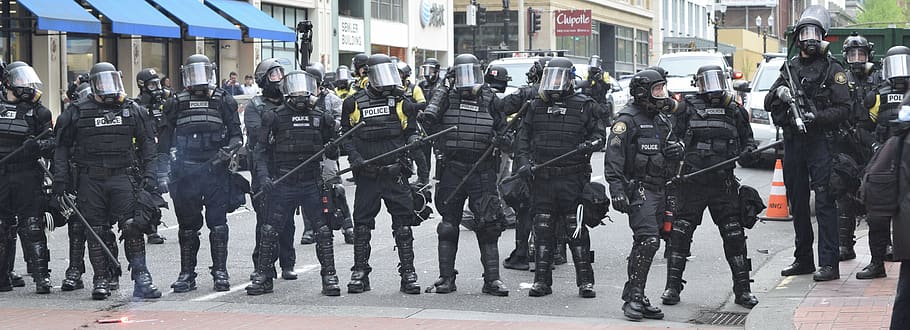 Another step down the path to fascism with an American accent.
According to ProPublica (and many other news sources):
Federal authorities are using a new tactic in their battle against protesters in Portland, Oregon: arrest them on offenses as minor as “failing to obey” an order to get off a sidewalk on federal property — and then tell them they can’t protest anymore as a condition for release from jail.
Legal experts describe the move as a blatant violation of the constitutional right to free assembly, but at least 12 protesters arrested in recent weeks have been specifically barred from attending protests or demonstrations as they await trials on federal misdemeanor charges.
“Defendant may not attend any other protests, rallies, assemblies or public gathering in the state of Oregon,” states one “Order Setting Conditions of Release” for an accused protester, alongside other conditions such as appearing for court dates. The orders are signed by federal magistrate judges.
For other defendants, the restricted area is limited to Portland, where clashes between protesters and federal troops have grown increasingly violent in recent weeks. In at least two cases, there are no geographic restrictions; one release document instructs, “Do not participate in any protests, demonstrations, rallies, assemblies while this case is pending.”
…
ProPublica identified several instances in which the protest ban was added to the conditions of release document when it was drafted, before it was given to the judge. It remained unclear whether the limits on protesting were initiated by Justice Department officials or the magistrates hearing the cases.
…
The ACLU’s Somil Trivedi said, “Release conditions should be related to public safety or flight” — in other words, the risk that the defendant will abscond. “This is neither.” He described the handwritten addition of a protest ban to a release document as “sort of hilariously unconstitutional.”
I’m not laughing. The shocking part here is not that some unknown party in the government asked for this — although they ought to know better — but that a federal judge, even if it was ‘just’ a Magistrate, signed off on this.
UPDATE (6/30): Good news/bad news: The good news is that the unconstitutional no-protest condition has been dropped in all cases. Bad news: the source of the condition was two federal Magistrates themselves. Ouch.
I really doubt that anyone outside Miami-Dade will find this nearly as funny as I do, but I couldn’t resist posting Jamónton, the musical saga of Alejandro Jamónton – the founding father who brought the Cuban sandwich to America.
The U.S. death rate for COVID-19 is, sadly, climbing again, and this number, along with the number infected, tends to be the headline. But there are a lot of other numbers to be concerned about.
Someone named Franklin Veaux has collected and estimated some. I haven’t checked them personally, but they seem plausible.
Veaux frames the issue as “How can a disease with 1% mortality shut down the United States?” and then he’s off to the races:
There are two problems with this question.
- It neglects the law of large numbers; and
- It assumes that one of two things happen: you die or you’re 100% fine.
The US has a population of 328,200,000. If one percent of the population dies, that’s 3,282,000 people dead.
Three million people dead would monkey wrench the economy no matter what. That more than doubles the number of annual deaths all at once.
The second bit is people keep talking about deaths. Deaths, deaths, deaths. Only one percent die! Just one percent! One is a small number! No big deal, right?
What about the people who survive?
For every one person who dies:
- 19 more require hospitalization.
- 18 of those will have permanent heart damage for the rest of their lives.
- 10 will have permanent lung damage.
- 3 will have strokes.
- 2 will have neurological damage that leads to chronic weakness and loss of coordination.
- 2 will have neurological damage that leads to loss of cognitive function.
So now all of a sudden, that “but it’s only 1% fatal!” becomes:
- 3,282,000 people dead.
- 62,358,000 hospitalized.
- 59,076,000 people with permanent heart damage.
- 32,820,000 people with permanent lung damage.
- 9,846,000 people with strokes.
- 6,564,000 people with muscle weakness.
- 6,564,000 people with loss of cognitive function.
That’s the thing that the folks who keep going on about “only 1% dead, what’s the big deal?” don’t get.
The choice is not “ruin the economy to save 1%.” If we reopen the economy, it will be destroyed anyway. The US economy cannot survive everyone getting COVID-19.
There’s more than money at stake — this is a lot of misery. Even if the economy could survive it, surely this is a scenario worth working to avoid?
UPDATE: (7/27/2020) As I should have pointed out initially, the numbers below the 65,358,000 hospitalized are a breakdown of that number, not in addition to it. As far as I know, we don’t have any data at all on what the long-term effects, if any, of COVID-19 are likely to be on persons who are not hospitalized for it.
 Recent Bluessky Posts
 Jotwell Blenderlaw