
Author Archives: Michael Froomkin

Mandatory Unpaid Labor by Government Workers: Involuntary Servitude? Wages and Hours Violation?

These are probably stupid questions, but I never took Labor Law: Why is it that the U.S. government can require some workers (e.g. TSA) to do their jobs without pay? As a formal legal matter there is no way that the bosses can guarantee back pay will be forthcoming ever, since it’s axiomatic that money can only be disbursed from the Treasury pursuant to a Congressional appropriation. Theoretically, Congress might never vote the back pay.

Doesn’t the absence of a payment guarantee make the forced labor either involuntary servitude, or at least a wage-and-hours violation since it is work for less than the minimum wage (zero)?

I presume the answer to the 13th Amendment question might have something to do with terms in the employment contract, in that the government perhaps reserves the right to require the unpaid labor, or the worker gets fired. Or, more likely, it’s just that civilian workers (but not military personnel, in this case the Coast Guard?) have the choice to just not show up and be fired, as opposed to slavery/involuntary servitude when the worker has no option to quit. That option, I’m guessing, makes the servitude not ‘involuntary’ for 13th Amendment purposes?

But even so, how does this conform with minimum wage laws? Is it as simple as, no one brings the case, then backpay makes the matter moot? In which case, how long before someone files the complaint?

Posted in Law: Constitutional Law, Politics: US | 1 Comment

A Truly Muscular Reply Brief in a Case of Great Importance

One case I’ve been following with great interest is (well, was) Michaels v. Sessions in which by a strange turn of events the Supreme Court is being asked to decide whether
Matthew G. Whitaker is or is not the Attorney General.

The underlying matter isn’t in my wheelhouse, having to do with the constitutionality of a federal ban on possession of firearms by convicted felons. Michaels lost in the court of appeals, and duly asked the Supreme Court to hear his appeal via a petition for writ of certiori. While that was pending, Trump forced out Sessions; whether Sessions legally resigned or was fired is actually a not-irrelevant issue. Trump then tapped Whitaker to take over the job of Attorney General, purporting to exercise power delegated under the Vacancies Act.

The Vacancies act is a mire of constitutional and structural issues, but suffice it for now to say that it does give the President vast authority to fill vacancies with a wide variety of government employees, but it also contains exceptions, one of which very arguably applies to the Attorney General’s office becuase there is a specific statute that provides for succession in the AG’s office. Under that statute Rod Rothstein, the #2 in the department, would automatically becoming the Acting Attorney General until a successor was properly nominated and confirmed (or, I presume, given an interim appointment–an option that the Senate has quietly foreclosed by having pro-forma sessions every few days during the recess thus preventing the Constitutional trigger that permits interim appointments).

When a person sues the United States about a regulation, it is common to caption (that’s lawyer for “title”) the case with the name of the movant and the government official who heads the agency. When there is turnover at the head of an agency, as there often is, it is usually routine for the name of the case to change too — on request of a party, the court just amends the caption of the case.

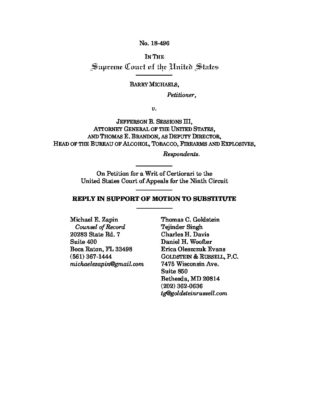
That is what happened with the petition for certioria — until Michaels’s lawyers objected. Earlier this month they filed a “Motion to Substitute” in the Supreme Court in which they asked the Court to rule that the case should be captioned “Michaels v. Rothstein” rather than “Michaels v. Whittaker” as Rothstein, not Whittaker, was in fact the Acting Attorney General. Needless to say, the government objected. Michael’s lawyers replied with one of the most muscular briefs I’ve ever read. If you are a lawyer or law student, this is a must-read.

The Supreme Court has not yet ruled, and it could do so without a hearing if it chose to do so.

Posted in Law: Administrative Law, Law: Constitutional Law, Law: The Supremes | Comments Off on A Truly Muscular Reply Brief in a Case of Great Importance

Another One

Real or The Onion?  “Blind creature that buries head in sand named after Donald Trump

Continue reading
Posted in Onion/Not-Onion | Comments Off on Another One

You Guess

Real or The Onion?  Soldier Has Suspicion Murder Charge Due To His Admission On Live TV  You be the judge.  Answer below.


Continue reading
Posted in Onion/Not-Onion | 1 Comment

Tor’s Matrix

Tor, the SF&F publisher, just sent out a funny chart (under the headline “fear is the cat-killer”) that I felt like sharing:

Posted in Completely Different | Comments Off on Tor’s Matrix

I’m on the ‘This Week in Health Law’ Podcast

Nicholas Terry of Indianan University was kind enough to ask me to join him and other experts on episode 151 (!) of  his podcast, This Week in Health Law (TWIHL) which was devoted to AI and health care:


I am joined by Abbe Gluck, Professor of Law and the Faculty Director of the Solomon Center for Health Law and Policy at Yale Law School. In November 2018 her team pulled together an excellent roundtable on “The Law and Policy of AI, Robotics, and Telemedicine in Health Care.” This episode of TWIH is the first of two taking a deeper dive into just a few of the  issues that were so well presented at the roundtable. Here we were joined by Michael Froomkin, the Laurie Silvers and Mitchell Rubenstein Distinguished Professor of Law at the University of Miami School of Law and by Nicholson Price, Assistant Professor of Law at The University of Michigan Law School. Topics ranged from consent in the next generation of healthcare research to data protection, and appropriate regulatory models.

Posted in AI, The Media | Comments Off on I’m on the ‘This Week in Health Law’ Podcast