
The claimed authority in the Proclamation on “Restriction On Entry Of Certain Nonimmigrant Workers” for the $100,000 immigration fee on H1-B visa holders is 8 U.S.C. § 1182(f) and 8 U.S.C. § 1182(f). Here are the relevant bits of those two code sections:
8 U.S.C. § 1182(f)
(f) Suspension of entry or imposition of restrictions by President
Whenever the President finds that the entry of any aliens or of any class of aliens into the United States would be detrimental to the interests of the United States, he may by proclamation, and for such period as he shall deem necessary, suspend the entry of all aliens or any class of aliens as immigrants or nonimmigrants, or impose on the entry of aliens any restrictions he may deem to be appropriate. …
8 U.S.C. § 1185
(a) Restrictions and prohibitions
Unless otherwise ordered by the President, it shall be unlawful—
(1) for any alien to depart from or enter or attempt to depart from or enter the United States except under such reasonable rules, regulations, and orders, and subject to such limitations and exceptions as the President may prescribe; ….
I see three legal issues:
First whether 8 U.S.C. § 1182(f) has an “intelligible principle” defining the President’s authority; if not, 8 U.S.C. § 1182(f) would be an unconstitutional delegation of power. Here the purported principle is whether “the entry of any aliens or of any class of aliens into the United States would be detrimental to the interests of the United States”. That may seem vague and general, and it is, but probably not more so than other things that have been held to be an intelligible principle. A slightly harder question is whether the imposition of a $100,000 fee on H1-B entry to the US exceeds that delegation? Alternately, are aliens incapable of paying the $100,000 fee the sort of group that constitutes a “class of aliens” as contemplated by the statute? They may be a social class but that doesn’t seem to be what the statute contemplates…
Second, is this a lightly disguised tax as opposed to something contemplated by the statute? This is akin to the claim now before the Supreme Court in the appeal of the Federal Circuit’s decision in VOS Selections Inc v Trump as to whether IEEPA empowers the President to set tariffs where it nowhere mentions them.
Third, is the $100,000 per entry or re-entry a “reasonable rule” under 8 U.S.C. § 1185(a)?
I think this is very doubtful. But even if it is reasonable, one still would need to explain why a lack of authority under § 1185(a) would limit the argued authority in § 1182(f). I think this could be an occasion for application of the General/Specific Canon (approved by Justice Scalia, no less): “If there is a conflict between a general provision and a specific provision, the specific provision prevails (generalia specialibus non derogant),” but I’d defer to people who know more about immigration law than I do.

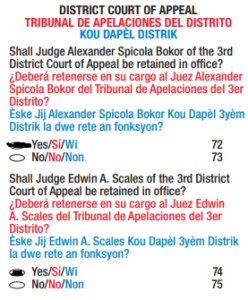 For the 3rd DCA, I start with the presumption that sitting judges deserve retention unless there is a good reason not to retain them. I don’t know either of the two judges up for retention this year, Judge Alexander Bokor (appointed by Governor Ron DeSantis in 2020), and Judge Edwin Scales (appointed by Governor Rick Scott in 2013 and retained by the voters in 2016). My research has not revealed anything to disturb that retention presumption. Admittedly, though, information was hard to come by this year.
 Amendment 2 would abolish the Florida Constitution Revision Committee. It’s true that the most recent instantiation of the committee was not impressive, as its membership was stacked for one party, and its outputs were
  Amendment 1 would take another bite out of the property tax base, by allowing the legislature to exempt improvements designed to respond to climate change from increases in rateable value of property. In principle this is a decent idea, and I know people who say climate change is such a big emergency that anything which might add to resilience is worth doing. I get that. My concern is that this will work as a subsidy to people rich enough to do improvements at the expense of those who cannot. Plus, I’m certain that—this being Florida—many many many improvements will be claimed to be about climate change when the majority are just standard maintenance or non-climate-related improvements. Which will just make the subsidy to the wealthy at the expense of everyone else to be that much worse. So I’m voting NO on Constitutional Amendment 1.
 Amendment 3 would grant an additional homestead exemption to various public servants including teachers, firefighters, police, serving military, and others. Sounds like motherhood and apple pie, right? I don’t have very strong feelings here, but I think we’ve gone far enough in giving bonus homestead exemptions to various groups – and this is a big one. Remember that every dollar we don’t collect from one group comes from another. Add in policies to limit the increase in valuations, the incredible resistance to upward changes in the millage rate, and in no time you are starving local government of essential revenue. (Recall that “starving the beast” was and is the slogan of one of our major parties when it comes to preventing effective government.) So I’m voting NO on Constitutional Amendment 3.
 Amendment 2 would require a referendum before privatizing MIA, the Port, or the Miami-Dade Expressway Authority (who control local tolls among other things).
 Charter Amendment 1 creates a loyalty oath in which county commissioners and the county mayor would swear to “support, protect and defend” the county charter. This too comes out of recent controversies in which state-level groups wanted to undermine home rule. The thought is that the oath will underline the importance of local control. I guess that’s fine, although honestly it’s hard to get worked up about this one since a substantial fraction of local pols probably would swear to anything if it kept them in office.
 This will permit a small (1 mil) increase of property taxes for the public (and, alas, charter) schools. They could use the money.
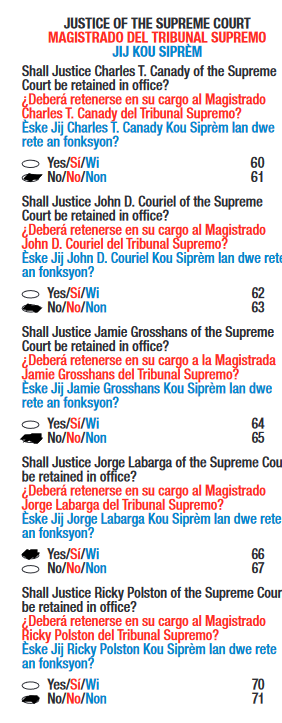 Sadly, four of the justices on the current Florida ballot do not deserve retention. I strongly advise voting to remove Justices Charles Canady, Ricky Polston, Jamie Grosshans and John Couriel. I recommend voting to retain Justice Jorge Labarga.
