Author Archives: Michael Froomkin

War Crimes

Seymour M. Hersh interviews Army Major General Antonio M. Taguba (forcibly Ret.), and gets a preview of his testimony at the c. 2010 war crimes trials:

“There was no doubt in my mind that this stuff”—the explicit images—“was gravitating upward. It was standard operating procedure to assume that this had to go higher. The President had to be aware of this.” He said that Rumsfeld, his senior aides, and the high-ranking generals and admirals who stood with him as he misrepresented what he knew about Abu Ghraib had failed the nation.

“From the moment a soldier enlists, we inculcate loyalty, duty, honor, integrity, and selfless service,” Taguba said. “And yet when we get to the senior-officer level we forget those values. I know that my peers in the Army will be mad at me for speaking out, but the fact is that we violated the laws of land warfare in Abu Ghraib. We violated the tenets of the Geneva Convention. We violated our own principles and we violated the core of our military values. The stress of combat is not an excuse, and I believe, even today, that those civilian and military leaders responsible should be held accountable.”

Posted in Torture | Comments Off on War Crimes

Istanbul

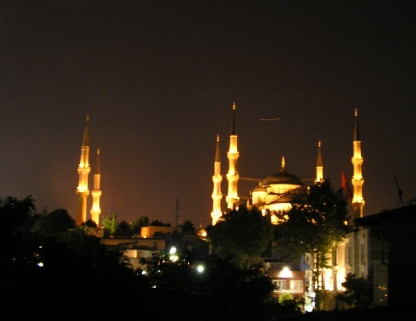
We are enjoying Istanbul. Below is the night-time view of the Blue Mosque from the far corner of the roof terrace of our hotel, which hints at the grandeur of the best of the local architecture.

bluemosque.jpg

Indeed, given the number of mosques near here, we are well-placed to hear the muezzins' calls.

Posted in Personal | 2 Comments

Meet Guest Blogger Patrick Gudridge

Tomorrow, my family and I will be leaving for a week in Istanbul, which is a place I've always wanted to visit. Admittedly, this may not be the very best time in history to be visiting Turkey, given both the domestic tensions between secularists and Islamicists and the Turkish army's provocative shelling across the Northern Iraqi border. We made the arrangements about a week before the current round of unrest began and have been watching developments, especially the bombings, with some concern. So far, however, there do not seem to have been attacks in Istanbul itself, and we haven't called off the trip.

Our hotel in Istanbul promises wireless internet, but I've learned to be wary of such promises, and anyway, this is a holiday. So I'm turning the blog over to a guest until I get back on the 22nd (or more if he wants): my good friend and colleague Patrick Gudridge.

Patrick's willingness to guest blog is a very good thing for readers. Patrick either embodies or exemplifies most of the best things about the University of Miami School of Law. He is intellectually omnivorous, deeply thoughtful, and irrationally charitable and optimistic — all the things that make him a superlative commentator and conversationalist. He's also very nice. Best known, perhaps, for his recent Harvard Law Review article “Remember Endo?,” Patrick's interests range far and wide, but often return to issues of federal and state constitutional law. On the faculty, in addition to his intellectual reputation, Patrick enjoys a special status as a sort of utility player, someone ready, willing, and able to teach almost any course in the curriculum. Patrick is also fond of dogs, having raised, among others, champion bull mastiffs.

Here's the official bio:

Patrick O. Gudridge, Professor of Law, received an A.B. from Harvard College in 1972 and a J.D. in 1976 from Harvard Law School. Professor Gudridge served as a law clerk to Justice Mathew O. Tobriner of the California Supreme Court. He joined the faculty in 1977, and served as Associate Dean at the Law School from 1990 to 1994. He has published articles on the structure of legal interpretation and analysis. His teaching interests are eclectic, and have included courses in federal jurisdiction, U.S. and Florida constitutional law, jurisprudence, business associations, torts, and agency.

I have no idea what he's going to say (I rarely do), but I'm sure it will be interesting (it always is).

Posted in Discourse.net | 2 Comments

I Wish Robert Waldmann Had Been My Freshman Economics Teacher

What do you think the world would look like if freshman micro-economics students were routinely taught by Robert Waldmann? Instead of carrying around an Austrian model in their heads in which we assume total selfishness, zero transactions costs, and conclude that transfer payments are suspect, they'd be hearing about Possible efficiency gains due to taxes and transfers,

A little bit of altruism changes everything. If people care about their own physical well being (pleasure minus pain) plus that of those they love plus 0.00001 times the well being of strangers redistribution can be Pareto improving. Non poor agent A doesn't need taxes and transfers to give his money to the poor. However, after he has chosen my level of private giving, he doesn't want to give any more via taxes. However he wants to give rich agent B's money to the poor. He cares a tiny bit about the small cost (in pleasure minus pain) to B and the same tiny bit about the large benefit to the poor. Increasing taxes and transfers from zero will make everyone happier if the population is large enough so that taxing one me is more than balanced by taxing lots of you

I'm pretty sure I had to wait until sophomore year to hear this stuff, and even then it was said with much less enthusiasm, as an embarrassing exception to an otherwise tidy result.

(Or course, Robert couldn't have been my freshman economics teacher, we graduated the same year from different universities, but you know what I mean.)

Posted in Econ & Money | Comments Off on I Wish Robert Waldmann Had Been My Freshman Economics Teacher

But they Love Him in Albania

Lest you fear I've gone soft on Bush while on vacation, Crooks and Liars reminds us why Bush is so well respected abroad in ‘What exactly did I say?’:

Bush at a press conference on Saturday:

Q: And on the deadline [for Kosovo independence]?

Bush: In terms of the deadline, there needs to be one. This needs to come — this needs to happen. Now it’s time, in our judgment, to move the Ahtisaari plan. There’s been a series of delays. You might remember there was a moment when something was happening, and they said, no, we need a little more time to try to work through a U.N. Security Council resolution. And our view is that time is up.

Bush at a press conference on Sunday:

Q: Thank you, Mr. President. Yesterday you called for a deadline for U.N. action on Kosovo. When would you like that deadline set? And are you at all concerned that taking that type of a stance is going to further inflame U.S. relations with Russia? And is there any chance that you’re going to sign on to the Russian missile defense proposal?

Bush: Thanks. A couple of points on that. First of all, I don’t think I called for a deadline. I thought I said, time — I did? What exactly did I say? I said, “deadline”? Okay, yes, then I meant what I said.

At which point assembled reporters started laughing at him.

Kevin asked, “[I]s it really too much to ask the president of the United States to take his own policies seriously enough to actually know what they are?”

Apparently so.

The issue, though, isn't so much whether Bush knows what 'his' policies are as what role he plays in setting them. Or, as Adam Kotsko suggests that The real problem with the Bush presidency is that it is conceptually unclear what kind of king he thinks he is — the absolute monarch of the Ancien Régime, or the Hegelian constitutional monarch who just “says yes and dots the i's.”. But I prefer his other observation, that

The Democrats are now the party of continuing to have a constitution — paradoxically, they think that the only way to do this is by refusing to face down Bush's gravest violations of the constitution. Hence no impeachment, no real investigation into intelligence manipulation, just this endless dithering with marginal scandals like the US Attorney thing.

No one wants to “officially” expose the fact that the executive branch has been effectively treating the constitution as suspended for all this time, even though the information pointing to this conclusion is publicly available and overwhelming.

Meanwhile, I read in the papers that Bush received a rapturous reception in Albania. “Why did Bush go to Albania?” someone asked here. “It was the largest country he could find that approved of him,” someone else said.

Posted in Politics: International | 3 Comments

A Day in the Park in Didsbury

I am currently in East Didsbury. Didsbury is a little village which has been subsumed into greater Manchester and now falls just within the outer limits of the city. Long known as a home to academics from the nearby University of Manchester, in recent years Didsbury, or at least West Didsbury which is the other part of town, is also gradually becoming something of a fashionable home to media figures of various degrees of fame. The formerly sleepy village center has long enjoyed a first-class cheese shop, the Cheese Hamlet, but in recent years has also accumulated an increasing number of nice restaurants with a variety of Asian and Mediterranean cuisines.

On Saturday we walked a few blocks to a local park which was the setting for the annual village fair. In addition to rides for the kids, there were dozens of booths either raising funds for good causes (mostly local schools) or publicizing good causes (everything from local history to Amnesty International and helping Darfur). What particularly struck me, however, was the large sign on the booth that had the most prominent location by the entrance, “Free the Miami Five”.

The booth, it seems, belonged to the Cuba Solidarity Campaign, a group that sports three web sites, and which has gotten very worked up about the trial of five Cuban agents convicted in 2001 of conspiracy and being foreign agents. From what I recall of the trial — being here on a slow and expensive dial-up link I'm not going to look up the details (but invite commentators to do so) — there were valid questions about whether a Miami jury could give alleged Cuban agents a fair trial, or whether the trial should be moved elsewhere. And, if I recall, not all the judges who looked at the issue were of the same view. And although, from what I recall, the basic mechanics of the trial were fair, a reasonable person could question the decision as to the jury. In fact, my knee-jerk reaction — not knowing the facts of how the actual jury was selected, which I'm sure might change my mind — is that a change of venue to somewhere less reflexively anti-Castro might have been a pretty good idea to ensure the fairness of the jury pool.

What's odd, though, is to pick on this case, of all the justice-related issues in the USA (much less the world), as the one to make an issue of in a park in East Didsbury. If I were going to try to get the good people of Didsbury worked up about a US justice issue, or a Cuba-related justice issue, I might start with Guantanamo. Somewhere not too far down the list we might have the treatment of political dissidents in Cuba itself. Or maybe the move in Florida to cut the pay of court-appointed defenders in order to save a buck and make sure that they can't afford to mount much of a defense. The “Miami 5,” for all that there may be a question about the underlying fairness of the jury selection for their trial, would not be near the head of my list.

I have no idea to what extent the “Cuba Solidarity Campaign” represents something genuine among the British soft left, or to what extent it is funded by the Cuban government or whatever remains of the Communist International. Despite its location, their booth didn't seem to be nearly as popular as the ones offering used books, or the various tombolas, or the one selling very good Indian snacks. Still, “Free the Miami 5” was a funny first thing to see at at the Didsbury fair.

Posted in Law: Criminal Law, Miami, UK | Comments Off on A Day in the Park in Didsbury