
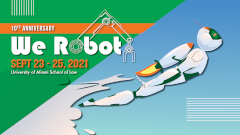
 I’m delighted to share the We Robot 2021 Call for Papers, Demos & Posters (.pdf version):
Call for Papers, Demos & Posters
We invite submissions for the 10th annual robotics law and policy conference—We Robot 2021—to be held at the University of Miami in Coral Gables, Florida, USA, on September 23-25, 2021. Currently we are planning for an in-person event with a virtual option, but this may change subject to circumstances. Previously, the conference has been held at University of Miami, University of Washington, Stanford, Yale, and University of Ottawa. The conference web site is at https://werobot2021.com/. The submission portal will open for poster proposals, papers, and demos on December 14, 2020. Paper and demo proposals are due by Feb. 1, 2021. Posters will be accepted on a rolling basis until June 1, 2021.
Marking the 10th anniversary of the conference, We Robot 2021 seeks contributions by North American and international academics, practitioners, and others, in the form of scholarly papers, technological demonstrations, or posters. We Robot fosters conversations between the people designing, building, and deploying robots and the people who design or influence the legal and social structures in which robots will operate. We particularly encourage papers with co-authors from different fields, e.g. interdisciplinary collaborations between developers of robotics, artificial intelligence (AI), and related technology and experts in the humanities, social science, and law and policy.
This conference will build on a growing body of scholarship exploring how the increasing sophistication and autonomous decision-making capabilities of robots and their widespread deployment everywhere from the home, to hospitals, to public spaces, to the battlefield disrupts existing legal regimes or requires rethinking policy issues.
We invite proposals for each of the following:
- Scholarly papers
- Demonstrations
- Poster sessions
Scholarly Papers
Topics of interest for the scholarly paper portion of the conference include, but are not limited to:
- Comparative international perspectives on the regulation of robotic technologies.
- Assessment of what institutional configurations, if any, would best serve to integrate robotics into society responsibly.
- The impact of artificial intelligence on civil liberties, including sexuality, due process, equal protection, privacy, suffrage, and procreation.
- Deployment of autonomous weapons in the military or law enforcement contexts.
- Law and economic perspectives on robotics.
- Feminist or critical race theory perspectives on robotics.
- Regulatory and licensing issues raised by robots.
- Robots in specific sectors, ranging from agriculture to underwater to the professions (law, medicine, accounting).
- Issues of legal or moral responsibility, e.g. relating to autonomous robots or robots capable of exhibiting emergent behavior.
- Effects of robotic adoption on the demand for human labor.
- Privacy and intellectual property issues relating to robotics.
- Ethical issues arising from automation.
- Co-robotics in practice, be it assembly lines, small businesses, hospitals, or other contexts where robots and humans work side-by-side.
Please note that this list is not meant to be exclusive or exhaustive. Instead, it suggests potential avenues for inquiry. We encourage other contributions that engage how law and policy should react to the development of robots – defined broadly to include AI and cyberphysical systems. The purpose of this conference is to continue to frame (and report on) research agendas relating to the deployment of robots in society, to inform policy-makers of the issues, and to help design legal rules that will maximize opportunities and minimize risks arising from the increased deployment of robots in society.
How to Propose a Paper
The conference submission portal will open Dec. 14, 2020. (Link will be available from werobot2021.com.) Submissions are due by Feb. 1, 2021. Proposers will need to provide:
- Title of the proposed paper and an abstract of between 500 and 1000 words. Submitters are cautioned that proposals that exceed the length limit will be rejected unread. We anticipate posting some model abstracts at https://werobot2021.com/ to serve as suggestive examples. In addition (not counted in the word limit) please provide a list of up to 6 key references that you refer to in the paper that will help us understand how to situate your paper;
- Please do NOT put any names or biographical information in your uploaded proposal. However, on a separate sheet, please – again without your name(s) or the name(s) of institutions or corporations – list the current title of each contributor (e.g. “Ph. D candidate in Mechanical Engineering” or “Associate Professor of Anthropology” or “Chief Technologist at Robotics Startup”). We are asking for this information because in past years we have sometimes struggled to determine whether proposers had the experience or disciplinary breadth to deliver on certain types of ambitious proposals; purely blind submissions did not, for example, allow us to tell if submissions were by one person or a group.
To preserve blind review, we ask that you not ask members of the program committee to review draft abstracts in advance of submission.
Important Note
Full text of accepted papers will be due on Aug. 16, 2021. This is a hard deadline because at We Robot authors do not present their papers (except for occasional panel or lightning-round-format presentations). Instead, the paper will be briefly summarized by a discussant, and we make all papers available one month before the conference so that the discussant — and all attendees – can read them. We also invite expressions of interest from potential discussants. Every paper accepted will be assigned a discussant who will present and comment on the paper. These presentations will be very brief (no more than 10 minutes) and will consist mostly of making a few points critiquing the author’s paper to kick off the conversation. Authors will then respond briefly (no more than 5 minutes). The rest of the session will consist of a group discussion with the discussant acting as a moderator.
We will waive conference fees for all authors of accepted papers if the full paper is submitted by Aug. 16, 2021. In addition, subject to funding availability, we intend to provide for domestic air travel (or, if necessary, at least partial funding for international air travel), plus lodging, for one paper presenter provided the full paper is submitted by the due date.
Demonstrations
We invite proposals for demonstrations of interesting new robots and related technology. Unlike scholarly papers, proposals for demonstrations may be purely descriptive and designer/builders will be asked to present their work themselves. We’d like to hear about your latest innovations, what’s on the drawing board for the next generations of robots, or about legal and policy issues you have encountered in the design or deploy process. Please bring your robots if you can!
How to pitch a demo. The conference submission portal will open Dec. 14, 2020. Submissions are due by Feb. 1, 2021. Please send description of what you have, or are doing, with links to any relevant photos or audio-visual information, as well as your C.V. Please be sure to choose the “Demo ” track for your upload. Please include a brief description of what facilities and resources your demonstration might require (e.g., power, internet connection, space).
Poster Session
We Robot’s poster session is designed to accommodate late-breaking and cutting edge projects. This session is ideal for researchers to get feedback on a work in progress. At least one of the authors of each accepted poster should plan to be present at the poster during the entire poster session on the afternoon of Sept. 24, 2021, and for a “lightning round” of one-minute presentations during the main session. You can bring the poster or, in some cases, with sufficient lead time we may be able to print it in Miami for you. If accepted, you will also need to provide a web-friendly summary of the work that we can post on the conference web site.
How to propose a poster session. Please send an up to 500 word description of what you have or are doing, with links to any relevant photos or audio visual information, as well as your C.V. via the conference submission portal. Please be sure to choose the “Posters ” track for your upload. Submissions open December 14, 2020 and are due by June 1, 2021. We’ll accept poster proposals on a rolling basis, meaning that there will be an advantage to submitting before this date. Remember, at least one author of an accepted poster must register at the conference to submit the final version.
We will waive all conference fees for one author of every accepted poster.
Summary of Key Dates
- December 14, 2020. Submission portal for papers, demos, and posters opens.
- January 8, 2021. Early Bird Registration begins.
- February 1, 2021.. Call for papers and demos closes. All proposals submitted by this date will be treated equally.
- March 8, 2021. We aim to have responses to paper and demo proposals by this date.
- June 1, 2021. Early bird registration closes.
- June 1, 2021. Call for posters closes, but acceptances may be offered on a rolling basis (i.e. it may be beneficial to submit earlier).
- August 16, 2021. Full papers due. They will be posted online at the conference web site unless otherwise agreed.
- September 23, 2021. We Robot Workshops, University of Miami, Coral Gables, FL, USA.
- September 24-25, 2021. We Robot Conference, University of Miami, Coral Gables, FL, USA. (Note – poster session on Sept 24, 2021.)
More information and updates at: https://werobot2021.com/.
We anticipate waiving conference fees, paying reasonable round-trip coach airfare, and providing two nights hotel accommodation for one presenter per paper and for all discussants. We will waive all conference fees for all other authors and for poster presenters; we are currently exploring scholarship opportunities to help students cover costs of attendance.
(You can download a pdf version of the We Robot 2021 – Call For Papers, Demonstrations & Posters.)
PLEASE NOTE: All paper submissions are reviewed blind by the program committee and the review committee. To maximize your chances of acceptance, please do not discuss the substance of your proposal with any organizers.
© 2020 We Robot 2021. Permission granted to copy for any non-commercial use.
 Germans — notorious for being hardworking — are told to adopt the ‘stay lazy at home’ mentality to defeat COVID. Here’s another
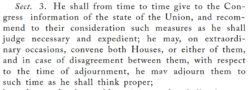 U.S. Constitution Article II, Section 3, cl. 2 is having its moment in the sun. This clause says that the President
