
Author Archives: Michael Froomkin

Good Companies

At some point during the past Spring semester I made a snarky comment during a class about one of the corporate parties in a case or a hypo, and a student challenged me to name a corporation I liked. Which seemed like a fair demand — especially as it took me some effort. In a way, that shouldn’t be surprising: in capitalism red of tooth and claw, a corporation that is liked may be leaving some consumer surplus on the table that it maybe should be grabbing and turning into producer surplus. Then again, perfect price and service discrimination is not yet possible: so, assuming I am not the absolutely average consumer even in the mythical world of free and perfect competition there ought to be some firms whose delivery of goods and services is sufficiently great as to give me some warm fuzzies.

I was reminded of this because a very pretty and inexpensive table we bought just a few years ago — from a store we will not be going back to — is showing signs of imminent collapse. To replace it we recently ordered a table from one of my favorite local companies, written before. And we recently celebrated our 23rd wedding anniversary at a fabulous local restaurant that we go to only for the most special occasions.

Of the big national firms that I deal with, the ones that I think I do the best job and are most pleasant to deal with are, in alphabetical order:

  • Aetna. It may be strange to list a health insurance company, and in part this may be a case of exceeding very low expectations. And, yes, the premiums have gone up a lot over what we paid a decade ago. But for that money we seem to have gotten a good policy. Aetna paid out pretty well when I had my aortic valve troubles – there was only one piece of attempted unreasonable behavior and we got it sorted quickly; financially the end damage was more like buying a new car than a new house (or, at the rack rate, waterfront property). When I call them for assistance with something billing-related, the people on the phone are usually (not inevitably, but almost always) not just friendly but competent and efficient.
  • Costco. Too far away, and I doubt we actually save money there, but we sure eat better when we shop there. Staff at checkout work like beavers to get you through.
  • GEICO. Yes, another insurance company. Hands down the best phone service from any company I deal with. Plus, they have done things that I didn’t expect and saved me significant money. Example: They don’t charge anything extra for a teen driver when your teen is in college, even if he spends the summer at home; I would have expected something pro-rata.
  • UPS. I get a lot of packages. They are almost never late, and in 20 years even more rarely lost. The tracking system online is excellent. The driver who comes to our house is always very pleasant. The prices seem reasonable when I want to ship something. So they always park illegally downtown — no one is perfect.

I was tempted to add Whole Foods to the list, because I love their cheese and the staff are nice, almost creepy nice, but the prices are so absurdly high that I don’t go often. Similarly, the rare times I’ve dealt with Williams-Sonoma it’s been great, but pricey. And the experience of dealing with Puget Systems to buy the computing equivalent of a noiseless Ferrari for the kids’ gaming machine (had to be silent as it would be in the family room) was excellent. The product was beautiful, indeed noiseless, and I’ve never seen such fine cabling and documentation. It really felt like a luxury product and luxury purchasing experience, but I still can’t believe how much I paid for it. Or that I’d like another one for myself.

I ought also to mention a small software company, Thornsoft, the makers of Clipmate. Not only is this probably the single most useful piece of productivity software I’ve relied on for about 20 years, but on the rare occasions I’ve had a problem and emailed support, I’ve had a prompt responsive helpful reply from the programmer himself, Chris Thornton. Great stuff.

Plus, as I mentioned recently, I’m a big fan of the Gables Stage, although I don’t know if this counts as it’s a non-profit.

Notably absent from the list above are any banks, and any electrical or air conditioning maintenance/repair companies. I don’t seem to have much luck with those.

What are your favorite national or South Florida firms, winners not just in terms of price/quality but also in terms of quality of customer service?
Posted in Econ & Money, Shopping | 2 Comments

Local Food Note Update

In response to yesterday’s Local Food Note I had a chirpy email from a person who asked to be identified only as “a Shake Shack representative” saying that the Shake Shack opening near the UM campus is planned for “mid-to-late July.”

(Sadly, no promotional considerations were offered for this message.)

Update (6/24): Drove by today and it looks as if some construction is underway.

Posted in Coral Gables | 2 Comments

Local Food Note

Some time ago I blogged about the death of the Smoke’t near the UM campus which was to make way for a Shake Shack. I drove by the other day, and it didn’t look like a lot was going on there. Online, however, I learn that Shake Shake is due to open here in “June 2012”, which would be…now? On the other hand, the official Shake Shake page just says “this summer”. But Craigslist has them hiring. So maybe soon?

From Danny Meyer, the founder of the chain, I find that we’re going to be part of an odd pairing:

We’re going into Coral Gables, Florida, right across from the University of Miami. We’re going into New Haven, just adjacent to Yale.

Which I think will make us the only two universities outside New York City with one near by.

As for Smoke’t (I never noticed the apostrophe before — I thought of it as “Smoke T” not “smoked”), rumors of its rebirth in South Miami are not confirmed by their website, which says nothing about any relocation or reopening.

Posted in Coral Gables | Comments Off on Local Food Note

UM Law Employment Numbers Are Much Better Than In Erroneous ABA Report (Updated) (Again)

Last year’s class’s employment numbers for the University of Miami School of Law are not wonderful, but they’re not hideous either. They are much better than reported by the ABA and echoed all over the internet today.

I have no idea if the error was in UM’s reporting or the ABA’s transcription, but I do know that the summary I saw in the National Law Journal’s report this morning, based on ABA data, does not have the correct numbers. [Update: The ABA admits it was their “transcription error” and is correcting it.]

Here are the correct data:

There were 385 graduates in the class of 2011.

Of these, 369 are known to be employed (369/385 = 95.8%). But, of that 369 with jobs, only 280 (75.9% of those with jobs, 72.7% of the entire class) are employed in jobs that required bar passage, 33 (8.9%) were employed in jobs where the JD was an advantage, 11 (3%) were employed in “other professional” positions and 4 (1.1%) were employed in “non-professional” jobs.

This 72-76% of the class with law jobs (or if you prefer the 313 with law-related jobs, 84.8% of job-holders, or 81.2% of all graduates), is well above the national average, even if it’s still lower than we’d like. Nationally,

Slightly more than half of the class of 2011 — 55 percent — found full-time, long-term jobs that require bar passage nine months after they graduated, according to employment figures released on June 18 by the American Bar Association.

The NLJ reports that we hired 23% of our own grads. I knew that couldn’t be right — nearly one out of four? where did we put them? — and sure enough, it’s not true. Somehow something got double-counted in the “law school/university funded position” row of the report. That report shows we hired 88 grads, but the correct number is actually half that: Last year, we hired 44 of our own grads (11.4%) for short or long-term jobs. The lion’s share of them were hired by the Legal Corps where they get placed with non-profits or governments and get work experience. While it’s too soon to know the results for the class of 2011, their predecessors in the class of 2010 did very well out of this experience, with many parlaying it to full-time employment.

I’m told that the error in the ABA form (I’ve attached a copy of the erroneous form) seems to be in the “part-time long term” law school funded box, where the ABA report has 44. The actual number is zero, making the total of that row 44, not 88. Thus, even if one takes out the 44 people from the 313 with law jobs (and I’m not sure one should, since the Legal Corps often does lead to permanent work), that still leaves 269 with law jobs, or 69.9% of the entire class. That is not at all good — but it still beats the national average of 55% by a decent margin.

I doubt this correction will ever catch up with the inaccurate info, but there it is.

Posted in Law School, U.Miami | 4 Comments

U Miami Has Its Own App

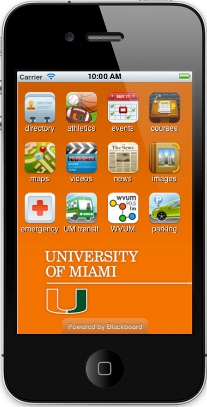
explorer taxMaybe everyone else knew, but I was surprised to learn that the University of Miami has its own Android/IPhone app.

Of course it’s a bloated 10MB monster, but even so. Rumor has it you can use it to check out books from the library, but I haven’t figured out how yet. The map looks useful, but a search for “Architechture School” and “Law School” returned not found.

First impression: Looks slick, but it isn’t very efficient, and it’s not terribly user-friendly. In other words, all very Miami?

Posted in Android, U.Miami | 2 Comments

Privacy and the Lumpen Consumertariate

The Secret Shopper by Willie Osterweil has a bit too much jarring Marxist jargon for me to feel in tune with it, but it makes some provocative points about the institution of the “Secret Shopper” — the folks hired by management to go to stores and pretend to be customers and then report on the quality of the service.

Stripped of (some of) the cant, the conclusion is that the mystery shoppers are tools of conformity:

Mystery shoppers are miniature thought police, affective pinkertons, mercenary management to whom real management outsources the legwork of everyday psychic control. They are sent in to break the avenues of refusal available to workers, to enforce the arbitrary standards dreamed up by marketers, bureaucrats, and MBAs that so deaden the experience of everyday life under late capitalism. … All just for a little extra cash for the weekend.

Producing identification with the bosses; smashing labor; and making solidarity difficult through contract labor, precarity, and remote working are key features of neoliberal workplace organization. But central to this vision, too, is workplace surveillance. … Heightened workplace surveillance helps build a workplace where no time is wasted, where all effort is put directly into the production of the bosses’ product. But it transforms more than just the bottom line.

The threat of the ever-present spy, the fear that the woman who forgot her ID in the car but swears she’s 18 is actually a scab employed by your boss, means you trust no one, expecting them all to be against you, out to catch you breaking management’s rules, which you now enforce with paranoiac efficiency. Surveillance, ultimately, isn’t about stopping crime. It’s about making police.

I think that even if you are OK with Taylorized service jobs, this critique ties somehow to the importance of privacy in other realms — or the need for concern about the upcoming Dossier Society — more generally. Data is a way to watch you too.

Posted in Law: Privacy, Shopping | 1 Comment