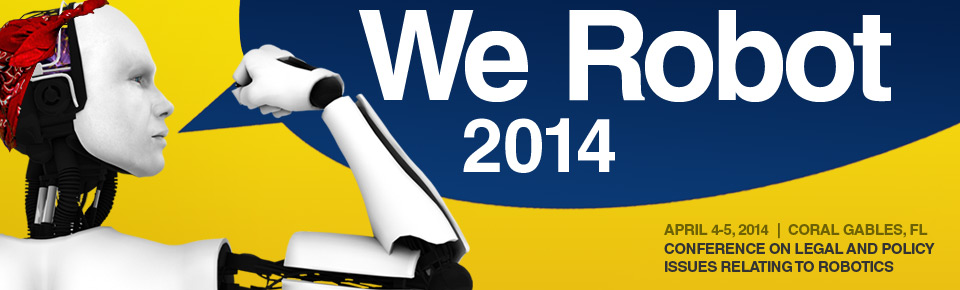
We invite submissions for “We Robot 2014: Risks & Opportunities” – a conference at the intersection of the law, policy, and technology of robotics, to be held in Coral Gables, Florida on April 4-5, 2014. We Robot is now in its third year, returning to the University of Miami School of Law after being hosted by Stanford Law School last April. The conference web site is at http://robots.law.miami.edu/2014.
We Robot 2014 seeks contributions by academics, practitioners, and developers in the form of scholarly papers or presentations of relevant projects. We invite your reports from the front lines of robot design and development, and invite contributions for works-in-progress sessions. Through this interdisciplinary gathering, we are encouraging conversations between the people designing, building, and deploying robots, and the people who design or influence the legal and social structures in which robots will operate. We particularly encourage contributions resulting from interdisciplinary collaborations, such as those between legal or policy scholars and roboticists.
Robotics is becoming a transformative technology that presents many legal and social challenges. This conference will build on existing scholarship that explores how the increasing sophistication and autonomous decision-making capabilities of robots and their widespread deployment everywhere from the home, to hospitals, to public spaces, and even to the battlefield disrupts existing legal regimes or requires rethinking of various policy issues.
Scholarly Papers
Topics of interest for the scholarly paper portion of the conference include but are not limited to:
- Risks and opportunities of robot deployment in the workplace, the home, and other contexts where robots and humans work side-by-side.
- Issues related to software-only systems such as automated trading agents.
- Regulatory and licensing issues raised by robots in the home, the office, in public spaces (e.g. roads), and in specialized environments such as hospitals.
- Design of legal rules that will strike the right balance between encouraging innovation and safety, particularly in the context of autonomous robots.
- Issues of legal or moral responsibility, e.g. relating to autonomous robots or robots capable of exhibiting emergent behavior.
- Usage of robots in public safety and military contexts.
- Privacy issues relating to data collection by robots, either built for that purpose or incidental to other tasks.
- Intellectual property challenges relating to robotics as a nascent industry, to works or inventions created by robots, or otherwise peculiar to robotics.
- Issues arising from automation of professional tasks such as unauthorized practice of law or medicine.
- How legal scholars should think about robots, and how roboticists should think about the legal code.
These are only some examples of relevant topics. We are very interested in papers on other topics driven by actual or probable robot deployments. The purpose of this conference is to help set a research agenda relating to the deployment of robots in society, to inform policy-makers of the issues, and to help design legal rules that will maximize opportunities and minimize risks arising from the increased deployment of robots in society.
Discussants
We also invite expressions of interest from potential discussants. Every paper accepted will be assigned a discussant whose job it will be to present and comment on the paper. These presentations will be very brief (no more than 10 minutes) and will consist mostly of making a few points critiquing the author’s paper to kick off the conversation. Authors will then respond briefly (no more than 5 minutes). The rest of the session will consist of a group discussion about the paper moderated by the discussant. Attendees will need to read papers in advance to understand and participate in each discussion.
Works-in-Progress Presentations
Unlike the scholarly papers, proposals for the works-in-progress presentations may be purely descriptive and designer/builders will be asked to present their work themselves. We’d like to hear about your latest innovations – and what’s on the drawing board for the next generations of robots as well, or about legal and policy issues you have encountered in the design or deploy process.
How to Submit Your Proposal
Please send a 1-3 page abstract outlining your proposed paper, and a c.v. of the author(s).
We Robot 2014 will be hosted by the University of Miami School of Law, Coral Gables, Florida on April 4-5, 2014. Venue details are at the conference web site.
We anticipate paying reasonable round-trip domestic coach airfare and providing hotel accommodation for presenters and discussants.
This is going to be great.