Category Archives: U.Miami

Still a Rock Star

Bill Clinton came to town Thursday and gave the Spring Convocation address. It was a great performance. And given that Al Gore came by a day earlier and presented the “Inconvenient Truth”, it's been a busy week.
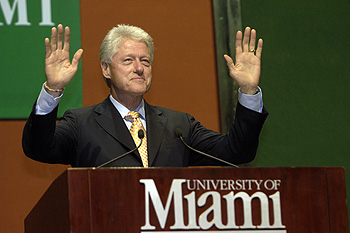
Clinton's facility with language and his ability to persuade an audience of his passionate belief never fails to impress, and today was no exception. (The audience interrupted with applause more than twenty times.) He spoke for about 45 minutes, then sat on stage in a nice upholstered armchair next to UM President Donna Shalala and answered some student questions that she had pre-selected.
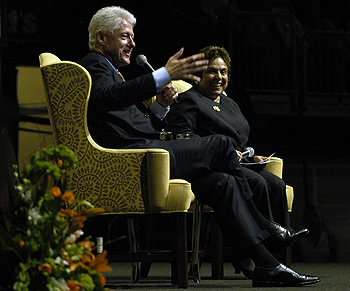
Clinton's main talk, which he said was an abbreviated from of a lecture he's been giving around the world, centered around five questions that he said everyone should try to answer for themselves (everything that follows is summary or close paraphrase; but it's not necessarily actual quotation unless I use quote marks):

1. What is the fundamental character of the 21st Century?

Many might say globalization, but “I prefer 'interdependence.'”

2. It it a good or a bad thing?

Both. Many benefits – diversity, variety, exchange of ideas, economic development for the third world. But also some “not-so-good” aspects including (1) It's unequal: great inequality (e.g. one billion people living on under $1 per day)
(2) It's unstable: we may actually be less vulnerable today than in the 20th Century, but with modern communication/life more people feel the effects of hijackings and bombings
(3) It's unsustainable: climate change is ongoing and we are depleting critical resources including water, soil, biodiversity, oil & natural gas, fisheries.

3. How should we change it?

Work from interdependence to integrated communities – work locally, nationally and eventually internationally. “The humanity we share … is more important than our differences”

4. How can we do that?

First, we need a security policy in a dangerous age.
Must deal with climate change. Climate change and avian flu are security issues.
Also need to understand that it is “never possible to kill, jail or occupy all of your adversaries.” (Applause)
Third, need a world with “more partners and fewer enemies” (Applause)

Here Clinton cited North Korea, [where the current administration has just conducted a return to a Clintonian policy] as an example of the advantages of talking.

Diplomacy, he said, is “always cheaper then going to war” (Applause)

Clinton then told several stories about making friends and doing good abroad: bringing aid to Indonesia after the tsunami, causing US popularity which had been much lower than bin Laden's rise to eclipse him. (Applause) And about fixing broken markets in pharmaceuticals that allowed Indonesia to cut its spending on essential medicines.

But, Clinton warned, it's not just foreign countries that need aid or need to het their houses in order. We also need “home improvement” or many will “wonder why we are taking care of others and not of our own” (Applause).

5. Who's supposed to do all this?

Everyone. Everyone should give time or money as they are able (Applause)

President Clinton then detoured into a personal discussion of his role reversal with Senator Clinton (there was only very scattered applause at this point). She got elected just as he left office. I've become part of the NGO sector.

One project he's pursued is lowering drug prices for the third world: in the Bahamas he was able by presenting suppliers with data about prices elsewhere to get them to lower costs for a year's worth of generic anti HIV drugs from $3500 to $500. And in time, to $140 then $100 per year. Markets, he said, were not functioning properly. By arranging for purchases in bulk, by guaranteeing payment [and, he implied, by being Clinton], his foundation was able to get large price cuts. Similar successes in Rwanda and Malawi. The foundation will help buy drugs in many countries, but if they want more help, they must agree to strict structural conditions so aid will not be wasted by corruption or inefficiency.
[If I have the time, I'll try to write up the second half of the presentation, the Q&A, some time tomorrow.]

Posted in U.Miami | 1 Comment

We Have Great Students (and Alumni)

One of our recent LL.M. graduates, and a former student of mine, Dr. Daniel Schnabl, LL.M., has published a book with the imposing title of Die Anhörungsrüge nach § 321a ZPO. Gewährleistung von Verfahrensgrundrechten durch die Fachgerichte which apparently translates as “The Appeal for the Right to Be Heard According to § 321a of the German Code of Civil Procedure. The Guarantee of Basic Procedural Rights in the Courts.”

Here's the blurb:

The right to be heard is one of the essential guarantees in court proceedings granted by Article 103 I of the German Basic Law. Daniel Schnabl examines the new Section 321a, which was changed as of January 1, 2005 and provides an additional safeguard for the right to be heard in the German Code of Civil Procedure and in other procedural codes. Thus the significance of this topic transcends the code of civil procedure. The author gives detailed answers to legal and constitutional issues which are related to this new regulation. In conclusion, he examines whether or not the current version of Section 321a of the German Code of Civil Procedure is compatible with the rule of real legal protection which ensues from the general right to have recourse to a court. The author received an award from the “Dr. Feldbausch-Stiftung” for this thesis.

I'm sure it's just the start of a glittering academic career.

Posted in U.Miami | Comments Off on We Have Great Students (and Alumni)

Crocodile Reminder

The University of Miami sent me the following helpful reminder (I added the photo for local color):

The natural Florida habitat and crocodiles at UM

Eight hundred to 1,000 wild American crocodiles live in the southern tip of the Florida peninsula; occasionally, one of these reptiles visits Lake Osceola on the Coral Gables campus. The University of Miami Police Department, Florida Fish and Wildlife Conservation Commission, and other University administrators have been closely monitoring the on-campus crocodile situation over the past few years. Attempts have been made on several occasions-some successful-to capture and relocate individual crocodiles to more suitable off-campus habitats. In addition, crocodile barriers have been erected in several locations to impede the reptiles from coming on campus.

american-crocodile-emerging-water.jpg

The real issue is that South Florida is a natural habitat for crocodiles. The more the crocodile population recovers from the brink of extinction and the more humans encroach on their natural habitat, the more instances there will be of human-crocodile interactions. Crocodiles are very mobile in South Florida waterways, so the number in Lake Osceola is constantly changing and sometimes at zero. The good news is that if you show them respect and keep your distance, there is no need to worry. American crocodiles are a rather shy species of reptiles. So long as the University community respects the crocodiles' space and doesn't attempt to feed or harass them, there should be no problems. There is no record of the American crocodile attacking a human in Florida. Crocodiles are a federally protected, endangered species, and feeding, harassing, or otherwise harming them is a felony. If you see a crocodile on shore on campus, keep your distance and call UM Police at 305-284-1105. Further information on the American crocodile is available at www.myfwc.com, www.miami.edu/police, or through the UM Police Crime Prevention Office at 305-284-1105.

Shorter UM Reminder: Do not pet the crocodiles.

Posted in U.Miami | 3 Comments

Bar Camp Miami Tonight

The UM School of Communications will be hosting Bar Camp Miami tonight.

I'm looking forward to it.

Posted in U.Miami | 1 Comment

UM International Arbitration Symposium Tomorrow

I'll be going to the UM Law School International & Comparative Law Review's International Commercial Arbitration Symposium tomorrow. Here's the official announcement,

On January 20, 2006, the University of Miami School of Law International & Comparative Law Review presents a symposium entitled “Dealing With Challenges in International Commercial Arbitration: A Comparative Approach.” Professor Jan Paulsson will give a keynote speech to explain the use of public policy and the notion that a “transnational” public policy could begin to affect enforcement of arbitral awards. Additionally, the other presenters will focus on specific decisions that explicate the judicial climate of their jurisdictions.

International Commercial Arbitration (ICA) is one of the fastest growing fields in crossborder dispute resolution. With the growth of ICA, a transnational public policy (TPP) has emerged that has great potential to change the way businesses and practitioners evaluate the desirability of international arbitration. In this symposium, the International and Comparative Law Review at the University of Miami (ICLR) brings together experts from Europe, Latin America and the United States to consider the classic text on the role of public policy (the New York Convention), the emergence and viability of TPP, and the important trends of which practitioners need to be aware. Other important topics in ICA will be discussed, including anti-suit injunctions, attachment of property, drafting and practical considerations.

Fuller details, including the program, are in this .pdf file. Sounds like a great event if you have any interest at all in this admittedly somewhat specialist subject.

Back in the day, when I was working in a US law firm office in London, most of what I did was international arbitration. It was interesting and highly varied work, with a very diverse set of clients from all over. And now Miami is emerging as a regional center for international arbitration in the Americas.

Posted in Talks & Conferences, U.Miami | 1 Comment

The Anarchist in the Library: The Revival

Sue-Ann writes, the anarchist is back:

For a while I thought that the person who perpetually moved the Anarchy and Order (or is it Order and Anarchy) from the proper place on the shelf at the UM Law Library, had graduated. The book had been in place during the whole of the first semester this year. The only movement was when the entire shelf of books was “shifted” to make room for more books and use empty space.

Well, I was wrong to jump to that conclusion.

The book was removed, once again, from its proper slot in the call number order of books on the shelf, and gently placed on it side a shelf below. Once again, I replaced it.

Previous related post: Library Performance Art.

Posted in U.Miami | 5 Comments