Category Archives: Econ & Money

Shorter Obama Jobs Speech

“Attention GOP: I’m going to start counting and you better pass my bill of GOP-endorsed tax cuts and popular spending before I get to 10; meanwhile, here’s a preemptive concession on Medicare. And as part of my commitment to transparency, and to ensure that my plan isn’t really all that stimulative to the economy, we’ll ask the Congressional Super-Committee to meet in secret to decide even more cuts to pay for it.”

Posted in Econ & Money, Politics: US | 7 Comments

Citibank Pays Lower Interest Rates to People With Florida State Mailing Addresses

People with a New York mailing addresses get a higher interest rate on “Savings Plus” savings accounts from Citibank than we here in Florida get.

So much for a national capital market, eh?

I learned this when I called Citibank to ask about rates and was accidentally given the New York one at first and then couldn’t find it on their web site.

In any case they are all low. Citibank, much like other big banks, offers less than 0.5% to savers — how much less depends on which product and where you are. In contrast some online banks, Sallie Mae for example, seem to go up to 1.15%, slightly edging out Costco’s 1.06%.

All these numbers compare poorly with the annualized rise in the Consumer Price index — 3.6%. Not to mention what banks charge for loans.

Posted in Econ & Money | 1 Comment

Unexpected Consequences of P ≠NP

Philip Maymin, Markets are Efficient if and Only if P = NP.

I prove that if markets are efficient, meaning current prices fully reflect all information available in past prices, then P = NP, meaning every computational problem whose solution can be verified in polynomial time can also be solved in polynomial time. I also prove the converse by showing how we can “program” the market to solve NP-complete problems. Since P probably does not equal NP, markets are probably not efficient. Specifically, markets become increasingly inefficient as the time series lengthens or becomes more frequent. An illustration by way of partitioning the excess returns to momentum strategies based on data availability confirms this prediction.

But if P = NP then that’s it for most of modern cryptography, especially public/private key encryption. We’ll have to send giant one-time pads to each other before we can have secure communications.

So it turns out (if this paper is correct) that the choice is not (national) security or privacy. It’s market efficiency or (data) security and privacy.

Then again, it’s hardly news that markets fail. Look outside your window.

Posted in Cryptography, Econ & Money | 8 Comments

I Like This Idea

Unqualified Offerings calls it The equivalence principle:

Remember how the Tea Party refused to discuss removal of tax code loopholes? What if every targeted deduction or credit were replaced by a check, i.e. instead of deducting that dollar amount from your taxes you paid the full amount and then received a check for the amount of the former tax credit or deduction? Fiscally there would be no difference (aside from a possible difference in administrative costs, although processing and checking those deduction and credits must also involve a certain administrative cost at the IRS). However, eliminating those checks would no longer be a tax increase, it would be a spending cut. Would the Tea Party still defend these things

Of course step one would be derided as new spending, so it won’t work, but it’s a nice idea.

Posted in Econ & Money | 2 Comments

Thought for the Day – August 6, 2011

US average income was $54,283 in 2009. Of the 235,413 US taxpayers who reported earning $1 million or more in 2009, 1470 paid no federal income tax (way up from 959 in 2009). Not only was average income down $1,106 from 2007, but so too was the number of people reporting any income at all — down 4.2 million filers (single or married households).

Of course, the economy is so much better now than it was in 2009, so we don’t have to worry.

Posted in Econ & Money | 2 Comments

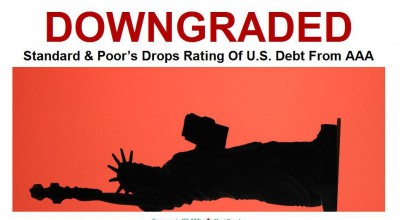
The Rest of the World is Enjoying the US Downgrade

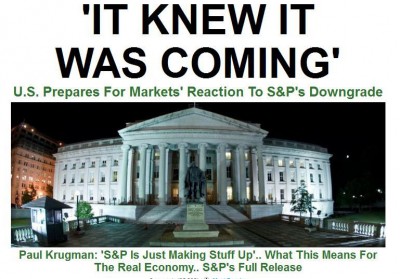
Whatever the merits of the downgrade, I think there’s some schadenfreude out there, more than may be visible to people in the US. I happen to be abroad this week, and I was struck by how differently web pages are playing the story in and out of the US. Here’s a particularly striking example from the front page of the (US-owned!) Huffington Post’s regional editions:

Canadian Version:

UK Version:

Compare these to the patriotic, we-knew-it-was-coming US version:

FWIW, on the economic fundamentals, I don’t see much justification for the downgrade given the Full Faith and Credit Clause.

Standard & Poors is in any case in a funny position, given its lousy track record, the various politically-motivated threats they have been issuing all week, the company’s strategic need to discourage the US from regulating it in light of the ratings’ agencies failures to foresee in the mortgage-back security crisis, and the possibility of something even more nefarious, and the large number of other countries with AAA ratings. On the other hand, if we were grading countries for the intelligence of their political class.

Posted in Econ & Money, Politics: International | Comments Off on The Rest of the World is Enjoying the US Downgrade