
Honest Government Ad: A Message from the White House (Warning: Contains constant swearing)
Brought to you by The Juice Media.
Honest Government Ad: A Message from the White House (Warning: Contains constant swearing)
Brought to you by The Juice Media.
State Attorney, 11th Circuit: Melba Peterson (line 24)
State Rep District 114 (Dem Primary): Jean-Pierre “JP” Bado (line 60)
Circuit Judge, Group 55: Olanike “Nike” Adebayo (line 310)
Circuit Judge, Group 57: No recommendation
Circuit Judge, Group 65: Thomas J. Rebull (line 315) [but see * & **]
Circuit Judge, Group 67: Mavel Ruiz (line 317)
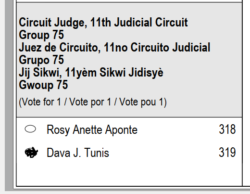
Circuit Judge, Group 75: Dava J. Tunis (line 319)
County Judge, Group 9: Joseph J. Mansfield (line 320)
County Judge, Group 24: Christine Bandin (line 322)
County Commission, District 7: Cindy Lerner (line 343)
Miami-Dade County Mayor: Daniella Levine Cava (line 362)
Property Appraiser: Marisol Zenteno (line 367)
All contests are open to all voters except the State Rep primary.
See the reasons for these recommendations in my Miami-Dade Primary Day Ballot Recommendations 2020, Part I and Miami-Dade Primary Day Ballot Recommendations 2020, Part II (Judges).
(This will remained pinned to the front of the blog until Aug 19th.)
From the Lincoln Project of course.
This is actually very painful to watch. Will it swing any votes? I’m dubious.
This is Part II of my 2020 Primary Election Recommendations. Don’t miss Part I (the non-judicial elections).
 Unlike most law professors I know, I support the idea of judicial elections at the state level as a reasonable democratic check on what I believe should be the expansive power of judges to interpret the state and federal constitutions.
As I’ve often said before, if it were up to me, I’d have the executive branch pick judges with legislative confirmation, followed by a California-style retention election every few years in which there would be an up or down vote on the incumbent. If the vote was down, the executive would pick a new judge. It seems to me that the right question is “has this judge done a good (enough) job” — something voters might be able to figure out — rather than asking voters to try to guess from electoral statements which of two or more candidates might be the best judge.
Florida’s system uses appointment plus retention elections for Supreme Court Justices and District Court of Appeal Judges, but not for trial courts. The Governor can appoint judges to fill vacancies between elections, but otherwise those jobs are straight up elected, so this election pits one or more challengers against the incumbent unless, lacking opposition, the incumbent wins reelection automatically; many trial judges were indeed unopposed this year. There are also open seats when the incumbent retires.
My recommendations are based on:
This will be a long blog post because there are five Circuit Court elections and two County Court elections in Miami-Dade this year. Both are trial courts, but the County Courts have a more limited jurisdiction, comprising Misdemeanors, small claims up to $5,000, civil disputes up to $15,000, and traffic court. Circuit Courts have broader jurisdiction. They also hear some appeals from County Courts, while other appeals go straight to the DCA’s, the District Courts of Appeal.
All registered voters in Miami-Dade County get to vote on these judges, regardless of party affiliation. Here are my suggestions how to vote in the August 18, 2020 judicial elections:
Are You Better OFF? By Meidas Touch
And, just out — this too:
Miami is hardened for wind. Most tropical storms just beat up vegetation and some power lines. You don’t want to be out walking or driving in it, and it makes some noise, but in most cases things are mostly OK the next morning. It’s when it gets to hurricane-force winds that I start to worry.
And hurricane force winds are a possibility here, although not it seems a strong possibility.
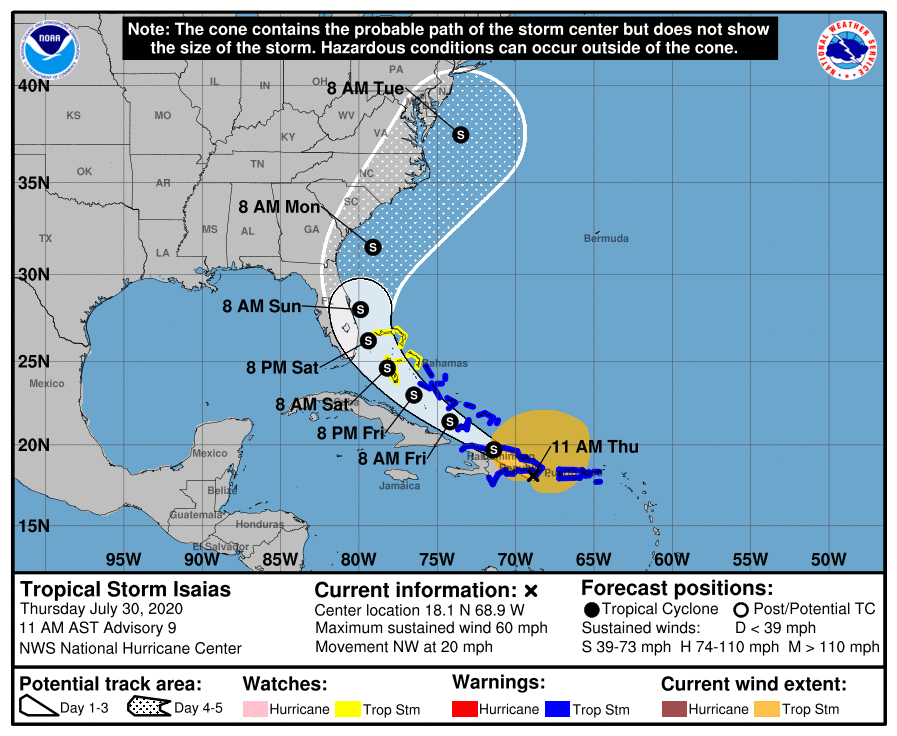 National Weather Service says:
By late Friday, a mid-latitude trough moving into the east-central United States is expected to weaken the western portion of the ridge. This pattern should cause the cyclone to turn northwestward to north-northwestward on Saturday when it is near the northwestern Bahamas and South Florida. As the trough slides eastward over the United States, this should steer Isaias northward and northeastward early next week. Although the bulk of the track guidance agrees on this overall scenario, the confidence in the track forecast remains lower than usual due to the expected land interaction and possible center reformation in the short term. The new NHC track forecast is a blend of the HFIP corrected consensus and the TCVA multi-model consensus, and is similar to the previous advisory.
The intensity forecast remains challenging. The structure of the storm is likely to be disrupted by its passage near or over Hispaniola today, and some weakening is likely. Once the system moves away from the Greater Antilles gradual strengthening is anticipated. The global models and the SHIPS guidance suggest that Isaias will encounter an area of moderate southwesterly shear over the weekend, and the NHC intensity forecast is again leveled off at that time. There are models that continue to suggest Isaias could become a hurricane when it is near the U.S., but given the continued uncertainty, the NHC intensity forecast remains near the intensity consensus.
Also, the track has moved East some in the past day or two; that could continue too….
Of course, there’s a lot of food in the freezer right now, so it would be a lousy time to lose power.
 Recent Bluessky Posts
 Jotwell Blenderlaw