The WSJ reports that Thomas M. Cooley Law School is suing a law firm, and also suing four pseudonymous Internet posters some or all of whom might be former students. This is the first such case I’ve ever heard of.
Cooley has issued a statement, and links to (1) the complaint against the law firm of Kurzon Strauss LLP and two lawyers in that firm, and also (2) the complaint against four John Doe Internet writers styling themselves “Rockstar05,” “Informant,” “Anonymous,” and “Ch Bruns.”.
Cooley claims in its statement that the law firm defamed it “by falsely claiming on Internet websites, social media, and email that Cooley, a nonprofit 501(c)(3) Michigan educational corporation, has defrauded students by misrepresenting its graduate employment placement rates, average starting salary figures, and student loan default rates.” These statements were, Cooley says, part of an attempt to recruit members of a planned class-action lawsuit against it. (There is already a pending class-action claim of this type against Thomas Jefferson Law School.)
The complaints against the four Internet posters aim at the author of the blog at http://thomas-cooley-law-school-scam.weebly.com/, two commentators on that blog, and one commentator on a post at the Huffington Post.
The first issue, however, will be whether Cooley can get subpoenas and expose the identities of the posters. The leading case on this subject is Dendrite Int’l, Inc. v John Doe, No. 3, et al., 342 N.J. Super. 134, 141–42 (App. Div. 2001):
The trial court must consider and decide those applications by striking a balance between the well-established First Amendment right to speak anonymously, and the right of the plaintiff to protect its proprietary interests and reputation through the assertion of recognizable claims based on the actionable conduct of the anonymous, fictitiously-named defendants.
. . . when such an application is made, the trial court should first require the plaintiff to undertake efforts to notify the anonymous posters that they are the subject of a subpoena or application for an order of disclosure, and withhold action to afford the fictitiously-named defendants a reasonable opportunity to file and serve opposition to the application . . .
The court shall also require the plaintiff to identify and set forth the exact statements purportedly made by each anonymous poster that plaintiff alleges constitutes actionable speech.
The complaint and all information provided to the court should be carefully reviewed to determine whether plaintiff has set forth a prima facie cause of action against the fictitiously-named anonymous defendants . . .
Finally, assuming the court concludes that the plaintiff has presented a prima facie cause of action, the court must balance the defendant’s First Amendment right of anonymous free speech against the strength of the prima facie case presented and the necessity for the disclosure of the anonymous defendant’s identity to allow the plaintiff to properly proceed.
It may be, however, that NY uses a standard that is less protective of anonymous internet speech than Dendrite.

 I indulged my inner geek last night and made some fairly extensive changes under the hood to the blog. If I did it right — always a dubious proposition — then no changes should be visible to the reader whatsoever, except perhaps that the blog will load a bit quicker.
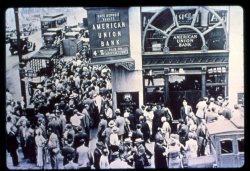 If the US hits the debt ceiling, will there be a run on the banks?
