
Author Archives: Michael Froomkin

Justice Stevens to Speak at U Miami L Rev Syposium

Criminalized Justice: Consequences of Punitive Policy” will be held Feb 6-7 in the Student Activities Center: 1330 Miller Drive, University of Miami, Coral Gables.

The Symposium, entitled “Criminalized Justice: Consequences of Punitive Policy,” will take a critical look at how our nation’s laws have been increasingly criminalized over the past 30 years, the negative consequences of this criminalization, and recent positive developments. We will explore this topic through a variety of subjects, including sentencing policy, immigration, homelessness, and race and social class.

Keynote Speakers

The Honorable John Paul Stevens, Justice of the Supreme Court of the United States (Ret.)
Introduced by Donna Shalala, President, University of Miami

Katherine Fernandez Rundle, Miami-Dade State Attorney

Topics

 Panel I: The Criminalization of Race and Poverty

This panel will examine how and why an individual is more likely to be targeted by police because of their race, social class, or where they live.  We will discuss the cycle of crime and incarceration that this creates as well as possible solutions to this problem.

Moderator: Charlton Copeland, Professor of Law, University of Miami School of Law

Speakers:
Jeffrey Fagan, Isidor and Seville Sulzbacher Professor of Law, Columbia Law School
Jonathan Simon, Adrian A. Kragen Professor of Law, University of California, Berkeley School of Law
Tristia Bauman, National Law Center on Homelessness and Poverty

 Panel II: Sentencing Policy and Mass Incarceration

This panel will focus on the impact that the same trend of criminalization has had on incarceration. We hope to discuss the radicalization of punishment and the problems that has created in our country’s prison systems as well as the recent movement away from heavy sentencing.

Moderator: Rebekah J. Poston, Partner, Squire Patton Boggs

Speakers:
Franklin Zimring, William G. Simon Professor of Law, University of California, Berkeley School of Law
Douglas Berman, Robert J. Watkins/Proctor & Gamble Professor of Law, The Ohio State University Moritz College of Law
Nicole Porter, The Sentencing Project

Panel III: The Criminalization of Immigration Law

Since the Supreme Court’s landmark opinion in INS v. Lopez-Mendoza in 1984 categorizing immigration proceedings as civil in nature, the immigration laws and the ways in which they are enforced have become increasingly criminal. This panel will examine the issues that this criminalization has created and what procedural and substantive protections should be in place as a result.

Moderator: David Abraham, Professor of Law, University of Miami School of Law

Speakers:
 Daniel Kanstroom,  Professor of Law, Boston College Law School
Paromita Shah, National Immigration Project of the National Lawyers Guild
Allegra McLeod, Associate Professor of Law, Georgetown Law

Panel IV: Roundtable Discussion

 Moderator: Mary Anne Franks, Associate Professor of Law, University of Miami School of Law
Posted in Law: Criminal Law, U.Miami | Comments Off on Justice Stevens to Speak at U Miami L Rev Syposium

AALS Android App Wants Ridiculous Number of Permsissons

How many permissions does a meeting app need?

The American Association of Law Schools has an Android app to help guide the perplexed through the giant list of events that is its 2015 annual meeting.

The app seems to want a ridiculous number of permissions and I decided not to install it:

Version 1.0.0 can access:

  • Device & app history
    • retrieve running apps
  • Identity
    • find accounts on the device
    • add or remove accounts
  • Calendar
    • add or modify calendar events and send email to guests without owners’ knowledge
    • read calendar events plus confidential information
  • Contacts
    • read your contacts
    • modify your contacts
  • Location
    • precise location (GPS and network-based)
    • approximate location (network-based)
  • Phone
    • directly call phone numbers
  • Photos/Media/Files
    • modify or delete the contents of your USB storage
    • test access to protected storage
  • Camera
    • take pictures and videos
  • Device ID & call information
    • read phone status and identity
  • Other
    • receive data from Internet
    • pair with Bluetooth devices
    • access Bluetooth settings
    • full network access
    • view network connections
    • control vibration
    • prevent device from sleeping
    • run at startup
    • use accounts on the device
    • send sticky broadcast
    • delete all app cache data

Not to mention that “Updates to AALS2015 may automatically add additional capabilities within each group.”

I’m disappointed that the AALS hasn’t offered an app that is more sensitive to the privacy interests of attendees. What possible functionality does it offer that needs all this?

There is also an iPhone version – no idea if it’s better behaved.

Posted in Talks & Conferences | 3 Comments

See You at the AALS?

I’ll be chairing a panel on “Automated Decision-Making” at the AALS’s Jan 2015 conference. It’s co-sponsored by the Section on Internet and Computer Law and the Section on Defamation and Privacy.

Please come by and say hello, or send an email and maybe we can meet up some other time. One of the good things about the AALS is a chance to see old friends and it’s been a while since I went to one.

The panel, Saturday at 10:30am, should be well worth your time:

Proliferating sensors, affordable data storage, indiscriminate personal data collection, and increasingly robust predictive algorithms individually raise issues related to privacy, security, and due process. Combined, however, these technological advances have created a nearly insatiable appetite for data in order to improve organizational decision-making. The domains across which this voracity reaches include consumer lending, insurance, advertising, legal compliance, national security, and employment.

Automated decision-making promises accuracy and efficiency, but it is also rife with peril. Humans irrationally trust decisions made by computers, even though bias is easily hard-wired into computer systems. The use of personal data to make extremely nuanced and particularized decisions raises a number of privacy concerns. Incorrect inputs risk correspondingly erroneous outputs. Automated decision-making could also have a disparate impact on vulnerable populations that are susceptible to certain kinds of influence or that find it hard to fight back. Compounding this problem is the almost complete lack of meaningful transparency for those subjected to automated decisions.

Policy makers are struggling to respond to the challenges posed by automated decision-making. This panel will explore those challenges and will attempt to identify similarities and differences among the varied domains in which automated decision-making operates.

Moderator:

A. Michael Froomkin, University of Miami School of Law

Panelists:

  • Meg Leta Ambrose, Georgetown University School of Communication, Culture & Technology
  • Frank Pasquale, University of Maryland Francis King Carey School of Law
  • Dennis D. Hirsch, Capital University Law School
  • Michael Rich, Elon University School of Law

DATE: Saturday, 1/3/2015

TIME: 10:30 am-12:15 pm

ROOM: Thurgood Marshall West, Mezzanine Level, Marriott Wardman Park Hotel

Posted in Talks & Conferences | Comments Off on See You at the AALS?

My Congressperson Calls Americans “Pigs”

Ileana Ros-Lehtinen thinks we are Yankee imperialist pigs?

This is what my my Representative said after we normalized relations with Cuba:

“We are saying to the Yankee imperialist pigs, come and own a piece of Cuba, we are for sale, and those who have money, come on over because it’s a fire sale.”

Posted in Politics: FL-25/FL-27 | 1 Comment

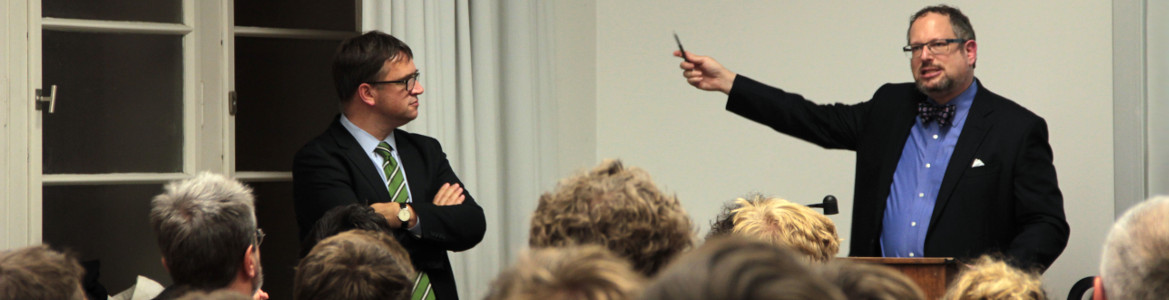
Heidelberg Talk Video Posted

Gesticulating

From Anonymity to Identification: Online Communication in a Time of Surveillance | Prof. Michael Froomkin (Audio: MP3) (Video: MP4 / OGV)

I can’t thank my hosts in Heidelberg enough for the warmth of their welcome and their kindness while we visited.

Posted in Talks & Conferences | Comments Off on Heidelberg Talk Video Posted

Cuba

The US approach to Cuba stopped making sense decades ago. Opening exchanges with Poland helped dislodge the Communist regime; the same is likely to happen to Cuba in the future. Maintaining the embargo with Cuba has done more to empower the dictatorial Castro regime than anything else we could do. So I’m all for the resumption of diplomatic relations because it furthers US interests, human rights, and the humanitarian cause of reuniting separated families. It likely will further the cause of freedom in Cuba.

But there’s another reason why this is good: the revanchist faction among Cuban-Americans is overwhelmingly Republican. It’s good politics for a President to reward his friends and ignore — or punish — his enemies. So this is good politics for Obama: serve the US national interest and hit his enemies at the same time.

I hope it’s a sign of what we can hope for in the next two years from Obama: No more Mr. Nice Guy.

Posted in Politics: International, Politics: US | Comments Off on Cuba