Category Archives: Law: Reading the Constitution

MiamiLaw Constitutional Crisis Seminar

I am proud to announce the University of Miami Constitutional Crisis Seminar Series. The series includes thirteen lectures, almost all of which will be available on line, with new ones appearing weekly. Select University of Miami Law School students will also have a private seminar-style discussion with the speakers, but these will not be published.  I have organized this program because I think the issues are urgent and important.

The United States currently faces widespread and intense challenges to our constitutional system, particularly what remained of our checks and balances: While courts and scholars have wrestled with the expansion of executive powers and worried about Congressional delegation of its legislative powers, the current administration – with the assistance of both Congress and the Supreme Court — has taken these challenges to new levels.

Today we see unprecedented assertions of executive power, including powers to ignore statutes, impound funds, cancel signed contracts, shutter executive departments, fire independent officials, and make highly creative invocations of emergency authority. Behind many of these are Constitutional claims for the power of the “unitary executive” and (although much remains to be seen) an alleged executive authority to ignore federal judicial orders. Complicating matters is Congressional silence, if not paralysis, in the face of executive power grabs, and an historic dependence on often unwritten constitutional and statutory norms that have been cast aside.

As lawyers and potential lawyers, we face particular responsibilities to understand the nature of what is fairly termed a constitutional crisis, and to think about whether and how to respond to it.

This seminar series will look at the legal system’s ongoing reaction to this massive reordering of federal power and individual constitutional rights, with a focus on the legal system’s reaction to current controversies. In addition to placing current events in historical context, we will look at the theoretical and structural constitutional causes of the crisis and what we might to do prevent a repetition or undo its most malign effects. We will examine how the legal system, primarily the courts but also other institutions such as the bar, have reacted to these new challenges, and what law and legal theory has to offer as to their causes and perhaps cures.

We are fortunate to have a stellar group of legal scholars, legal practitioners, and public intellectuals who have each agreed to speak on an aspect of the evolving situation.

With one exception, all of the lectures in the Constitutional Crisis Seminar series will be published online, on a weekly basis.

1

Intro: What is a Constitutional Crisis?
Speaker: Kim Lane Scheppele

2

The Unitary Executive & Its Critics
Speaker: Peter Shane

3

Constitutional Hardball
Speaker: Mark Tushnet

4

Tariffs
Speaker: Ilya Somin

5

Assertions of Emergency Power
Speaker: Harold Hongju Koh

6

Immigration Control / Rendition
Speaker: Cody Wofsy
At the speaker’s request, this lecture will not be published online

7

Removals of Officers & Inferior Officers, Bureaucratic Control (Schedules F & G), Vacancies Act
Speaker: Thomas Berry 

8

Impoundments & Other Fiscal Control Strategies
Speaker:  Zachary Price 

9

Attacks on Civil Society (Law Firms, Universities, NGOs)
Speaker:  Genevieve Lakier

10

Role of Courts / Attacks on Courts
Speaker: Stephen Vladeck 

11

Reserved for late-breaking developments

12

Formal Correctives Including Constitutional Reform
Speaker: Sanford Levinson 

13

Life During a Constitutional Crisis
Speaker: Bernard Harcourt  
Posted in Law: Reading the Constitution, Trump, U.Miami | Comments Off on MiamiLaw Constitutional Crisis Seminar

Attention Law Review Editors

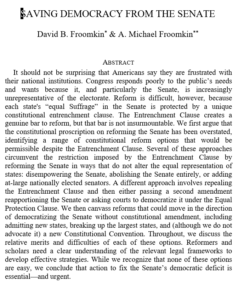
The odds that any actual law review editors read this blog is vanishingly small, but if you, gentle reader, happen to know one, please tell them about this terrific article, Saving Democracy from the Senate, co-authored with one David Froomnkin, that they might want to publish in their journal.

This article is the first to take stock, in a systematic and comprehensive way, of the constitutional and statutory avenues available for reforming the malapportionment of the U.S. Senate. Collecting together the various options available enables reformers to think both programmatically about the normative choices at stake and strategically about a reform agenda. This in itself is a substantial contribution, not just to constitutional theory but also to ongoing practical efforts to reform the legal architecture of U.S. democracy. Moreover, by systematizing these considerations, the article also helps to make clear the relationship between statutory and constitutional reforms of the Senate, proposing a two-track strategy for reformers.

While the work of synthesizing the options and providing a comparative analysis is the most significant contribution, the article also provides several significant and novel analytical contributions that advance legal debates in these areas:

(1) The meaning of the Article V Entrenchment Clause. The article’s claims that (a) disempowering the Senate and (b) abolishing the Senate would not violate the Entrenchment Clause are claims that have been made before, although rarely. But they are not claims that have ever, to our knowledge, received extensive analysis. The article provides this extensive analysis, explaining why a range of ambitious constitutional reforms of the Senate would not violate the Entrenchment Clause and responding to objections.

(2) The referent of the Article V Entrenchment Clause. We are not the first to suggest that the Constitution could be amended to remove the Entrenchment Clause and then subsequently amended to alter the composition of the Senate. But we provide a crisper analysis of the reason than scholars have done previously. The reason is that the referent of the Entrenchment Clause is not a provision in Article V but a provision in Article I. The Entrenchment Clause, by its language, is not a self-entrenching clause.

(3) Article V and Equal Protection. The article provides a novel argument about the relationship between the Entrenchment Clause and the application of equal protection principles to the Senate. Orts in 2019 made a related argument, but his suggestion that Congress could reapportion the Senate by statute takes an idiosyncratic view of the Entrenchment Clause. We advance the more restrained argument that, while the Entrenchment Clause at present bars the application of equal protection principles to the Senate, amendment of the Constitution to remove the Entrenchment Clause would enable reapportionment of the Senate under Reynolds v. Sims.

(4) At-large Senators. Building on our argument about what the Entrenchment Clause prohibits—and what it does not—we explore the addition of a substantial number of nationally elected Senators to make the Senate more representative of the Nation. Whether or not we kept the existing Senators, no state’s “equal Suffrage” would be altered.

(5) Statehood. The article surveys the relevant legal authorities on the admission of new states, compiling an extensive range of relevant material. In the course of discussing the currently most salient cases of Puerto Rico and DC, the Article analyzes a Twenty-third Amendment issue that has not been extensively discussed.

(6) Breaking up (and merging) states. The article provides novel analysis of practical challenges confronting breakups (and, analogously, mergers) of states. It also suggests a promising policy response to these challenges, arguing that federal legislation to mitigate states’ costs and help to incentivize state breakups would be feasible, desirable, and constitutional. This prescription is, to our knowledge, original—perhaps in part because scholars have not yet grappled with the magnitude and stakes of the problem requiring a remedy.

Although we canvas a very wide variety of alternatives, and we weigh the difficulties, virtues, and vices of each, our recommendations center on certain constitutional reforms and the admission of a few new states.

All this, and yet even with the footnotes it’s still under 30,000 words!


Posted in Law: Constitutional Law, Law: Elections, Law: Reading the Constitution, Writings | 1 Comment

My Brother Imagines a Hypothetical World in Which Republicans Answer Hypothetical Questions

Dan has a whole bunch of sensible questions that reporters should be asking members of Congress from both parties about what they believe constitutes an impeachable offense. I agree they should be asking them.

So rather than asking Republican members of Congress about impeaching Trump, we should be getting them to say what they themselves consider impeachable offenses – arguably locking them in, when and if Mueller can prove they were committed.

These are straightforward yes-or-no questions:

  • If a president is found to have solicited or knowingly accepted help from a foreign government to influence an American election, isn’t that an impeachable offense?
  • If a president fires a special prosecutor investigating him, isn’t that an impeachable offense?
  • If a president directly orders the Justice Department to prosecute his political rivals, isn’t that an impeachable offense?
  • If a president pardons himself, isn’t that an impeachable offense? 1
  • If a president promises pardons to potential witnesses against him, isn’t that an impeachable offense?

And, bonus essay question:

  • What level of presidential lying to you consider an impeachable offense?

But I think I know what most of the answers will be: “I don’t want to get into hypothetical questions.”

Even so, reporters should be asking them. Maybe the follow-up should be: “Wait, you mean you think there’s actually a sufficient probability of this that you consider the question hypothetical?”


Bonus xkcd on hypotheticals:

  1. Note by MF: For the record, I think there are two good arguments that if a President pardons himself the pardon is invalid. First there is the idea that ‘no man should be the judge in his own cause.’ Second there’s the idea that a pardon is a thing one person confers on another, so a self-pardon just is incoherent.[]
Posted in Dan Froomkin, Law: Reading the Constitution, Trump | 5 Comments

Trump Likely To Be Deposed

No, not like that, at least not yet.

Rather, odds are that Trump will have to answer questions in a deposition:

A New York State judge ruled on Tuesday that a defamation lawsuit brought by a woman who has said President Trump made unwanted sexual advances could go forward, raising the possibility of a public airing of other allegations of sexual misconduct against the president.

The decision by Justice Jennifer Schecter of State Supreme Court in Manhattan paved the way for lawyers to seek depositions from several women who accused Mr. Trump of sexual harassment before he was elected and to subpoena Trump campaign records related to his female accusers.

Justice Schecter rejected Mr. Trump’s argument that a state court has no jurisdiction over a sitting president. She cited a United States Supreme Court ruling that allowed Paula Jones to bring a sexual harassment suit against President Bill Clinton.

Actually, the issue of whether the Paula Jones precedent should apply with full force in state court is not frivolous at all. I can imagine reasons why a court might hold that there is too much risk of interference with the President’s, ahem, affairs to allow just any court to make demands on his time. Then again, I can think of even more arguments why the state courts should be allowed to proceed — if only that surely a sitting President could get an injunction from a federal court if the state court were to misbehave in some way.

Posted in Law: Civil Procedure, Law: Reading the Constitution, The Scandals | Comments Off on Trump Likely To Be Deposed

Is Obama Too Young to Be President?

Steven Calebresi has a pretty persuasive argument that if you interpret the Constitution dynamically, Obama is Too young for the No. 1 job.

Good thing Calabresi doesn't have standing to raise it in court!

Continue reading

Posted in Law: Reading the Constitution | 7 Comments

Guns and Senatorial Privilege

The news that one of Senator Webb's aides has been arrested for (inadvertently?) carrying the Senator's gun into a Senate office building raises a fun question. It seems Sen. Webb gave the aide the gun which the Senator usually carries because the Senator was getting on a plane and couldn't take it on board.

It made me wonder if gun control laws of this sort, when applied to Senators and representatives in any way infringe Art. I, sec. 6, paragraph 1 of the Constitution which states,

The Senators and Representatives shall receive a compensation for their services, to be ascertained by law, and paid out of the treasury of the United States. They shall in all cases, except treason, felony and breach of the peace, be privileged from arrest during their attendance at the session of their respective Houses, and in going to and returning from the same; and for any speech or debate in either House, they shall not be questioned in any other place.

My suspicion that the answer is “no” and that it is proper to apply speed limits, DUI, and other rules of general public safety to Senators and Representatives appears after superficial research to be correct, but not quite for the reason I imagined, at least according to LII's annotated Constitution,

Privilege From Arrest

This clause is practically obsolete. It applies only to arrests in civil suits, which were still common in this country at the time the Constitution was adopted. 376 It does not apply to service of process in either civil 377 or criminal cases. 378 Nor does it apply to arrest in any criminal case. The phrase ''treason, felony or breach of the peace'' is interpreted to withdraw all criminal offenses from the operation of the privilege. 379.

Posted in Law: Reading the Constitution | Comments Off on Guns and Senatorial Privilege