
Category Archives: Law: Criminal Law

Wisconsin Court of Appeals Cites My ‘Death of Privacy?’ Paper

In State v. WALLI, 2011 WL 1775995 (Wis.App., May 11, 2011), the Wisconsin Court of Appeals, 2nd District, cites to my The Death of Privacy? article.

The case was a fairly routine-looking DUI, but the Court of Appeal decided to use it as a vehicle to settle a more general question of law:

Because the first step in this analysis requires us to review the trial court’s findings of historical facts and, in this case, those findings are based in part on a video recording of the event, this court, sua sponte, issued an order converting this appeal from a one-judge appeal to a three-judge appeal and requested the attorney general to file a supplemental brief on the appropriate standard of review. With the near ubiquitousness of squad car video cameras, surveillance cameras and traffic cameras, appellate courts will be deciding more and more cases where some of the evidence is preserved on recordings.

(footnotes omitted). Death of Privacy? got cited for the ubiquitousness point, which is fair enough, although not exactly central to the main issue the court was concerned about.

The standard of review for decisions based on recorded evidence is debatable because a reviewing court ought to be as able to review recordings as is the trial court; the same cannot be (or at least, is not) said about testimonial evidence, since the trial court sees the live witness while the reviewing court sees only the ‘cold’ written record. Traditionally Anglo-American legal systems tend to give a great deal of weight to the seeing of live witnesses by triers of fact, whether or not this in fact enhances accuracy; civil law systems, I gather, do not have the same fetish.

States differ on the appropriate standard of review in such cases, but the Wisconsin Court decided that “clearly erroneous” was indeed the test it would apply when a trial court makes an evidential determination based on a combination of testimony and recorded evidence rather then the far less deferential “de novo” standard urged by the appellant. The perhaps more interesting issue of what standard of review would apply if all the evidence were recorded is not decided in this case, at least not explicitly.
Posted in Law: Criminal Law, Law: Privacy | 2 Comments

None Dare Call it Perjury

I admit crim pro is not my strong suit, but why isn’t the conduct described in Islamic Shura Council v. FBI (C.D. Cal. Apr. 27) simple perjury by a government official?

The Government’s in camera submission revealed that the Government initially misled the Court in two material respects. First, the Government’s representations regarding its use of “outside the scope” were inaccurate. The Government initially represented to the Court that the Government provided all information that “include[d] any reference to plaintiffs in any document in any file,” and any information withheld as “outside the scope” of Plaintiffs’ request was “non-responsive.” (Opp’n to Pl.’s Mot. Summ. J. at 3, 11.) Mr. Hardy’s second declaration stated that, in truth, documents “that would otherwise be considered to be responsive to plaintiffs’ request” were excluded from production or redacted as “outside the scope.” (Second Hardy Decl. ¶ 5.) Second, the Government’s representations regarding the number of responsive documents were false. The Government previously represented that it had identified only a limited number of documents responsive to Plaintiffs’ FOIA request. (First Hardy Decl. ¶¶ 19, 31–43, 45–46.) Mr. Hardy’s second declaration acknowledged that the Government had identified a large number of additional responsive documents, but that the Government did not disclose the existence of these other documents. (Second Hardy Decl. ¶ 13.)

The first declaration was, if I am reading it right, under oath. And there were lawyers involved in many stages of this too.

(Case spotted via Volokh. Neither he nor the judge call it perjury.)

Posted in Law: Criminal Law | 2 Comments

State Cops Have a Device that Secretly Searches Cellphones

Wait a minute.

The American Civil Liberties Union of Michigan urged the Michigan State Police MSP today to release information regarding the use of portable devices which can be used to secretly extract personal information from cell phones during routine stops. For nearly three years, the ACLU has repeatedly asked for this information through dozens of Freedom of Information Act requests, but to date it has not been provided.

ACLU Seeks Records about State Police Searches of Cellphones via Pogo Was Right.

Michigan state cops — and thus presumably lots of other state and federal cops and TLAs — have a secret “portable devices that have the potential to quickly download data from cell phones without the owner of the cellphone knowing”? And they’ve had it for three years?

This has to be tinfoil stuff, right? Right?

Uh-Oh..

According to CelleBrite, the manufacturer of at least some of the devices acquired by MSP, the product can extract a wide variety of data from cellphones including contacts, text messages, deleted text messages, call history, pictures, audio and video recordings, phone details including the phone number and complete memory file dumps on some handsets.

CelleBrite touts itself online as a “maker of mobile forensics and data transfer solutions”.

Cellebrite’s mobile forensics products enable extraction and analysis of invaluable evidentiary data including deleted and hidden data for military, law enforcement, governments, and intelligence agencies across the world.

Among the goodies in their product line is the Cellebrite UFED Forensic System:

The Cellebrite UFED Forensic System is the ultimate standalone mobile forensic device, ready for use out in the field or in the lab.

The UFED system extracts vital information from 95% of all cellular phones on the market today, including smartphones and PDA devices (Palm OS, Microsoft, Blackberry, Symbian, iPhone, and Google Android). Simple to use even in the field with no PC required, the UFED can easily store hundreds of phonebooks and content items onto an SD card or USB flash drive.

Cellebrite UFED supports all known cellular device interfaces, including serial, USB, infrared, and Bluetooth. Extractions can then be brought back to the forensic lab for review and verification using the reporting/analysis tool. Cellebrite works exclusively with most major carriers worldwide including Verizon Wireless, AT&T, Sprint/Nextel, T-Mobile, Rogers Wireless – Canada, Orange France and Telstra Australia, as well as 140 others. This ensures that future devices are supported prior to retail launch.

Yikes. Does this sort of search violate the 4th Amendment? It should, but presumably the courts will treat it much like an actual search of a phone incident to a stop. Courts, such as the California Supreme Court recently, have held that such searches are allowed incident to arrest — but it doesn’t follow that a such an intrusive search would be allowed incident to a stop since there’s no way to hide a weapon in a cellphone SIM card; also not all stops are equal.

Posted in Law: Criminal Law, Law: Privacy | 3 Comments

Our Brave Men in Law Enforcement

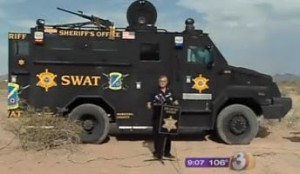
Sheriff uses tank to knock down part of house and arrest unarmed man…on suspicion of …wait for it…cockfighting.

Yes, it was crazy Sheriff Joe Arpaio of Pheonix, Arizona. The fact that they had a guy along riding in the tank and filming for a TV show had nothing to do with it.

But they did kill 115 chickens on the spot, so all that force might have been necessary: “We’re going to err on the side of caution.” a spokesman explained.

Video about the raid, and more about what I take to be the “tank” (pictured) — which looks more like an over-armored APC to my untrained eye — here.

You know, when Heller or Pynchon wrote stuff like this, I read it as surrealism, not clairvoyance.

(Spotted via Daily Kos.)

Posted in Law: Criminal Law | 1 Comment

The Wrong Guy to Raid

News of  Clark Freshman, a former UM Law colleague now teaching at UC Hastings, that appeared in the SF Weekly: Castro Pot Bust Goes Awry and a Law Professor Threatens to Sue.

If the news story is accurate, the police got a clearly invalid warrant, either through carelessness or worse (it described the house completely inaccurately).  And indeed, the raid was a bust — for the police.

The SFPD and DEA found no piles of marijuana money at 243 Diamond St., one of six addresses raided simultaneously in San Francisco that morning. Instead, they found Clark Freshman, who rents the penthouse at the two-unit building. Freshman, a UC Hastings law professor and the main consultant to the television show Lie to Me, was put into handcuffs while in his bathrobe as agents searched, despite Freshman’s insistence that they had the wrong place and were breaking the law.

He’s sort of angry:

“I told them to call the judge and get their warrant updated,” he says. “They just laughed at me — I guess that’s why they’re called pigs.”

No, he’s really angry:

[Freshman] pledged to sue until “I see [the agents’] houses sold at auction and their kids’ college tuitions taken away from them. There will not be a better litigated case this century.”

I’d be spitting mad too.  Not sure I’d say that about college tuitions, though.  They’re sacred.

(Thanks to Michael Marshall for the story.)

Posted in Law: Criminal Law | 4 Comments

Mandatory Gun Insurance?

The free-market approach to gun control over at Crooks and Liars seems pretty clever: A Modest Proposal: What If We Required Mandatory Gun Insurance?

Combine this with strict liability for misuse of a weapon — liability which resides with the manufacturer and/or distributor if they fail to make sure that the purchaser is insured, on the insurance company if they allow a policy to lapse without evidence that someone else has provided the insurance or the gun has been sold or destroyed, and on the purchaser if the next in chain of title is not insured, and pretty soon we might be getting somewhere.

Posted in Law: Constitutional Law, Law: Criminal Law | 36 Comments