Category Archives: Econ & Money

Gregory Koger Tries to Head Off the Death Star Construction Program

U Miami Political Science Professor Gregory Koger knows how to get way ahead of the curve, and has published a comprehensive treatment of what will someday be a major political issue — Should we build a Death Star?:

I wish to address the most important policy question of the millenium: should we build a Death Star?  This debate picked up this year after some Lehigh University students estimated that just the steel for a Death Star would cost $852 quadrillion, or 13,000 times the current GDP of the Earth. Kevin Drum suggests this cost estimate is too low but, in the context of a galactic economy, a Death Star is perfectly affordable and “totally worth it.” Seth Masket and Jamelle Bouie highlight the military downside of the Death Star, suggesting that more people might rebel against the wholesale genocide of the Empire, and that the Death Star would be the prime target of any rebellion. I have two thoughts to add. First, the Death Star is a bit misunderstood. It is primarily a tool of domestic politics rather than warfare, and should be compared to alternative means of suppressing the population of a galaxy. Second, as a weapon of war, it should be compared to alternative uses of scarce defense resources. Understood properly, the Death Star is not worth it.

And there’s lots more where that came from.

I look forward to subsequent articles about the costs, benefits, and ethical ramifications of building a time machine, a Stargate, and a transporter.
Posted in Econ & Money, National Security, Sufficiently Advanced Technology, U.Miami | 2 Comments

At Cardozo’s “Anonymity and Identity in the Information Age”

I’m in New York for Cardozo Law’s Anonymity and Identity in the Information Age, speaking on the war on online anonymity.

It’s a great program, and I’m on the first panel so then I get to relax and enjoy the event.

Travelling here yesterday I learned two things: First that putting your boarding pass on your electronic device instead of a phone is not a smart move. The person in front of me at the TSA line was not able to have his boarding pass on his iPad read by the TSA screener’s machine. And at the gate, the person in front of me in the boarding queue was not able to have her boarding pass on her smart phone read by the gate agent’s scanner.

Second thing I learned, from the French person sitting next to me on the plane, is that a lot of French people with money are investing in Belgium (!) as a form of tax evasion. Apparently, if you buy an asset there you don’t have to pay tax on the appreciation if you hold it 5-7 years. Thus, among other things, there’s a property boom going on with appreciations of as much as 5% per year. (Bubble, anyone?) It wasn’t clear to me if this was legal tax avoidance, or a classic French fiddle, but my interlocutor seemed to think there was an awful lot of it going on.

Incidentally, last night I saw Venus in Fur. Highly recommended. It has three Tony Award nominations. The play is clever — arch at points, but fun and brainy at the same time — and I think that Nina Arianda in particular has to be a very strong contender for her spectacular performance.

Posted in Econ & Money, Sufficiently Advanced Technology, Talks & Conferences | Comments Off on At Cardozo’s “Anonymity and Identity in the Information Age”

We Like Facts (Tax Rates)

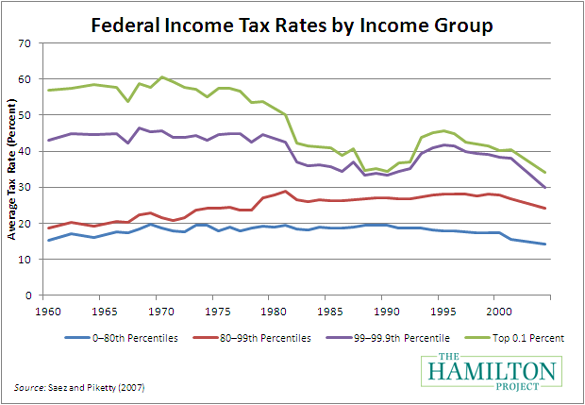
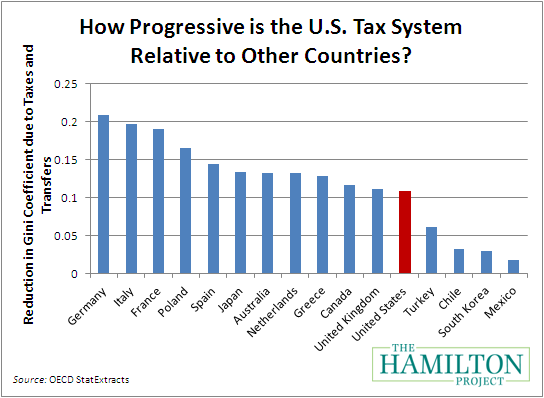
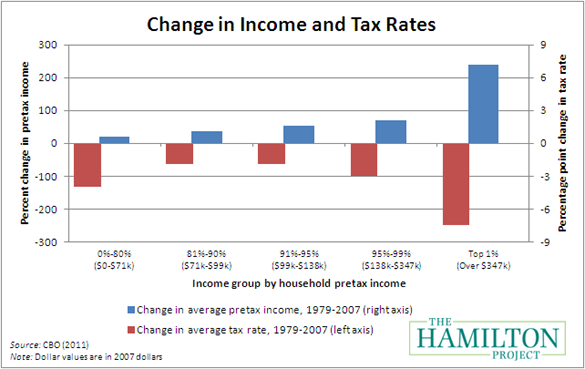
Three charts lifted from Just How Progressive is the U.S. Tax Code?:

via Tax Prof Blog

Posted in Econ & Money | 1 Comment

Income Inequality 101

John Cassidy in The New Yorker, Inequality 101: The Picket Fence and the Staircase.

Nothing you shouldn’t already know, but it is very concise and clear and it can’t be said too often: US inequality is at a historically high level, and higher than in most of our allies. Plus social mobility is relatively low both temporally and compared to other democracies.

Note, though, that the article is primarily about income inequality. There is also the issue of wealth inequality, which is the cumulative effect of this trend. Maybe that’s the 102 course.

Posted in Econ & Money | 11 Comments

Japan Worrying About Energy Death Spiral?

Steve Clemons has an interesting blog post about Japanese energy fears: Japan Heading for Energy Death Spiral?.

I mention this not to endorse the somewhat pro-nuclear drift of the item, because I’m not at all sold on that, not one little bit. But I think it’s an interesting look at what at least one segment of the Japanese political class is worrying about: that “a total rejection of nuclear energy will send Japan over a cliff as deindustrialization is triggered by energy shocks.”

And you get the idea they are really worried. It begins:

Nobuo Tanaka’s hair is on fire. The immediate past executive director of the International Energy Agency is on a mission attempting to alert officials in the United States, Japan, Europe, China and elsewhere that post-Fukushima Japan may be approaching an energy death spiral.

And it’s not just the Japanese worrying:

Tanaka told me that one high-ranking Chinese official recently approached him asking if and when Japan would turn its nuclear reactors back on — as Japan’s massive energy needs now were disrupting supply patterns and costs and could affect China’s energy investment picture if Japan’s needs were to become structurally permanent.

[Updated to add a link to “not one little bit”.]

Posted in Econ & Money | Comments Off on Japan Worrying About Energy Death Spiral?

The Great Gold Bar Hoax (Hoax?) [Updated]

This story is going viral fast: SilverDoctors: Tungsten Filled 1 kilo Gold Bar Discovered in UK.

Australian Bullion Dealer ABC Bullion has contacted SD to advise that one of its suppliers has provided them photographic evidence of a tungsten filled 1 kilo gold bar discovered this week. The bar passed a hand-held xrf scan which showed 99.98% pure AU. The tungsten was only discovered when the bar was physically cut in half.

After numerous reports of 400oz tungsten filled bars being discovered in Hong Kong, this is the first documented and verified report with photographic evidence that has been made public.

Attached are photographs of a legitimate Metalor 1000gm Au bar that has been drilled out and filled with Tungsten (W).

This bar was purchased by staff of a scrap dealer in xxxxx, UK yesterday. The bar appeared to be perfect other than the fact that it was 2gms underweight. It was checked by hand-held xrf and showed 99.98% Au. Being Tungsten, it would not be ferro-magnetic. The bar was supplied with the original certificate.

The owner of the business that purchased the bar only became suspicious when he realized the weight discrepancy and had the bar cropped. He estimates between 30-40% of the weight of the bar to be Tungsten.

I’ve already seen links to it on blogs I read, and I bet there will be lots more.

It has all the earmarks of the perfect Internet fact(oid): slightly technical information, hard to verify, significant implications if true (how many countries may discover they have much less gold than they thought?), and nothing about it in the mainstream media (yet). Not to mention having the possibility to move markets — although whether in the short term gold prices go up on the theory that supplies are lower than believed, or down due to fear of a Gresham’s Law effect where we don’t know which bars are actually pure gold, is not clear to me.

If it’s true, it’s the Great Gold Bar Hoax. And if it’s not true, or not widespread, it’s the Great Gold Bar Hoax Hoax.

[Updated to reinsert text that inexplicably did not get into original.]

Posted in Econ & Money | Comments Off on The Great Gold Bar Hoax (Hoax?) [Updated]