Author Archives: Michael Froomkin

Almost as Good as ‘No Vehicles in the Park’

‘No Vehicles in the Park’ is the basis of one of the great teaching texts for jurisprudence. HLA Hart famously asked,

A legal rule forbids you to take a vehicle into the public park. Plainly this forbids an automobile, but what about bicycles, roller skates, toy automobiles? What about airplanes? Are these, as we say, to be called “vehicles” for the purpose of the rule or not?’

Believe me, any law professor can fill two hours running hypotheticals off this. There us even the occasional real-life case.

Comes now, however, the Nevada Highway Patrol, in the person of Nevada Highway Patrol Trooper Travis Smaka, who pulled over a vehicle in an HOV lane (not a park) that appeared to have only one occupant — only to be told by the driver that there was in fact another “occupant” in the vehicle: the corpse he was transporting. Trooper Smaka was unpersuaded, but he let the driver off with a warning. (See Police: No, a corpse doesn’t count toward the HOV lane passenger minimum for details.)

So, if the HOV rule is “minimum two occupants in the vehicle,” should a corpse count? Or, as my wife says, how about a pregnant woman in Alabama? If a fetus is a ‘person’ for manslaughter purposes, it is a person for HOV occupancy purposes? Or what about a telepresence robot being operated by some third party? Could that count?

Update: ‘Pearls Before Swine’ weighs in.

Posted in Legal Philosophy | Comments Off on Almost as Good as ‘No Vehicles in the Park’

Useful Advice

Tips For Staying Civil While Debating Child Prisons.

A sample: “Avoid unkind generalizations like equating the jailing of ethnic minorities with some malevolent form of fascism.” And “Make sure any protests are peaceful, silent, and completely out of sight of anyone who could actually affect government policy.”

Previously: Yes, We Have Reached a New Low

Posted in Immigration, Onion/Not-Onion | Comments Off on Useful Advice

Thirty Years!

That, apparently, is how long we’ve been married as of today.  Caroline and I are going somewhere nice to celebrate.

Posted in Personal | 1 Comment

Yes, We Have Reached a New Low

…and I suspect we’ll go lower.

A lawyer from the US Department of Justice argued (with by all accounts a straight face and no embarrassment) to a federal court of appeals that the US has no obligation to give soap or toothbrushes to children being detained — in cages — in a federal facility while their asylum claims are pending.

Meanwhile the online crowds are debating what to call these places where kids sleep on concrete floors under foil blankets, and will no longer get English lessons or even playground access.

Is it wrong to call them “concentration camps”? That’s what the British authorities called the camps in which they imprisoned Afrikaners; the US called the WWII-era camps in which they put US citizens of Japanese origin “internment camps” but I’ve head people call them concentration camps. The terminology gets muddied when one brings in the Nazis. Historians distinguish between the Nazis’ “concentration camps” and the Nazis’ “death camps”, but I suspect a large part of the non-Jewish public today mostly doesn’t.

Personally, although I have no problem with the term “concentration camp” since it’s historically accurate, I think the best word is “atrocity”.

PS. Just to head off one common and inaccurate rejoinder, a recent study shows that “When families and unaccompanied children have access to legal representation, the rate ofcompliance with immigration court obligations is nearly 98 percent.”

And to anticipate a second rejoinder, Godwin’s Law does not apply here.

Posted in Immigration | Comments Off on Yes, We Have Reached a New Low

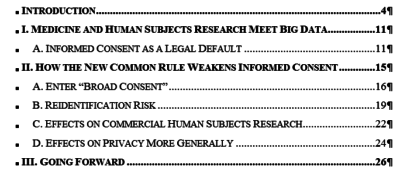
New Paper–“Big Data: Destroyer of Informed Consent”

Just posted: A near-final draft of my latest paper, Big Data: Destroyer of Informed Consent. It will appear later this year in a special joint issue of the Yale Journal of Health Policy, Law, and Ethics and the Yale Journal of Law and Technology.

Here’s the tentative abstract (I hate writing abstracts):

The ‘Revised Common Rule’ took effect on January 21, 2019, marking the first change since 2005 to the federal regulation that governs human subjects research conducted with federal support or in federally supported institutions. The Common Rule had required informed consent before researchers could collect and use identifiable personal health information. While informed consent is far from perfect, it is and was the gold standard for data collection and use policies; the standard in the old Common Rule served an important function as the exemplar for data collection in other contexts.

Unfortunately, true informed consent seems incompatible with modern analytics and ‘Big Data’. Modern analytics hold out the promise of finding unexpected correlations in data; it follows that neither the researcher nor the subject may know what the data collected will be used to discover. In such cases, traditional informed consent in which the researcher fully and carefully explains study goals to subjects is inherently impossible. In response, the Revised Common Rule introduces a new, and less onerous, form of “broad consent” in which human subjects agree to as varied forms of data use and re-use as researchers’ lawyers can squeeze into a consent form. Broad consent paves the way for using identifiable personal health information in modern analytics. But these gains for users of modern analytics come with side-effects, not least a substantial lowering of the aspirational ceiling for other types of information collection, such as in commercial genomic testing.

Continuing improvements in data science also cause a related problem, in that data thought by experimenters to have been de-identified (and thus subject to more relaxed rules about use and re-use) sometimes proves to be re-identifiable after all. The Revised Common Rule fails to take due account of real re-identification risks, especially when DNA is collected. In particular, the Revised Common Rule contemplates storage and re-use of so-called de-identified biospecimins even though these contain DNA that might be re-identifiable with current or foreseeable technology.

Defenders of these aspects of the Revised Common Rule argue that ‘data saves lives’. But even if that claim is as applicable as its proponents assert, the effects of the Revised Common Rule will not be limited to publicly funded health sciences, and its effects will be harmful elsewhere.

This is my second foray into the deep waters where AI meets Health Law. Plus it’s well under 50 pages! (First foray here; somewhat longer.)


Posted in AI, Law: Privacy, Writings | Comments Off on New Paper–“Big Data: Destroyer of Informed Consent”

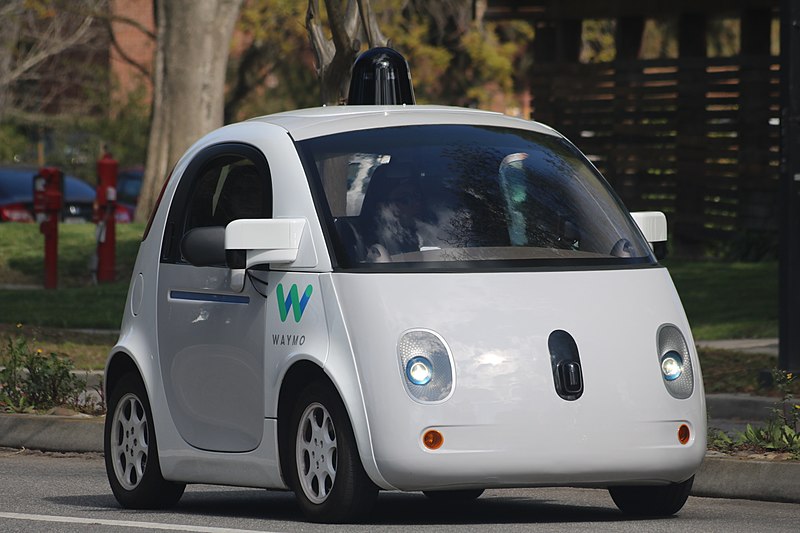
Florida Legalizes Fully Autonomous Vehicle Testing

Waymo Self-driving car
Source: Grendelkhan

Florida law now allows the testing of fully autonomous vehicles without a backup driver.

Since autonomous car tend to have trouble with bad weather–snow and sometimes rain–flat, sunny Florida would seem to be a natural testing grounds. Indeed, Ford is supposedly running or planning to run a test in Miami, although I haven’t heard of actual sightings yet. Then again, we have some of the craziest drivers in the US, which could be seen as a positive or negative, depending on what sort of torture test you want to give the AIs.

Posted in AI, Florida | Comments Off on Florida Legalizes Fully Autonomous Vehicle Testing