Author Archives: Michael Froomkin

FL-18 Notes

The Miami Herald reports that Rep. Ileana Ros-Lehtinen's campaign e-mail to Dade teachers draws ire. Imagine being so clueless as to think spamming people wouldn't bother them!

Meanwhile Daily Kos bring us some poll numbers that remind us of the strong position Ros-Lehtinen starts in (53-36, the usual margin in the past when running against weaker opponents) before the Taddeo campaign takes to the airwaves. Indeed, as South Florida seats go, this is one of the safer ones — but no one is safe this year.

I'm waiting for Taddeo to go negative; if and when that happens, I think this race will get much more fluid. After all, there's so much to be negative about.

Posted in Politics: FL-18 | Comments Off on FL-18 Notes

Someone Needs a New Lawyer?

In Thomson Reuters: The Gang That Couldn't Sue Straight, James Grimmelmann does a takedown on the (seemingly) asinine Thompson Reuters complaint against GMU (!) about a faculty member's distribution of (widely available) free open source firefox plugin Zotero.

(I'm partial to the less powerful but very useful Scrapbook myself, but that's mostly habit.)

That said, it does seem to me that there is one interesting and potentially triable (i.e. not utterly out-to-lunch) issue in the case, and that is the extent to which a contract by a firm with a (state) university can bind its professors. Let's say that the contract at issue does prohibit GMU from distributing software like Zotero (not obvious it does, but bear with me). Does that prohibition bind the GMU faculty? I'm not sure; but to the extent the acts were within the scope of employment, it might. But of course it doesn't bind either James or me, since we're not parties.

And, as James points out, even if it does there's the little question of what sort of damages would be owing. Since the claim is contractual, there's no scope for tort damages, just contract damages, and it's hard to see how those would be measurable here — in which case the courts would usually count them as zero.

Posted in Law: Internet Law | 2 Comments

National Shortage of Pro-Obama Yard Signs

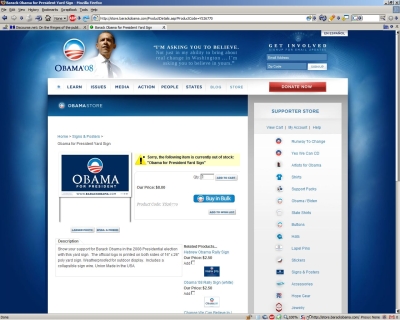
A few McCain yard signs have sprung up in the neighborhood, so I though I would retaliate. But it's not so simple.

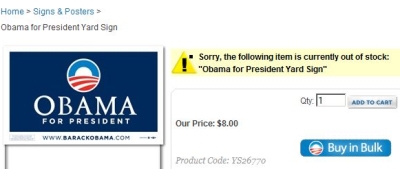
Either the Obama people are having supply problems, or an awful lot of people were impressed with the Senator's performance in last night's debate.

obmama-page1.jpg

Here's a closer look at the key part:

obama-sign2.jpg

It's especially impressive in that it seems you have to pay for them — in past campaigns down here they've been giving the signs away.

Posted in Politics: US: 2008 Elections | 7 Comments

Friday McBush/McSame Bashing

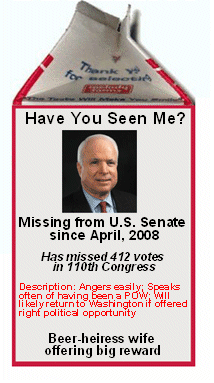
I've 'suspended' Friday McCain Bashing for the duration of the Emergency. I hope that makes it more popular.

Friday

Thursday

Wednesday

Tuesday

Monday

Sunday

Friday

Posted in Politics: McCain | 1 Comment

Contrasting Ads in FL-25

Contrasting ads in FL-25.

First, Joe Garcia again lampoons incumbent Mario Diaz-Balart:

Next, Mario Diaz-Balart trowels on the innuendo, suggesting that Garcia somehow has a connection to … Enron (!):

Both ads strike me as flawed, but in different ways. Garcia's ad has a very weak and silly start. Its point risks getting lost on the split screen. And it's high risk: ridicule can backfire…. Although it's interesting that the politically engaged Cuban-American I sat next to on the plane the other day who said he thought Joe's ads were too much had a few minutes earlier (unconsciously) adopted the very phrase in Joe's first and most effective effort, “one-trick pony”.

The production values on the Diaz-Ballart ad are better, as you'd expect given his is designed for TV while the Garcia ad is a web-only quickie. But it seems to me that the ad has two more serious problems. First, the claim it makes is pretty silly, and can only work with voters who know nothing about the candidate. It's too late for that group to be sizeable, although maybe it includes a good chunk of the undecided. Second, when the ad says “get rid of Enron Joe” it makes it sound like he's the incumbent. Maybe that's supposed to be a subtle hope that voters will think he is and vote to throw the rascal out — but to anyone who knows the score, and most voters do, this will look weak.

And, indeed, Channel 10 totally debunked Mario Diaz-Balart's ad:

As Garcia himself said in a recent email blast:

While serving on the Public Service Commission I helped usher-in the biggest utility rate cut in Florida history, which saved Floridians $1 Billion and forced FP&L to share excessive profits with consumers.

Diaz-Balart is scared of my record of fighting for consumers so he is trying to lie his way to re-election. …

One can see why Mario is run away from his record.  If I had been in Congress for six years and only passed one bill, while giving myself five pay raises, and voting against healthcare for children, services for our returning veterans and giving oil companies billions in tax breaks, I would be doing the same.

Posted in Politics: FL-25/FL-27 | Comments Off on Contrasting Ads in FL-25

Get Some Facts

The Economists' Voice has some timely writing:

Why Paulson is Wrong

Luigi Zingales

There are alternatives to a massive government bailout of the U.S. financial industry, according to Luigi Zingales—they just would be more costly for financiers and cheaper for taxpayers.

Questioning the Treasury's $700 Billion Blank Check: An Open Letter to Secretary Paulson

Aaron S. Edlin

The Treasury wants a blank check for $700 billion, at taxpayer expense; instead a businessman like Buffett should be given the job of making the taxpayers some money out of this mess, according to Aaron Edlin.

Dr. StrangeLoan: or How I Learned to Stop Worrying and Love the Financial Collapse

Aaron S. Edlin

Last week, on Wednesday September 17, 2008, the Bush Administration almost stumbled upon a way to eliminate the U.S. debt and even taxes. Aaron Edlin's ironic take on a world gone mad.

Investment Banking Regulation After Bear Stearns

Dwight M. Jaffee and Mark Perlow

The Bear Stearns bailout created an implicit guarantee that will create a great deal of moral hazard unless we smartly regulate investment banks in a way that doesn't destroy their value; so say Dwight Jaffee and Mark Perlow.

Posted in Econ & Money | 2 Comments