Author Archives: Michael Froomkin

Robert Paul Wolff Explains Tea Party Rage at ‘Obamacare’

WHY DOES THE RIGHT HATE OBAMACARE? isn’t a use of Occam’s Razor by a famous philosopher, but rather a famous philosopher’s use of the other string in his bow, his many years as a professor housed in a department of Afro-American Studies.

I have to say that, even if Occam’s Razor isn’t invoked, as explanations go it has the virtues of clarity and simplicity:

The emotions aroused on the right by the ACA are quite mysterious. It is not at all surprising that large numbers of people in the United States have intense feelings about abortion or same-sex marriage. I may find those feelings reprehensible, but I am not surprised by them. Nor does it surprise me that many people feel strongly about taxation, or about America’s military involvements. These are quite naturally subjects of controversy, and though we may grow angry at those who disagree with us, we ought not to be surprised by the disagreements. But medical insurance?

Medical insurance is a bit like highways, supermarkets, or television — a familiar part of life that we more or less take for granted. Most of the time, those of us who have medical insurance [which is to say, eighty percent of Americans, or more] use it without giving it a great deal of deep thought. …

And yet, there is now a sizeable fraction of the American public, and a considerable number of Representatives and Senators, who say that they consider Obamacare an assault on everything they hold dear, a fatal blow to the American Way, a Socialist plot to destroy life as we know it, an evil so great that it is worth bringing the government to a halt and threatening the world financial system to defund it or even slow marginally the pace at which its provisions go into effect.

What on earth is going on? The answer, I think, is actually rather simple, although unpacking it will take me more time than I usually devote to a blog post.

To put the answer in just four words, the real, underlying reason for the hysteria engendered by the ACA is: Because Obama is Black.

There follows a sustained discussion of white-black relations in the colonies and then the US, noting that, “During all of this time, it remained the case that poor Whites, exploited and oppressed by White capitalists, could tell themselves that they were free, White and twenty-one, that they were, at the very least, not black.” Then, this:

The Civil Rights Movement, launched by African-Americans half a century ago, threatened, and eventually began to break down even these legal, customary, residential, and employment barriers. It was at this time that the old familiar political rhetoric about “working men and women” also began to change. The new rhetoric spoke of “middle-class Americans,” which, although no one acknowledged it, was a thinly veiled code for “not Black.” As economic pressures mounted on those in the lower half of the income pyramid, Whites wrapped themselves in the oft-reiterated reassurance that at least they did not live in the Inner City []which is to say, Black neighborhoods], that they were “Middle Class.” All of the political discourse came to be about the needs, the concerns, the prospects of the Middle Class, which to millions of Americans, whether they could even articulate it, meant “not Black.”

All of this crumbled, frighteningly, calamitously, disastrously, when a Black man was elected president. “Free, white, and twenty-one” ceased to be the boast of the working-class White man. Statistics do not matter, trends do not matter, probabilities do not matter, income distribution differentials do not matter. If a Black man with a Black wife and two Black children is President of the United States, then a fundamental metaphysical break has occurred in the spiritual foundation on which White America has built its self-congratulatory self-image for three centuries and more.

Hysterical Whites tried every form of denial. Obama’s election was theft. Obama is not an American. Obama is a Muslim. Obama is a socialist. Obama’s election was a one-time proof that we are not racist, to be followed immediately by restoration of the status quo ante bellum. When Obama was reelected, vast numbers of Americans went into terminal denial. They seized upon the ACA simply because it was, as everyone knew, Obama’s signature domestic accomplishment. To repeal it, to defund it, to make it as though it had never existed, would be in some measure to deny that he had ever been President. The actual details of the ACA matter not at all. Neither do the actual felt medical needs of those driven insane by the very fact of Obama’s tenure in the White House. None of that has anything at all to do with the real cause of the hysteria. Why are millions of Americans driven beyond hysteria by the ACA?

Because Obama is Black.

On balance I still think that the Republican elites, at least, hate and fear the Affordable Care Act because they think it will work — thus locking in the Democratic vote as Social Security did two generations earlier — and also because the GOP’s opposition will relegate its elites to the dustbin of history. I don’t pretend to understand why, even so, they would be willing to have the US default on its debts, a plan that will cost them and their supporters a great deal of money, not to mention hurting almost everyone else at home and abroad and vastly reducing US global power and influence. (Closing the government for a while, I vaguely get, I imagine they think it’s mostly evil anyway.)

Update: Corroboration for Prof. Wolff’s view in Digby’s They’d rather die than help the “others”. Works for PG County, MD too; but in Miami it’s poor Latins as much or more than anyone else. Remind me why our local GOP opposes a benefit for the majority of their constituents?

Posted in Politics: US: Healthcare | 18 Comments

Proof Today’s GOP Would Shun Eisenhower

Here’s an Eisenhower quote from 1949 unearthed by Pogo Was Right:

If all that Americans want is security, they can go to prison. They’ll have enough to eat, a bed and a roof over their heads. But if an American wants to preserve his dignity and his equality as a human being, he must not bow his neck to any dictatorial government.

Hard to imagine Ike approving of the TSA.

Posted in Civil Liberties | 2 Comments

This Is Fun

Law and Law School in Six Words from the Marquette University Law School Faculty Blog.

My favorites so far are:

  • “It depends” worked most days
  • For sale: law degree, no promises.
  • No better preparation for serving humanity.

It’s not as easy as it looks.

(spotted via WSJ Blog, Describing Law School in Six Words) which also has some including, “‘But I’m tenured!’ the professor replied.” and “The former dean pleaded not guilty.” –which I think tells us something about the WSJ.

Posted in Law School | Comments Off on This Is Fun

Miami Heat Player Victim of (Wo)Man in the Middle Attack

You rarely see a MITM attack in real life, but the Miami Heat (that’s 2-time champion basketball for the foreign readers) big man Chris Andersen, known as ‘Birdman’ for his Mohawk and many tattoos, appears to have been the victim of one:

Andersen’s lawyer and agent, Mark Bryant, said his client was duped by a woman in Canada who sought a relationship and gifts and who threatened a female acquaintance of Andersen’s in California while impersonating the tattoo-covered fan favorite known as “Birdman.”

Bryant said neither Andersen nor his acquaintance realized they weren’t communicating with each other online or via cellphone texts but rather were communicating with the woman in Canada, who impersonated one to the other.

The article at Huffington isn’t clear about all the messy details; more oddly it calls the scam a “Catfishing Hoax” but that doesn’t seem appropriate because (as I understand it) in a Catfishing scenario the other person doesn’t exist. Here, it sounds like both parties existed but an intermediary was able to insert herself into their communications. The Man in the Middle (MITM) attack is one of the things that security professionals worry about a great deal when assessing purportedly secure communications mechanisms.

Please feel free to correct me in comments if I misunderstood something.

Update: Much clearer article at ESPN.com, Heat’s Chris Andersen cleared:

“We were always confident that Chris was innocent but we just couldn’t figure out what had happened,” Andersen’s lawyer, Mark Bryant, told ESPN.com. “It turned out that it was a Manti Te’o situation. It was Manti Te’o on steroids.”

Te’o, the former Notre Dame football star, was caught up in a scheme last year when several individuals created a fake person and started a relationship with Te’o over the Internet, something known as “catfishing.”

In Andersen’s case, a woman in the middle used social media to dupe two people without their knowledge, according to police.

The woman, identified by the Denver Post as Shelly Lynn Chartier of Easterville, Manitoba, posed as Andersen in electronic conversations with a woman in California. Then she posed as the California woman in electronic conversations with Andersen.

Along the way, police told Andersen, she made threats pretending to be Andersen and attempted extortion pretending to be the woman from California. Chartier was arrested by Canadian authorities in January.

“When they searched Chris’ house they were basically looking for an I.P. address,” Bryant said. “But it wasn’t there. They kept investigating but it took time because it ended up involving two countries.”

More than a year after sheriffs from Douglas Country, Colo., searched Andersen’s home, they asked for a meeting with him. ….

… Using charts and slowly explaining their case, the authorities informed Andersen what had happened to him.

“It was right out of CSI with all the charts,” Bryant said. “When we walked in there both pretty hostile, it had been 15 months since this happened and we were cooperating but we hadn’t heard anything. Chris had a pretty good scowl.”

As the police started showing him what took place, Andersen unfolded his arms and then moved closer to the table. He and Bryant just looked at each other, stunned by what they were being told had taken place.

Posted in Basketball, Cryptography | 2 Comments

Ten Years of Blogging

My first substantive post at discourse.net was ten years ago, and Rose Burawoy, Political Scientist, an even meatier post, was only a few days later. I was horrified by Guantanamo and by the Padilla case.

A great deal has changed since then, for me personally and for almost everyone else. Padilla is out of the Navy Brig and in a Miami jail — but Guantanamo is still there. It is hard not get used to it, but we need to make that effort.

Meanwhile, the blogging project has become somewhat more erratic as I have become deeply enmeshed in other projects, particularly Jotwell and We Robot. And I’m trying to keep up my scholarly writing productivity too; something has to go, and as I result I write fewer long pieces here. But not none!

If you haven’t been reading for ten years straight you might want to look at an arbitrary list of discourse.net’s greatest hits. It has what I think are the best posts — not the most popular. If I were listing the most popular it would be a very different list, probably headed by How Not To Pick Up Women Online, which for some years was on the first or second page of Google for people searching that phrase without the “not”.

More importantly, if you have not already done so, please would you take a minute and tell me a little something about yourself? One of the greatest rewards of shouting into the wind is to sometimes hear a voice answer back.

Posted in Discourse.net, Guantanamo | 1 Comment

We Robot 2014 Call for Papers

We’ve posted the We Robot 2014 Call for Papers.

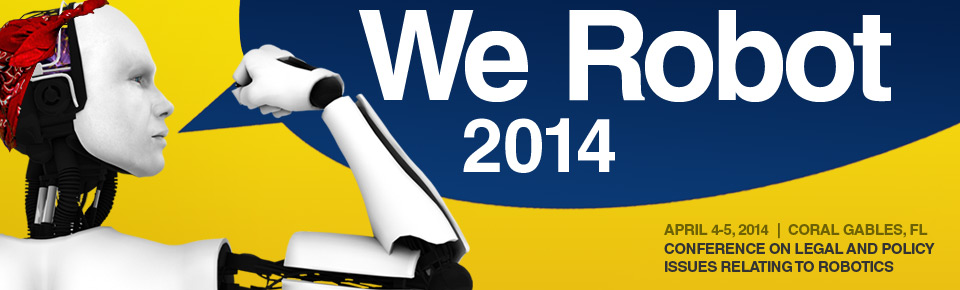
We invite submissions for “We Robot 2014: Risks & Opportunities” – a conference at the intersection of the law, policy, and technology of robotics, to be held in Coral Gables, Florida on April 4-5, 2014. We Robot is now in its third year, returning to the University of Miami School of Law after being hosted by Stanford Law School last April. The conference web site is at http://robots.law.miami.edu/2014.

We Robot 2014 seeks contributions by academics, practitioners, and developers in the form of scholarly papers or presentations of relevant projects. We invite your reports from the front lines of robot design and development, and invite contributions for works-in-progress sessions. Through this interdisciplinary gathering, we are encouraging conversations between the people designing, building, and deploying robots, and the people who design or influence the legal and social structures in which robots will operate. We particularly encourage contributions resulting from interdisciplinary collaborations, such as those between legal or policy scholars and roboticists.

Robotics is becoming a transformative technology that presents many legal and social challenges. This conference will build on existing scholarship that explores how the increasing sophistication and autonomous decision-making capabilities of robots and their widespread deployment everywhere from the home, to hospitals, to public spaces, and even to the battlefield disrupts existing legal regimes or requires rethinking of various policy issues.

Scholarly Papers

Topics of interest for the scholarly paper portion of the conference include but are not limited to:

  • Risks and opportunities of robot deployment in the workplace, the home, and other contexts where robots and humans work side-by-side.
  • Issues related to software-only systems such as automated trading agents.
  • Regulatory and licensing issues raised by robots in the home, the office, in public spaces (e.g. roads), and in specialized environments such as hospitals.
  • Design of legal rules that will strike the right balance between encouraging innovation and safety, particularly in the context of autonomous robots.
  • Issues of legal or moral responsibility, e.g. relating to autonomous robots or robots capable of exhibiting emergent behavior.
  • Usage of robots in public safety and military contexts.
  • Privacy issues relating to data collection by robots, either built for that purpose or incidental to other tasks.
  • Intellectual property challenges relating to robotics as a nascent industry, to works or inventions created by robots, or otherwise peculiar to robotics.
  • Issues arising from automation of professional tasks such as unauthorized practice of law or medicine.
  • How legal scholars should think about robots, and how roboticists should think about the legal code.

These are only some examples of relevant topics. We are very interested in papers on other topics driven by actual or probable robot deployments. The purpose of this conference is to help set a research agenda relating to the deployment of robots in society, to inform policy-makers of the issues, and to help design legal rules that will maximize opportunities and minimize risks arising from the increased deployment of robots in society.

Discussants

We also invite expressions of interest from potential discussants. Every paper accepted will be assigned a discussant whose job it will be to present and comment on the paper. These presentations will be very brief (no more than 10 minutes) and will consist mostly of making a few points critiquing the author’s paper to kick off the conversation. Authors will then respond briefly (no more than 5 minutes). The rest of the session will consist of a group discussion about the paper moderated by the discussant. Attendees will need to read papers in advance to understand and participate in each discussion.

Works-in-Progress Presentations

Unlike the scholarly papers, proposals for the works-in-progress presentations may be purely descriptive and designer/builders will be asked to present their work themselves. We’d like to hear about your latest innovations – and what’s on the drawing board for the next generations of robots as well, or about legal and policy issues you have encountered in the design or deploy process.

How to Submit Your Proposal

Please send a 1-3 page abstract outlining your proposed paper, and a c.v. of the author(s).

We Robot 2014 will be hosted by the University of Miami School of Law, Coral Gables, Florida on April 4-5, 2014. Venue details are at the conference web site.

We anticipate paying reasonable round-trip domestic coach airfare and providing hotel accommodation for presenters and discussants.

This is going to be great.

Posted in Robots, Talks & Conferences | Comments Off on We Robot 2014 Call for Papers