Author Archives: Michael Froomkin

Attention Law Review Editors

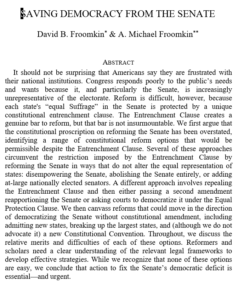
The odds that any actual law review editors read this blog is vanishingly small, but if you, gentle reader, happen to know one, please tell them about this terrific article, Saving Democracy from the Senate, co-authored with one David Froomnkin, that they might want to publish in their journal.

This article is the first to take stock, in a systematic and comprehensive way, of the constitutional and statutory avenues available for reforming the malapportionment of the U.S. Senate. Collecting together the various options available enables reformers to think both programmatically about the normative choices at stake and strategically about a reform agenda. This in itself is a substantial contribution, not just to constitutional theory but also to ongoing practical efforts to reform the legal architecture of U.S. democracy. Moreover, by systematizing these considerations, the article also helps to make clear the relationship between statutory and constitutional reforms of the Senate, proposing a two-track strategy for reformers.

While the work of synthesizing the options and providing a comparative analysis is the most significant contribution, the article also provides several significant and novel analytical contributions that advance legal debates in these areas:

(1) The meaning of the Article V Entrenchment Clause. The article’s claims that (a) disempowering the Senate and (b) abolishing the Senate would not violate the Entrenchment Clause are claims that have been made before, although rarely. But they are not claims that have ever, to our knowledge, received extensive analysis. The article provides this extensive analysis, explaining why a range of ambitious constitutional reforms of the Senate would not violate the Entrenchment Clause and responding to objections.

(2) The referent of the Article V Entrenchment Clause. We are not the first to suggest that the Constitution could be amended to remove the Entrenchment Clause and then subsequently amended to alter the composition of the Senate. But we provide a crisper analysis of the reason than scholars have done previously. The reason is that the referent of the Entrenchment Clause is not a provision in Article V but a provision in Article I. The Entrenchment Clause, by its language, is not a self-entrenching clause.

(3) Article V and Equal Protection. The article provides a novel argument about the relationship between the Entrenchment Clause and the application of equal protection principles to the Senate. Orts in 2019 made a related argument, but his suggestion that Congress could reapportion the Senate by statute takes an idiosyncratic view of the Entrenchment Clause. We advance the more restrained argument that, while the Entrenchment Clause at present bars the application of equal protection principles to the Senate, amendment of the Constitution to remove the Entrenchment Clause would enable reapportionment of the Senate under Reynolds v. Sims.

(4) At-large Senators. Building on our argument about what the Entrenchment Clause prohibits—and what it does not—we explore the addition of a substantial number of nationally elected Senators to make the Senate more representative of the Nation. Whether or not we kept the existing Senators, no state’s “equal Suffrage” would be altered.

(5) Statehood. The article surveys the relevant legal authorities on the admission of new states, compiling an extensive range of relevant material. In the course of discussing the currently most salient cases of Puerto Rico and DC, the Article analyzes a Twenty-third Amendment issue that has not been extensively discussed.

(6) Breaking up (and merging) states. The article provides novel analysis of practical challenges confronting breakups (and, analogously, mergers) of states. It also suggests a promising policy response to these challenges, arguing that federal legislation to mitigate states’ costs and help to incentivize state breakups would be feasible, desirable, and constitutional. This prescription is, to our knowledge, original—perhaps in part because scholars have not yet grappled with the magnitude and stakes of the problem requiring a remedy.

Although we canvas a very wide variety of alternatives, and we weigh the difficulties, virtues, and vices of each, our recommendations center on certain constitutional reforms and the admission of a few new states.

All this, and yet even with the footnotes it’s still under 30,000 words!


Posted in Law: Constitutional Law, Law: Elections, Law: Reading the Constitution, Writings | 1 Comment

Une Préface Pour <<Un droit de l’intelligence artificielle: entre règles sectorielles et régime général>>

I was very honored to be asked to write the preface for Un droit de l’intelligence artificielle: entre règles sectorielles et régime général. Perspectives de droit comparé (Céline Castets-Renard, Jessica Eynard, eds.) which should be forthcoming shortly. An English edition is due to follow in a few months.

Since a Preface is short, I decided to compose it in French, relying on the able editors to correct any infelicities and the occasional failure to agree gender or the like. The result is not my first foreign-language publication, nor even the only one due this year, but it is the first where the foreign version is not a translation. Here it is en version originale:

L’intelligence artificielle sera bientôt, si elle ne l’est déjà, une des technologies les plus importantes et aussi une des plus dangereuses que nous n’ayons jamais rencontrées. Comme William Gibson nous avertit, « l’avenir est déjà ici, il n’est tout simplement pas encore uniformément réparti ».

L’enfant de l’informatique et des mégadonnées, l’apprentissage automatique, dit l’intelligence artificielle (IA), a infiltré plusieurs domaines, y compris des décisions gouvernementales (soit les bénéfices sociaux ou l’administration de la justice), les services de santé, le champ  de bataille, et des tentatives de manipulation des élections et de l’espace public, ainsi que les marchés financiers.

Actuellement, les systèmes d’IA ont tendance à être opaques. Jusqu’à ce que nous ayons appris à en construire de meilleurs, il restera difficile d’identifier les informations spécifiques les plus susceptibles de déterminer une conclusion donnée. De même, sans schéma de provenance des données, il restera difficile de détecter les caractéristiques subtiles qui peuvent entraîner diverses formes de discriminations involontaires, mais néanmoins indésirables, et même illégales.

L’IA soulève de nombreuses questions sociales, tel que l’avenir du travail. Tous, des ouvriers d’usine aux professionnels tels que les médecins et les avocats, pourraient voir leurs emplois transformés. Ce que nous ignorons encore est de savoir si l’IA deviendra notre conseiller, notre collègue, notre patron (et notre surveillant qui voit tout), ou si peut-être certains d’entre nous ne travaillerons plus du tout parce que les IA auront pris nos emplois, étant à la fois plus précises et plus perspicaces.

Nous juristes avons tendance à considérer que le rôle de la loi et de la réglementation est au cœur de l’enquête sur l’IA. Je reconnais que les choix sociaux concernant la configuration et le déploiement de l’IA ne devraient pas être laissés au marché sans contrôle légitime. Mais ce qui devrait passer en premier, ce sont les questions éthiques liées à l’IA. Les principes éthiques de l’introspection et de l’engagement sont essentiels pour tous ceux qui construisent, entretiennent, réglementent ou utilisent l’IA et, encore plus certainement, lorsque nous considérons les intérêts de ceux qui font l’objet des actions prises par l’IA. Mais cela doit être fait de manière soignée. Actuellement, la prolifération des standards éthiques aux États-Unis, par exemple, permet aux moins scrupuleux de chercher le standard qui leur permettra de revendiquer la vertu sans la pratiquer.

Même si l’on croit qu’il n’y a aucune chance que la technologie actuelle produise une IA consciente, il est concevable que, tôt ou tard, une IA puisse si bien imiter une personne que nous ne pourrions pas discerner le silicium sous le sourire. Cela finira plus probablement dans la fraude que dans la sensibilité. Bien sûr, il pourrait devenir commode d’adopter une fiction juridique dans laquelle nous attribuons certains aspects de la personnalité à l’entité computationnelle artificielle, tout comme nous le faisons pour certains aspects d’entités économiques artificielles – les entreprises. Dans tous les cas, les questions essentielles seront ce que nous voulons que nos machines fassent, et ne fassent pas, des questions qui devraient éclairer le chemin vers l’établissement des règles qui encourageront des résultats favorables.

Les problèmes éthiques et juridiques créés par l’IA sont  interdisciplinaires, mais pour compliquer encore les choses, ils sont également transnationaux. Premièrement, n’étant que des données et des logiciels, à la fois les algorithmes et les méthodes de formation pour générer de nouveaux algorithmes, peuvent être partagés dans le monde entier en open source, dans la littérature académique, ou vendus au-delà des frontières. D’un autre côté, certains pays considèrent les informations sur leurs citoyens, par exemple les données nationales sur la santé, comme une ressource stratégique faisant partie de la politique économique nationale… mais les données et le code sont difficiles à enfermer.

Deuxièmement, la réglementation de l’IA est dans une période de débat, de développement rapide, et de concurrence. L’Union européenne, les ÉtatsUnis, la Chine et de nombreux autres pays sont confrontés au double défi de contrôler l’IA tout en l’encourageant – par peur d’être laissé derrière dans ce qu’ils décrivent comme une compétition commerciale et militaire. Dans le cas de l’UE, le RGPD crée chez certains un appétit bien compréhensible pour une seconde occasion de la création d’une norme transnationale, c’est-à-dire un système potentiellement extraterritorial, même viral.

L’IA doit-elle être réglementée en tant que technologie, de haut en bas ou de manière sectorielle par des experts versés dans les différents domaines où l’IA sera déployée ? Je prédis que l’IA deviendra trop importante, trop dominante, pour nous permettre d’avoir un seul organisme de réglementation, car cet organisme contrôlerait non seulement la majeure partie de l’économie, mais une grande partie du gouvernement, ainsi que de nombreux aspects de la vie privée. Mais cela ne signifie pas que des efforts réglementaires plus ciblés ne puissent ou ne doivent pas être guidés par des principes généraux et, en effet, nous pourrions avoir besoin à la fois des principes généraux et des règles ciblées pour maximiser les avantages de l’IA tout en minimisant ses effets secondaires.

Quelle que soit la nature de la réponse de la société (ou devrais-je dire des sociétés ?) aux bénédictions et aux malédictions mitigées de l’IA, il est clair que nous ne sommes qu’au début d’une longue évolution. Je suis convaincu que nous avons beaucoup à apprendre les uns des autres, tant au niveau transnational qu’à travers les disciplines académiques et techniques. Les savants et experts contributeurs à cet ouvrage se sont lancés dans ce projet essentiel d’enseignement et d’apprentissage, et nous devons tous leur en être reconnaissants.

Coral Gables, Floride, États-Unis
Avril 2022

Amusingly, when I agreed to write this, I was not aware that the awesome editors were planning an English edition. I was thus a little surprised when they offered to translate the French into English for me, but I said I would do it myself.


Continue reading

Posted in AI, Writings | Comments Off on Une Préface Pour <<Un droit de l’intelligence artificielle: entre règles sectorielles et régime général>>

More Consumer Annoyances (Insurance Dept.)

Toyota RAV4 (XA20) in the mud

Seems cars like this, which mine vaguely resembles, cost a lot to insure.

Generally, I find that my car insurance company, GEICO, has among the most pleasant phone support folks I deal with.  And, fortunately, I don’t have to deal with them very often.

Today I called in to find out why my insurance rates had jumped 10%.  It’s not like I had an accident; indeed I hardly leave the house these days.  And the car is, to put it mildly, somewhat ancient, so it’s not as if its value (if any) has created a high risk.  But maybe GEICO has a model in which drivers of aging cars (even Toyotas!) are a greater risk to other drivers?  Or maybe it’s just aging, although neither one of us had a milestone birthday.  So what was it?

I called GEICO, got a phone tree, and eventually lost patience and demanded “Operator”.  So I got put in the operator queue, and told I’d be better off online (nope, tried that already) or I’d just have to wait for the next available operator. And the wait would be … 40 minutes.  40 minutes??? Fortunately there was a ‘call you back’ option, so I took it.

About 40 minutes later the GEICO robot called me back, and then connected me to a charming representative. She explained to me that the reason my insurance had gone up 10% is that, and I quote, “the cost of insurance has gone up.”

Charming as she was, she seemed puzzled by my suggestion that there was something circular in saying that the cost of my insurance had gone up because the cost of insurance has gone up. “Some people had theirs go up even more,” she added. “But they had accidents.”

Someone is doing well out of this….

Interestingly, the cost of insurance for a new car of the same model  would only be 25% more than the cost for my old one.  So it’s either about inflation in medical costs or other people’s cars. Or price gouging. I’ve read there had been a lot of inflation in car prices, with prices at least for used cars dipping a lot in the past month.  But I’m going to bet my insurance cost does not go down in the next six month period, not even with GEICO.

My last question was whether GEICO was passing on 10% raises to its workers.  That got a laugh. It’s not.

Posted in Shopping | Comments Off on More Consumer Annoyances (Insurance Dept.)

GPT3Chat is a Coward

Posted in AI, Trump | 4 Comments

Annals of Consumer Law (Contracts of Adhesion Dept.)

After twenty or so years of reliable service the old fridge had started taking days off. We were not sympathetic.  The outages came without warning, and they did the food no favors. So out with the old and in with the new.

This morning, indeed about 45 minutes prior to the four-hour envelope in yesterday’s email, the delivery truck from Home Depot came bearing a shiny new fridge. They detached the rusty old fridge from its plumbing, carted it away, and attached the new one via the $17.98 “12′ Upgraded Braided Water Line ” which was a consequence of ticking the box asking for installation. Ten minutes after arrival, they and the old fridge were gone, leaving a warning to give the new machine several hours to cool, and even longer to start making ice.

It was not until this afternoon that we noticed that along with a users’ manual they had left this:

"By using ... you agree ... biding arbitration."I would be far more annoyed had stuff like this not been the hypo I gave my students years ago when teaching about so-called ‘clickwrap’ contract terms.  Now I try to be amused.

Posted in Arbitration Law, Shopping | Comments Off on Annals of Consumer Law (Contracts of Adhesion Dept.)

The Case of the Capitol Police and the January 6 Near-Putsch

Cop Jan 6

Capitol Police officer on Jan 6, 2021
© 2021 lvert Barnes via Creative Commons Attribution-Share Alike 2.0 Generic License

At Press Watch my brother drops the results of an intensive investigation into the Jan. 6 committee documents and more in The story no one wants to touch: Why the Capitol Police enabled 1/6:

The news media’s continuing failure to explore why the U.S. Capitol was so scantily defended against an angry horde of white Trump supporters on Jan. 6, 2021, has now been compounded by the House select committee’s refusal to connect the most obvious dots or ask the most vital questions.

It’s true that there were countless law enforcement failures that day — indeed, far too many to be a coincidence.

But the singular point of failure — the one thing that could have prevented all of it from happening — was that Capitol Police leaders brushed off ample warnings that an armed mob was headed their way.

They lied to everyone about their level of preparedness beforehand. Then they sent a less-than-full contingent of hapless, unarmored officers out to defend a perimeter defined by bike racks, without less-than-lethal weaponry and without a semblance of a plan.

Even the insurrectionists who actively intended to stop the vote could never have expected that breaching the Capitol would be so easy.

[…]

An examination of the committee reports, the accompanying depositions and supporting documents leads to the following conclusion:

  • The failure was not due to lack of intelligence. There was plenty. “I don’t think it was a failure of intelligence. I think it was a failure to operationalize the intelligence,” Julie Farnam, assistant director of the Capitol Police intelligence unit, told committee investigators. “They should have been ready for war, and they weren’t.”
  • The lag in mobilization of the National Guard is a red herring. No one at the Capitol requested their presence until after police lines had been breached. To the extent that it was discussed beforehand, it was in order to have the Guard help direct traffic on surrounding streets.
  • The Capitol Police were vastly unprepared. Despite Sund’s insistence that he was getting “all hands on deck,” he didn’t even cancel officers’ days off.
  • The perimeter was defined with bike racks, which are good only for protests where most people are law-abiding. They do nothing to stop a horde. In fact, they get turned into weapons to use against the police.
  • The Capitol Police had no backup plan in case multiple protesters posed a threat. Even as police lines had already collapsed, clueless police leaders were trying to deploy more bike racks.
  • Incredibly, chief Sund ordered the removal of some bike racks late on Jan. 5, for reasons that some of his colleagues considered suspect.
  • Actual calls for help were only made after it was too late. Justice Department officials said that even after they saw TV footage of insurrectionists parading through the Capitol Rotunda, Capitol Police officials told them they had things under control.
  • Police leadership simply could not conceive of white Trump supporters as the enemy. Time and again, law enforcement leaders were presented with intelligence showing that desperate Trump supporters were targeting the Capitol, but didn’t take it seriously.
  • Anti-scale fencing — the kind erected around the White House during the Black Lives Matter protests — would have stopped any of this from happening. It was never even considered.

There’s lots more where that came from.  IMHO, this deserves wide attention.

Posted in 1/6, Dan Froomkin | 2 Comments