Author Archives: Michael Froomkin

Is the Trial of David Hicks a War Crime?

In Justice at Guantanamo? The Paradox of David Hicks, Prof. Devika Hovell of the University of New South Wales, Sydney, Australia, provides a very measured introduction to the legal quagmire which is the ongoing trial of “Australian Taliban” David Hicks.

Article 5 of the Third Geneva Convention, which requires all persons falling into enemy hands to be presumed to be a prisoner of war until determined otherwise by a competent tribunal. Rather than hold a hearing to determine Hicks’s status, the US has instead presumed he is an ‘enemy combatant’ (a category not recognized by the Geneva Conventions, which divides people into soldier-POW or citizen-criminal). Irregulars, such as the Taliban in Afghanistan, likely fall within the “[m]embers of the armed forces of a Party to the conflict as well as members of militias or volunteer corps forming part of such armed forces” who all are entitled to POW status. (Whether Hicks falls into this group may well be debatable, but it has yet to be debated.)

Unlike the new rules invented by the Pentagon, a mere “enemy combatant” gets a very very second class kind of trial, far below what the Geneva Convention would require for a POW. Aside from their fundamental injustice (see Condemned By the Company We Keep), Prof. Hovell reminds us that there’s another problem too: ” Failure to provide a prisoner of war with a fair trial constitutes a war crime.”

Posted in Guantanamo | 4 Comments

The Bingaman Amendment

On Monday the Senate will consider the “Bingaman Amendment,” a provision which would remove the habeas-stripping provision from the Graham Amendment adopted Thursday. Forty-nine Senators voted for the Graham amendment; a few were absent. The odds do not look at all good, even if one assumes that Sen. Wyden’s vote was tactical and that Sen. Olympia Snow is educable on this issue.

The folks at The Million Phone March are providing an interface by which US voters can contact their Senators. It can’t hurt.

Posted in Guantanamo | Comments Off on The Bingaman Amendment

Rebuttal on White Phosphorus Allegation

Someone has been going around the blogs posting a quite detailed and plausible rebuttal to the allegations raised by Italian TV and noted here under the title US Admits White Phosphorus Use In Fallujah. The core of it is that the white phosphorus artillery rounds in question are to make light or smoke, and that in any ordinary case you are more at risk if the cannister lands on your head than you are from the phosphorus itself. You can see a copy of it in the comments to that item, and on other blogs too. I would be delighted if this rebuttal proves correct.

Even so, alas, the other point remains: what did our bloody fighting in Fallujah achieve in the end, and was it worth the US and Iraqi casualties, not to mention the destruction of the city?

Posted in Iraq | 1 Comment

Condemned By the Company We Keep

Today’s New York Times carries an excellent and harrowing account of a Chinese father’s so-far-fruitless attempt to get Chinese justice for his son, now sentenced to life imprisonment, Desperate Search for Justice: One Man vs. China. The Chinese criminal judicial process is presented as an oriental version of Kafka: only limited rights for the defendant, and those are routinely ignored (e.g. right to see evidence, or to cross examine). In this case the father actually managed to win an appeal, but that just got the case sent down for re-trial, which again was a farce. And the second appeal was decided on political grounds — it seems that the specially selected panel thought that public confidence in the state required a scapegoat for the ugly crime, and here was a convenient scapegoat…

So my first reaction was that here was an object, and abject, account of why the rule of law matters, and why it is so important to protect the criminal rights of defendants. As the Times noted, the Chinese system had a 99.7 percent conviction rate last year out of 770,947 adjudicated cases. The Times suggests that “Conviction rates are also high in the United States, especially in federal criminal cases.” Indeed, “More than 90 percent of federal defendants plead guilty,” usually taking a plea bargain to avoid a trial. Those who elect a trial fare better: for the most recent period for which I could find data [circa 1986-2000, source: Andrew D. Leipold, Why Are Federal Judges So Acquittal Prone?, 83 Wash. U. L.Q. 151 (2005) (citing Bureau of Justice Statistics, Sourcebook of Criminal Justice Statistics Online tbl. 5.22)], “the average conviction rate for federal criminal defendants was 84% in jury trials, but a mere 55% in bench trials.” These numbers are impressive when you figure that, in addition to the people determined to prove their innocence, a substantial subset of the people who go to trial are those whom the prosecutors think are so guilty that they offered little or nothing in the plea bargain.

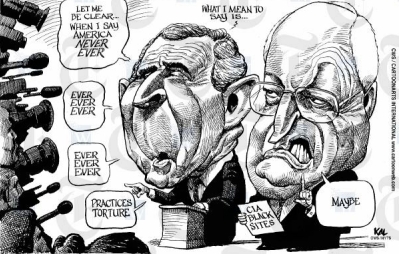
Unfortunately, it seems that on balance the average Chinese criminal defendant gets a better deal than what this administration wants to offer persons it labels “enemy combatants” and ships off to Guantanamo.

On the basis of no evidence, I’m prepared to stipulate that the Guantanamo prisoners get better food — at least when they are not on hunger strikes or attempting suicide due to years in solitary or near-solitary confinement.

There are several similarities, e.g. handpicked judges, beatings and other mistreatment of prisoners, life imprisonment (in China, post-trial, in Guantanamo includes pre-trial)

In other ways, the Chinese defendant gets, or at least can hope for, a better deal than under the “monsterous” procedures the US government offers alleged “enemy combatants” in Guantanamo: While it appears the Chinese rules often are not followed in practice, at least aspirationally they offer the hope of the following rights that the Bush administration does not want to see in Guantanamo: the right to know the charges against you, the right to know who your accusers are, the right to cross-examine prosecution witnesses (compare the facts of the Hamdan case), the right to call your own witnesses (compare the recent refusal to allow David Hicks to call expert witnesses), the right to proceedings in your own language or with competent translation, and (here we can blame the Senate too) the right to appeal the fundamental fairness of the proceeding. If nothing else, the railroaded Chinese defendants’ families have visitations rights. Not even human rights groups get that in Guantanamo. [Incidentally, for a real double whammy, consider how badly the US government treats Chinese nationals held in Guantanamo whom even the US thinks are innocent of any crime.]

Is this the level to or below which we wish to sink?

Not in my name, please.

Posted in Guantanamo, Law: Criminal Law | 1 Comment

Good Lawyering Makes a Difference

This account of how the Washington Post avoided the legal (and internal) problems that plagued the New York Times over its relations with special prosecutor Patrick Fitzgerald makes it clear that management made a smart call from the first — and then brought in the right high-octane lawyers who could negotiate a suitable deal.

Posted in Law: Everything Else | Comments Off on Good Lawyering Makes a Difference

A Vote for Unreviewable Injustice

The Senate did a bad thing yesterday, voting for the so-called Graham Amendment, 49-42 (with McCain voting for it), which would eliminate the statutory right of habeas corpus for alien detainees held by the Department of Defense at Guantanamo. The point of this amendment is to undermine the Supreme Court’s June 2004 decision in Rasul v. Bush.

For an explanation of the issues see Marty Lederman at SCOTUS Blog and then see Steve Vladeck for the advanced course in the horrible and complex federal courts and constitutional law implications.

Amazingly, the proposal has a (tentative) academic supporter, Julian Ku, at Opinio Juris.

Posted in Guantanamo, Law: Constitutional Law | 5 Comments