Category Archives: U.Miami

UM Offers Course on ‘Ethical Hacking’

So much of what we hear from the UM administration about computers is scare stories, so it's nice to see something different:

Ethical hacking and countermeasures course

The goal of the ethical hacker is to help an organization take preemptive measures against malicious attacks by attacking a computer system within the legal limits. This class will immerse the student in an interactive environment where they will be shown how to scan, test, hack, and secure their own systems. Students will learn how intruders escalate privileges and what security steps can be taken. Students will also learn about intrusion detection, policy creation, social engineering, DDoS attacks, buffer overflows, and virus creation. This five-day course, running from Monday, July 30 to Friday, August 3, prepares individuals for the EC-Council Certified Ethical Hacker Exam 312-50 and will be held at the Blue Lagoon campus. For information, call 305-284-2100 or e-mail f.freire@miami.edu.

But since when do we have a “Blue Lagoon Campus”?

Posted in U.Miami | Comments Off on UM Offers Course on ‘Ethical Hacking’

What’s Doing (Reptiles Dept.)

I just want to thank all the people who have kept the comments lively at The Buck Doesn't Even Stop By For Visits while I've been somewhat distracted by work.

If I know what's good for me, blogging will be light for the next few days — I have to write an exam and do major surgery to a paper.

The world certainly is doing its best, however, to be very distracting.

For one thing, there's a good-sized scaly toothed reptile back in the campus lake. I saw about seven eights of it, but not the snout which it had lodged under something at the bank of the lake, so I don't know if it's a gator or a croc, but I'd guess gator. The whatever-it-was had beached the front of its face, nose first, only 100 feet or so from the Rathskeller where students were happily boozing it up on a Friday afternoon, but there was a campus cop keeping the passing students from getting too close. He didn't seem to be enjoying the job, and gave a rather grim smile when I observed that the gator had a police escort.

Previous posts on our toothy friends include Crocodile Reminder, Crocodile Coincidence, What? A Croc?, Croc II !, Cold Front Flushes Out UM Croc, Fair Warning (Alligator Dept.), Who Gets Custody of the Alligator ? and of course Exam Question: Is an Alligator a Deadly Weapon?. It's not an obsession, really, just a fact of life.

Speaking of reptiles, the DoJ has done another Friday evening document dump.

Speaking of sinking your teeth into things, or maybe it's man-bites-dog, don't miss Army Officer Accuses Generals of 'Intellectual and Moral Failures' an amazing article about a Lt. Col. attacking his superiors (generically, not by name) in a prestigious army journal for incompetence and dishonesty in their prosecution of the Iraq war and for misleading Congress about it.

“After going into Iraq with too few troops and no coherent plan for postwar stabilization, America's general officer corps did not accurately portray the intensity of the insurgency to the American public,” he writes. “For reasons that are not yet clear, America's general officer corps underestimated the strength of the enemy, overestimated the capabilities of Iraq's government and security forces and failed to provide Congress with an accurate assessment of security conditions in Iraq.”

Yingling said he decided to write the article after attending Purple Heart and deployment ceremonies for Army soldiers. “I find it hard to look them in the eye,” he said in an interview. “Our generals are not worthy of their soldiers.”

Next to last, but not least, the Bush administration war on the rule of law continues apace with its latest attempt to make it impossible for lawyers to provide meaningful or effective representation for Guantanamo detainees. I would write about this but words fail me to describe the petty viciousness of this idea and the manifest hostility to the very due process that I would have thought was one of the great achievements of our civilization. The NYT has an editorial which says part of what needs saying; some more of it is found in this Conversation with Gitmo Lawyer on Proposed DOJ Rules. Don't look to the Supreme Court to do anything fast — in tangentially related cases, it's not rushing the process, which is Shakespearian in its delay:

“For who would bear the whips and scorns of time,
The oppressor's wrong, the proud man's contumely,
The pangs of despised love, the law's delay,
The insolence of office and the spurns
That patient merit of the unworthy takes,”

Meanwhile, only the willful blindness of one or two men (Bush, Chaney, take your pick), ensures that the US Army will continue to bleed itself dry in Iraq, to no visible benefit to anyone outside the White House. I understand that our departure could lead to horrors — and think we have a duty to mitigate them, especially be admitting a very large number of refugees here in order to protect all the people who have helped us. If there were a plausible scenario by which staying on would allow us to enact the 'Pottery Barn rule' (you broke it, you pay for it), I could support that. But the occupation is as big a failure as the initial military campaign was a success. No one arguing for staying on has a winning strategy that they can articulate other than “retreat is not an option”.

I tremble for my country when I reflect that God is just, that His justice cannot sleep forever.

— Thomas Jefferson

Posted in Guantanamo, Iraq, Politics: US: GW Bush Scandals, U.Miami | 1 Comment

Dean Dennis Lynch To Step Down In a Year

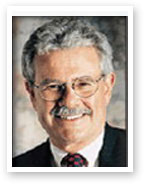
This letter just went out the whole law school community (I added the photo):

To: Law School Community

From: Dean Dennis O. Lynch


Today I announced to the faculty that the 2007-2008 academic year will be my final one as dean. These past eight years have been the most challenging and rewarding of my professional life. We have hired very talented young faculty, expanded clinical programs for our students, significantly increased student scholarships, and almost doubled the Law School's endowment. I am grateful to my faculty colleagues for their shared dedication to the quality of the education we provide our students. I want to thank the staff for all that you do to assure the success of our students. I firmly believe that the University of Miami has one of the most talented and socially committed student bodies in the country. We have a wonderfully supportive alumni community who have demonstrated their faith in the School's educational mission by their generous support of the Capital Campaign. It has been a privilege to serve as your dean. I am looking forward to my final year as dean, to rejoining the faculty as a professor, and to being back in the classroom with our students.

Posted in U.Miami | Comments Off on Dean Dennis Lynch To Step Down In a Year

Going Places?

This little item tucked at the end of a column in Sunday's Herald certainly has people talking,

LEGAL MOVE?

The University of Miami is considering moving its School of Law — from the Coral Gables campus to downtown Miami.

Law school Dean Dennis O. Lynch says developers approached UM. “It's at the earliest stage of conversation,” Lynch says. But, he acknowledges, “we are crammed.” The law school, founded in 1928, has 1,333 students and 173 faculty and employees — 69 full time, 104 part time. UM has plans for a five-story building adjacent to the law school, with the law school taking four floors, but no groundbreaking is set.

It's possible to imagine how a big modern building downtown near the courthouse might be fancy enough to justify moving off our beautiful campus in Coral Gables, but I think it would be prohibitively expensive.

The problem is not just that it would have be enough bigger than what we have to justify the move, plus have enormous parking, but that since this sort of a location would be cut off from both the Coral Gables campus and the med school, we'd need even more space to replicate many of the campus amenities we'd be losing (like the courtyard which is our social and faculty/student center, access to the gym, the campus dining area, on-campus child care). And I wonder what it would do to student and even faculty recruiting. This student has a pretty negative reaction, and as things stand I can't blame him.

The faculty only heard about this on Thursday, and it was presented much as reported in the Herald — an idea to study. It's good that people are thinking outside of the box about how to improve the law school. And it's good to think big. My first impression, though, is that unless there's a ton more money out there to pay for this than I suspect, then this isn't the right side of the box. And even then, I bet you could do a lot more for the school, for half the price, in other ways.

I especially admire whatever developer first floated the idea — it's always smart to try to create a client. I wonder if instead of moving the school, maybe a downtown annex would make some sense — although, again, big issues would be parking and night time security. I certainly expect, though, that before we even decide if we want to move anywhere we will do some zero-based planning about what we would want to gain from a new facility.

It would be tragic to do this wrong, and very hard and, I expect, real expensive to do it right, which is why I have to suspect UM President Donna Shalala will be too smart to try to make it happen once the numbers are toted up.

Posted in U.Miami | 8 Comments

Green Called on Account of Fear

E-mail from the UM Office of Public Safety, quoted in its entirety:

The UM Police Department had planned to support this weeks environmental initiatives with a “green day” on Wednesday, April 18th; UM patrol officers were logistically set to use only “green,” non-fossil fuel burning modes of transportation such as Segways, bicycles and GEMs (electric golf carts). However, due to increased security measures stemming from the recent events at Virginia Tech, the UM Police Department will be postponing this event.

(Despite this setback, the Green initiative seems real. I've noticed cops on Segways running around in the past week. Segways seem just the right size for campus walkways, although it seems I missed my chance to try one.)

As for fear, it could be worse: we're not locking down the campus in fear of an umbrella.

Posted in U.Miami | 1 Comment

Still a Rock Star

Bill Clinton came to town Thursday and gave the Spring Convocation address. It was a great performance. And given that Al Gore came by a day earlier and presented the “Inconvenient Truth”, it's been a busy week.

Clinton's facility with language and his ability to persuade an audience of his passionate belief never fails to impress, and today was no exception. (The audience interrupted with applause more than twenty times.) He spoke for about 45 minutes, then sat on stage in a nice upholstered armchair next to UM President Donna Shalala and answered some student questions that she had pre-selected.

Clinton's main talk, which he said was an abbreviated from of a lecture he's been giving around the world, centered around five questions that he said everyone should try to answer for themselves (everything that follows is summary or close paraphrase; but it's not necessarily actual quotation unless I use quote marks):

1. What is the fundamental character of the 21st Century?

Many might say globalization, but “I prefer 'interdependence.'”

2. It it a good or a bad thing?

Both. Many benefits – diversity, variety, exchange of ideas, economic development for the third world. But also some “not-so-good” aspects including (1) It's unequal: great inequality (e.g. one billion people living on under $1 per day)
(2) It's unstable: we may actually be less vulnerable today than in the 20th Century, but with modern communication/life more people feel the effects of hijackings and bombings
(3) It's unsustainable: climate change is ongoing and we are depleting critical resources including water, soil, biodiversity, oil & natural gas, fisheries.

3. How should we change it?

Work from interdependence to integrated communities – work locally, nationally and eventually internationally. “The humanity we share … is more important than our differences”

4. How can we do that?

First, we need a security policy in a dangerous age.
Must deal with climate change. Climate change and avian flu are security issues.
Also need to understand that it is “never possible to kill, jail or occupy all of your adversaries.” (Applause)
Third, need a world with “more partners and fewer enemies” (Applause)

Here Clinton cited North Korea, [where the current administration has just conducted a return to a Clintonian policy] as an example of the advantages of talking.

Diplomacy, he said, is “always cheaper then going to war” (Applause)

Clinton then told several stories about making friends and doing good abroad: bringing aid to Indonesia after the tsunami, causing US popularity which had been much lower than bin Laden's rise to eclipse him. (Applause) And about fixing broken markets in pharmaceuticals that allowed Indonesia to cut its spending on essential medicines.

But, Clinton warned, it's not just foreign countries that need aid or need to het their houses in order. We also need “home improvement” or many will “wonder why we are taking care of others and not of our own” (Applause).

5. Who's supposed to do all this?

Everyone. Everyone should give time or money as they are able (Applause)

President Clinton then detoured into a personal discussion of his role reversal with Senator Clinton (there was only very scattered applause at this point). She got elected just as he left office. I've become part of the NGO sector.

One project he's pursued is lowering drug prices for the third world: in the Bahamas he was able by presenting suppliers with data about prices elsewhere to get them to lower costs for a year's worth of generic anti HIV drugs from $3500 to $500. And in time, to $140 then $100 per year. Markets, he said, were not functioning properly. By arranging for purchases in bulk, by guaranteeing payment [and, he implied, by being Clinton], his foundation was able to get large price cuts. Similar successes in Rwanda and Malawi. The foundation will help buy drugs in many countries, but if they want more help, they must agree to strict structural conditions so aid will not be wasted by corruption or inefficiency.

[If I have the time, I'll try to write up the second half of the presentation, the Q&A, some time tomorrow.]

Posted in U.Miami | 1 Comment