Category Archives: Talks & Conferences

Off to DC

I'm off to DC today. Tomorrow I'll be appearing on a panel entitled The Future of Internet Governance at the American Society of International Law's annual meeting.

Although I've taught the basic public international law course a couple of times, and the connections to Internet Law are obvious, I don't consider myself a mainstream international lawyer. This will be the first time I go to an ASIL meeting. A number of the panels are about things I am particularly interested in — arbitration, terrorism, detainee related issues — so I'm looking forward to learning stuff and meeting new people.

I suspect that the atmosphere will be more formal than most of the events I go to these days. I tend to go to tech events and conferences that are held in inexpensive venues and where people wear t-shirts. (Or, occasionally, that are held in lovely, expensive venues, but people still wear t-shirts.) The ASIL is meeting in a very expensive venue, in the heart of Foggy Bottom, but it being DC, and the attendee list full of international judges, I'm expecting this is a suit environment.

Posted in Talks & Conferences | 1 Comment

What the Law of the Sea Teaches Us About the Regulation of the Information Ocean

On Friday I gave a short talk at a conference organized to honor my colleague Bernard Oxman, who is taking up one of our very rare chairs here at UM law in this, his thirtieth year as a UM professor. (Unlike most law schools, we don't have a tradition of having chaired professorships. That may slowly be changing, fundraising willing.)

Every panelist was asked to respond to an essay Bernie wrote for the centennial volume of the American Journal of International Law. Unfortunately, Bernie's essay was about the Law of the Sea, a subject in which he is a (the?) leading expert, but about which my ignorance is vast and deep.

Thus, the title of this essay, “What the Law of the Sea Teaches Us About the Regulation of the Information Ocean.”

The audience was polite, even kind, about my remarks, so I'm posting the text (without footnotes) here. I'd sort of like to publish the footnoted version somewhere, as it tickles me to have written, however tangentially, about the law of the sea, but I have no idea where to send this.

Continue reading

Posted in Talks & Conferences | 1 Comment

Blogging from the Dias

I'm giving a talk soon at a conference organized to honor my colleague Bernard Oxman. My talk has one of those titles I would never have expected to be speaking about: “What the Law of the Sea Teaches Us About the Regulation of the Information Ocean.”

If the audience doesn't throw too much, I may post a preliminary text later.

Posted in Talks & Conferences | 1 Comment

UM International Arbitration Symposium Tomorrow

I'll be going to the UM Law School International & Comparative Law Review's International Commercial Arbitration Symposium tomorrow. Here's the official announcement,

On January 20, 2006, the University of Miami School of Law International & Comparative Law Review presents a symposium entitled “Dealing With Challenges in International Commercial Arbitration: A Comparative Approach.” Professor Jan Paulsson will give a keynote speech to explain the use of public policy and the notion that a “transnational” public policy could begin to affect enforcement of arbitral awards. Additionally, the other presenters will focus on specific decisions that explicate the judicial climate of their jurisdictions.

International Commercial Arbitration (ICA) is one of the fastest growing fields in crossborder dispute resolution. With the growth of ICA, a transnational public policy (TPP) has emerged that has great potential to change the way businesses and practitioners evaluate the desirability of international arbitration. In this symposium, the International and Comparative Law Review at the University of Miami (ICLR) brings together experts from Europe, Latin America and the United States to consider the classic text on the role of public policy (the New York Convention), the emergence and viability of TPP, and the important trends of which practitioners need to be aware. Other important topics in ICA will be discussed, including anti-suit injunctions, attachment of property, drafting and practical considerations.

Fuller details, including the program, are in this .pdf file. Sounds like a great event if you have any interest at all in this admittedly somewhat specialist subject.

Back in the day, when I was working in a US law firm office in London, most of what I did was international arbitration. It was interesting and highly varied work, with a very diverse set of clients from all over. And now Miami is emerging as a regional center for international arbitration in the Americas.

Posted in Talks & Conferences, U.Miami | 1 Comment

My Dinner With ICANN (or, Where is Hunter Thompson When We Need Him?)

Most reports about ICANN are about the official parts. But as the real work of most meeting happens off stage (Board meetings, for example, are reliably rumored to be almost scripted in advance in a secret meeting held earlier in the week; Board members who dare bring up unscripted topics in public get dirty looks from the status quo crowd), I thought it might be productive, or at least amusing, to write up a report of the big “social” (non-business) dinner last night.

A fleet of buses drove us to the venue, which someone told me was a race track. Whatever it may be, it was a grand setting. We walked up the long walk and entered the main hall through an elegant wood-paneled corridor, decorated by two contortionists doing their moves in the middle of the floor. (Yes, you read that right.) After that, I went straight to the bar.

There were in fact two open and very popular bars (see my Caipirinha Report) and a small army of people bearing tasty canapes, all paid for by Verisign, the beneficiaries of the new .com contract extension which lets them raise their prices without much fear of competition. Your internet tax dollar/euro/yen at work.

Eventually we filed out onto the patio for dinner. A large group of round tables were set out on three sides of a sizable stage. The front and center tables all had little “reserved” signs — it seemed, for example, that the Board members were going to sit together, not mingle.

I joined a very convivial table of the powerless, located well off to the side of the stage. Before the dinner, we were treated to some entertainment by the Brazilian host committee. It was a combination of acrobatics, music and dance. Aided by the steady supply of Caipirinhas and, later, local red wine, I tried to sort out the symbolism of the performance. For example, the two girls — I call them that as they didn’t look even 18 — who hung upside down wearing colorful unitards after climbing long colorful streamers, were they trying to tell us that it helps to hang upside down like a bat to understand the ICANN process? Is the idea that to navigate the arduous climb up the greasy pole of new gTLD applications you have to be cute and perky and able to do amazing contortions? (And what to make of the remark of one the guys at my table that at the Rio meeting they did the show in thongs and feathers? ) Or, how about the choreographed battle dance between strapping buff youths? Was it trying to tell us that meetings are choreography, that the battles are just for show? Or the almost balletic pas-de-deux with trapeze in which smiling acrobats conduct a romance on the ground and in the air, ending with the chap carrying off the radiantly smiling girl: is that supposed to show how VeriSign woos and then carries off ICANN? How ICANN will ravish the user community? The drinks provide no answer. Maybe it’s trying to tell us that ICANN is like a circus act.

The show ends with a rousing percussion and dance number, then Vint Cerf does a break dance. No, I made that last part up. But he does do a nice hop-skip step as he goes up to the stage. Cerf has been a wonderful spokesmodel for ICANN. It’s a great pity that he has been so aggressively uninterested in checking the excesses of the staff and unabashedly sees no value in competition (see here, here and here).

Being seated off to the side may make it harder to see the show, but it turns out to give us prime position for the rush to the copious buffet. I used to say that all I ever got from VeriSign was a sandwich (during a tour of the root I had back in the pre-ICANN days). Now I’ll have to change that line, as I, like the rest of the cozy crowd, was fed and watered in style.

On the way out, I spot a fully staffed ambulance parked by the door. It seems that it is standard in Sao Paulo when you have a big meeting to hire an ambulance, and a doctor, to stand by since the traffic is so bad that they can’t be counted on to arrive quickly when needed. There is no doubt a metaphor there too, something about gridlock or life support perhaps, but I’m too tired to work it out.

Posted in Talks & Conferences | Comments Off on My Dinner With ICANN (or, Where is Hunter Thompson When We Need Him?)

ICANN’s Good Side

Having just arrived in Sao Paulo, I had to choose between the meeting on future ICANN meetings in the Very Big Room, or the meeting of the Security & Stability Advisory Committee (SSAC).

I suspect that the debate about future meetings is going to make ICANN look not-so-good — the proposals to make meetings more user-friendly and have fewer last-minute surprises is quite tame, and even so I gather that it is meeting resistance. (I”m not there, so I look forward to being wrong on this.)

But I can tell you that the SSAC makes ICANN look good. This is the kind of work ICANN should be doing — worrying about how to ensure stuff works. The presentations are sober, serious, and professional. They are based on actual data and offered in a spirit of finding the truth, chips fall where they may, and one has no sense of hidden agendas like one almost always does in the ICANN space.

The committee reported on its review of wildcards in the .Travel TLD, on IPv6, and on WHOIS privacy.

I was particularly struck by David M Piscitello‘s presentation on how much personal contact information can be harvested from WHOIS records. His estimate, based on a serious sampling activity, is that in the USA — where there are probably the most data-matching sources available — one out of seven WHOIS records can be recognized, with a high degree of certainty, as providing sufficient information so that “it is possible, using the information collected, to speak with or visit the individual at his or her residence, e.g., make personal contact”. Serious work that ought to inform the WHOIS debate.

Looks more like my brother

Other highlight: Steve Crocker reported that the .museum wildcard is going to be axed. Lyman Chapin said that this was consensual: “it didn’t do what they wanted it to do.”

There was also a lot of good-humored talk about the danger to Interent security and stability posed by Brazilian hospitality — it seems I missed some good drinking last night. Tonight I intend to find out just what a Caipirinha is exactly.

This is only the second ICANN meeting I’ve attended in person; my sense is and was that the real stuff happens behind the scenes, and that attendance takes too long and costs too much. On the other hand, virtual participation used to be a joke. One interesting thing going on here is that more is being done for non-attendees, both by ICANN and by independent initiatives such as the wonderful ICANN Wiki.

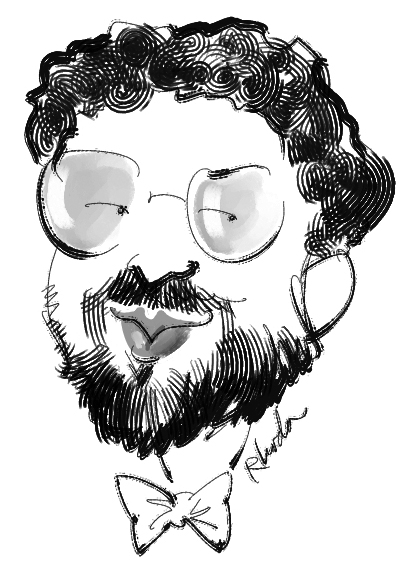
The ICANN Wiki folks have a great PR operation going on in their booth: caricatures of attendees. For regulars they use photos submitted online; for other attendees, they snap your picture on the spot, upload to their US-based caricaturist, and the picture is ready the next day. They print it out on a postcard-sized form factor that fits neatly into the ICANN name tag.

Check out the full Gallery.

Posted in Talks & Conferences | 3 Comments