The first round of Miami’s elections have early voting Aug 3-13, and the actual elections are Aug. 18. But the absentee ballots have already gone out, so here are my recommendations for the Judicial part of your ballot (the lowest bit).
Personally, I’d advise you not to trust to the mails with your ballot this year, but instead put it in a dropbox during early voting, but you do you.
General Intro
Unlike most law professors I know, I support the idea of judicial elections at the state level as a reasonable democratic check on what I believe should be the expansive power of judges to interpret the state and federal constitutions.
As I’ve often said before, if it were up to me, I’d have the executive branch pick judges with legislative confirmation, followed by a California-style retention election every few years in which there would be an up or down vote on the incumbent. If the vote was down, the executive would pick a new judge. It seems to me that the right question is “has this judge done a good (enough) job” — something voters might be able to figure out — rather than asking voters to try to guess from electoral statements which of two or more candidates might be the best judge.
Florida’s system uses appointment plus retention elections for Supreme Court Justices and District Court of Appeal Judges, but not for trial courts. The Governor can appoint judges to fill vacancies between elections, but otherwise those jobs are straight up elected, so a judicial election pits one or more challengers against the incumbent unless, lacking opposition, the incumbent wins reelection automatically; many trial judges were indeed unopposed this year. There are also open seats when the incumbent retires.
My recommendations are based on:
- My personal view that I will vote for an incumbent judge unless there’s reason to believe he/she is doing a bad job.
- After supporting incumbents, my other rule of thumb in sizing up candidates before even getting to the details of biography and practice experience is that in all but the rarest cases of other important life experience we ought to require at least ten years of legal experience from our lawyers before even considering them as judges. Fifteen years is better. I will very rarely support a judicial candidate fewer than ten years out of law school. It just isn’t long enough to get the experience and practical wisdom it takes to be a judge.
- I look for endorsements, including the Miami Herald. The Miami Herald is not 100% reliable, but this year I found I agreed with them in most cases.
- And oh yes, I read local blogs and listen to gossip too. Except this year, gossip is scarce, since I’m not leaving the house much due to immunocompromise.
All registered voters in Miami-Dade County get to vote on these judges, regardless of party affiliation.
This post is mercifully short compared to some past years because an astounding number of elections for Judge (27, I think) are unopposed this year. Maybe we don’t pay them enough? In fact, there are only six contested races: five for Circuit Judge and one for County Judge. Two of the Circuit Judge races have qualified incumbents and underqualified challengers, so these are easy cases. Ditto for the County Court race.
Here are my thoughts about how to vote in the August 18, 2020 judicial elections:
Circuit Judges
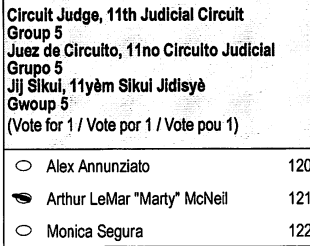
Group 5
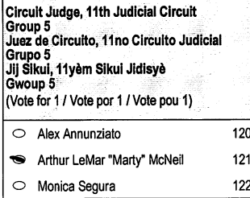 Open seat. There are three candidates. Alex Annunziato, Arthur LeMar “Marty” McNeil and Monica Segura. Alexander Annunziato is an in-house counsel at Ascendant Commercial Insurance. He has 21 years’ experience. Arthur McNeil is an Assistant Public Defender with 19 years’ experience. Monica Segura is Senior Managing Associate General Counsel for Universal Property & Casualty and has 20 years’ experience.
This isn’t a terribly hard call. McNeil has the most relevant experience, including 56 criminal jury trials and an unblemished record. Annunziato is a bit of an intriguing case as he was arrested for buying $20 worth of heroin from an undercover cop eight years ago. He didn’t contest the charge, and says he’s turned his life around. I don’t know him, and am prepared to believe it, but even so McNeil has the best bio.
(Segura, by the way, has almost no jury trial experience. Her biggest claim to fame is being married to Coral Gables Commissioner Ariel Fernandez. It would probably be wrong to hold that against her. Just don’t vote for her.)
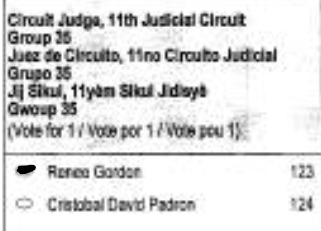
Group 35
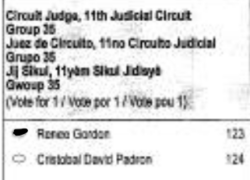 Open seat, easy case. Two candidates: Renee Gordon is an Assistant Public Defender with 30 years’ experience. Cristobal Padron is a family lawyer in private practice with 14 years’ experience. Both have run before and both lost by six and four percent margins respectively. I have endorsed Renee Gordon in both of her close losses, and I do it again. As I keep saying, she “has a long resume of working with troubled children in various managerial and legal capacities. This is a great background for a Judge – in the trenches and there for a long time.”
Christobal Padron has much less experience; Renee Gordon’s background is really top-notch. Maybe third time is the charm?
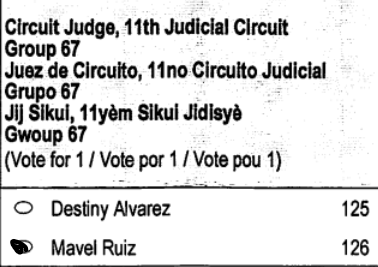
Group 67
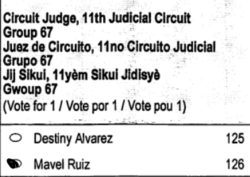 Not a slam dunk, but even so…
The incumbent is Judge Mavel Ruiz. Conservatives hate her because she initially blocked the transfer of valuable downtown Miami land from Miami-Dade College to the planned Trump library. Ruiz later dismissed the case when the College complied with its legal obligation to hold a public hearing on the giveaway. Having the spine to hold authorities to their duties in a high-profile case is a plus in my book. That said, Judge Ruiz does not have an unblemished record. As clumsy attack texts hitting my phone (headed, if you can believe it, “this is not an attack ad”!) like to remind me, Judge Ruiz ran into trouble for hugging a litigant in a high-profile case, And, Judge Ruiz received a written reprimand from the Florida Supreme Court because of a letter she and four other judges signed a letter to the Florida Department of Children and Families endorsing Our Kids of Miami-Dade & Monroe. As the court noted, none of the five judges who signed that letter did it for any personal gain. So while not nothing, it’s also not that much.
Unfortunately for sticklers, the challenger, DBA Destiny Goede Alvarez, has only has only five years’ experience as lawyer (way too little, IMHO), and now works as a partner at her father’s law firm after two years at GrayRobinson. She also changed her name to her husband’s shortly before filing, more than two years after being married, no doubt aware that women with Hispanic names tend to overperform in Miami-Dade judicial elections. She has a golden c.v., with Federalist Society chops, and links to the DeSantis administration, (Could that explain the anti-Ruiz text offensive?) She is raising money hand over fist. If she loses, as she deserves to, but which is far from a sure thing, I’m sure she will land on her feet.
Ruiz unseated Judge Fleur Lobree in 2014 when Lobree deserved to be re-elected, which might in some eyes create an opportunity for karmic justice. (Ruiz was re-elected in 2020.) I don’t care how good or smart Alvarez may be, but five years’ experience is nowhere near enough for a judge.
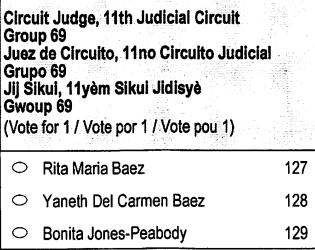
GROUP 69
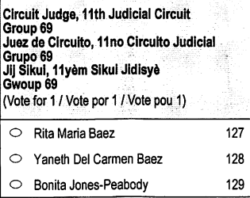 Open seat, confused by two Baez’s in the race. There are three candidates, and probably all are plausible.
Rita Baez is a personal injury lawyer in private practice with 30 years’ experience, nine as an Assistant States Attorney.
Yaneth Del Carmen Baez is an Assistant State Attorney with just 9 years’ experience in the State Attorney’s office, but the Herald endorsed her anyway based on the “intensity” of her caseload as an assistant state’s attorney, currently in the Human Trafficking Unit. I suspect that the fact that the Judicial Nominating Commission has nominated her for a judgeship four times (which suggests that top lawyers think very highly of her), but DeSantis never picked her, might have something to do with it.
Bonita Jones-Peabody, now in private practice, was formerly an Assistant Public Defender, and has 35 years’ experience. Jones-Peabody is an experienced criminal defense lawyer with over 200 jury trials in her resume, which includes many years at the Miami-Dade Public Defender’s Office before going into a varied private practice.
Rita Baez also has 80 jury trials, but on the civil side. She currently represents plaintiffs in auto accidents and slip-and-fall cases. A credible candidate, but I think the other two are stronger.
On experience I tend to favor Jones-Peabody. The fact that the JNC repeatedly thinks so highly of Yaneth Del Carmen Baez is something to weigh against a relatively short career as a lawyer, which makes this a harder case than I would like.
GROUP 76
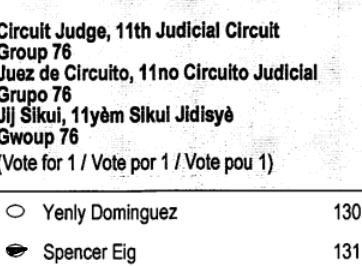
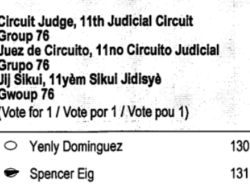 The incumbent is Judge Spencer Eig, a judge with 20 years on the bench, and I know of no reason to unseat him.
His challenger is Yenly Dominguez, a real estate & estate planning attorney with only 7 (!) years’ experience. Even if it was three times that much I’d vote to retain Eig.
Easy case.
County Judge
Group 25
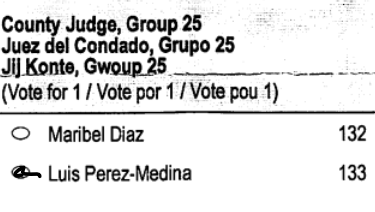
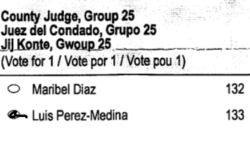 Just one contest for Circuit Judge, pitting incumbent (since 2018) Luis Perez-Medina, challenged by attorney Maribel Diaz, the director of legal services for the Miami-Dade County Tax Collector’s office. It sounds like Diaz, who has experience with foreclosures, collections, and property tax disputes, might make a good judge. But I can see no reason at all to turf out Perez-Medina who appears to be doing a fine job.

 Full official info here on times and locations.