Category Archives: Miami

Voter’s Guide to Coral Gables Election 2025

People have been asking me if I have recommendations for the upcoming Coral Gables elections. The problem is that local politics have become depressing, and given the state of national politics I don’t have much energy left over.

But. Yes, I do. Two of the races are easy, one a bit less so but no less important.

TL/DR:
Kirk Menendez for Mayor,
Felix Pardo for Group II, and
Tom Wells for Group III.

OK, here’s how I got there, for those who might care.

There are a few obvious points to make. The first is that every single member of the current Commission is a problem, although some are worse than others.  At present there are two factions on the Commission: One is the Vince Lago faction; the other is for the lack of a better term the anti-Lago faction. Two years ago Lago and his slate ran a well-funded pro-development campaign and were shocked when the voters didn’t hand them a majority, leaving Lago and (to my surprise) Rhonda Anderson on an island. The anti-Lago core is Ariel Fernandez  & Melissa Castro, both half-way through 4-year terms, and they’ve pulled in Menendez as the swing vote; it seems Menendez was repulsed by Lago’s nastiness and what seems from a distance as under-handedness and over-friendliness to development.

The second is that some of the new candidates are every bit as bad as the incumbents they want to ally with.

The third is that we have a fundamental cleavage between the nasty-verging-on-evil candidates on one side and the incompetent-verging-on-destructive candidates on the other side.  For me, though, this election is really a referendum on Vince Lago as much as anything else. The reason for saying this is that the errors the Lago faction would make–like over-development–cannot be corrected. The errors the anti-Lago faction make are mostly due to incompetence, and they can be corrected. Indeed with the right new blood I think they will be much improved.

Let me restate my priors here: the traditional dividing issue in Coral Gables has been how much development to allow. I’ve always opposed the hard-core NIMBYs but also the parties who take developer money in exchange for letting oversize development run wild. But, as the old Texas saying goes, in politics like in highways the only things in the middle of the road are a yellow stripe and a dead armadillo.

I think we’ve gone quite a bit too far in allowing monster complexes to take over downtown and elsewhere. They have changed the esthetic character of the city towards overpowering and ugly. They’re putting, or will put, a lot of small businesses e.g. on Miracle Mile, out of business. And while that ship may have largely sailed, we can stop making things worse and not allow it to spread further.

On the other traditional campaign issue – crime – I say that this is almost entirely demagoguery designed to frighten older voters and excite bigots.  Between those two groups, however, the perennial crime “issue” gets traction. But not with me. On the whole we have pretty good cops, at least when the Commission isn’t busy messing with them.

There are also some new issues surfacing this year.  One is the issue of whether it was wrong for the Commission to vote themselves salaries.  I have always believed that even part-time Commissioners deserve a salary, and that all of us benefit it the pool of potential candidates is not limited to the independently wealthy, business owners, the well-salaried, and perhaps those in the pay of interests that have business with a city. I think Lago & Co’s harping on this is just more demagoguery; it’s not only patrician and exclusionary, but it’s a tiny fraction of the City’s budget.

On another issue, I think Lago is actually right: I’ve said for years we should move the date of the city’s elections to when we elect other offices.  For the last 30 years or more, the Coral Gables establishment has steadfastly rejected this, arguing in public that voters get tire of long ballots so there is too much drop-off before they get the Commission races. In private I used to hear them say the real issue was keeping students at UM from voting.  Moving the date would save the City money; but the real issue is what best serves democracy. The Lago people having lost an election on the unique date, it seems they think their chances would improve in a more general election. I say so be it; more participation is a good thing. But this is not a deal-maker or deal-breaker in the grand scheme of things.

This takes me to an element of the current scene that I find particularly offensive. The Lago team has its tame PAC, “Coral Gables First”.  The name alone is offensive in two dimensions. To start with, if Coral Gables is “first” who is it who is “second”? Kendall? South Miami? Everyone else? This is not neighborly, and it’s not sensible. We’re in this together.  Second, Coral Gables First is a clear dog-whistle to MAGA politics. That is about the last thing we need in an already over-polarized political community.

Unfortunately, the MAGAfication of our local politics is of a piece with what has become the Lago M.O.: when Lago ran first ran for office he looked me in the eye and said he had no ambitions beyond serving on the Commission, and giving back to the City. To my shame, I believed him. Perhaps it was even true back then, but now there is no question now that Lago has the bug.

The amassing of a huge war chest, the creation of a formal slate in the last election, and the early embrace of “critical theory” as an enemy were all signs of someone who had drunk the MAGA Kool-Aid and had ambitions for greater things,  perhaps even Congress. After all, it worked for Marco Rubio didn’t it?  In any case, losing his majority on the Commission must have been a great shock, and what there was of Lago’s civility vanished.

Admittedly it must be hard for Lago, who at least understands how the city works, to be consistently outvoted by a group which follows Ariel Fernandez’s lead and sometimes give the impression that it is at sea. Fernandez has lived down to his political history as an aide to the corrupt David Rivera.  But even so, stupid—even when it messes up hiring a City Manger–is better than evil. And in any case Fernandez is not the ballot this year, but Lago is.

Lago’s chief opponent is Kirk Menendez.  Of the current governing majority on the Commission, Menendez is the least troubling, but mostly in the nonentity sense.  He came into office, I thought, prepared to ally with Lago but at least from out here it looked like he got offended by Lago’s high-handedness and pro-development stance and switched sides. I’m not going to argue that Menendez is wonderful.  But he’s better than the alternatives.

Before she got elected Rhonda Anderson seemed like a classic good government candidate, one who came up through the ranks and had grass roots interests at heart.  I’ve been bitterly disappointed by her voting record, which is to support Lago in all he does and what limited leadership we’ve seen has not been in the direction of listening to or empowering residents. Felix Pardo seems like a far better choice.  He’s been around a long time, and served his time on numerous city boards. He’s endorsed by the Police, the Firefighters and (yikes?) the Teamsters (solid waste collectors).  He sounds like the sort of candidate who used to run things in the good old days.  Maybe they were a bit clubby for my taste, but sometimes you don’t know when you are well off.

In Group III the leading candidate is likely Richard Lara, who might make Lago look good.  Our only hope here is Tom Wells. One of his big issues is reopening Burger Bob’s about which I personally could not care less. And I think he’s on the wrong side of the election date issue. But he won’t be in the pocket of developers, he credibly claims to be not just an advocate but a practitioner of civility, and being a lawyer we can expect him to be more punctilious about following rules than some of the folks not on the ballot. Please please don’t vote for Lara.

So, bottom line:

Kirk Menendez for Mayor,
Felix Pardo for Group II, and
Tom Wells for Group III.
Posted in Coral Gables | Comments Off on Voter’s Guide to Coral Gables Election 2025

No Joke

There was a saying (which I first encountered 30+ years ago in the UK) that, “Everyone talks about the weather, but no one does anything about it.”

That silly joke has a much more ominous cast in light of global warming.

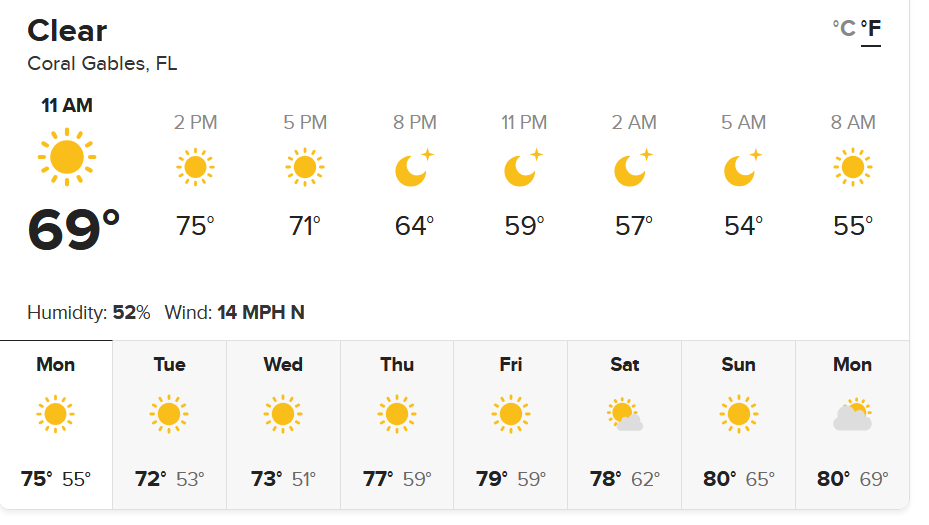
On a less grim note, it’s so cool here today I not only could open the windows but I put on a sweater! This is quite rare in South Florida.

On a technical note, this will be my first attempt to auto-post to Bluesky….

Posted in Coral Gables, Global Warming | 2 Comments

Election 2024 Summary & Downballot Voter’s Guide

[This post will remain on top of the blog until after polls close in Florida on Nov. 5.]

This is a critical election.  You really should vote, and soon. Early voting has begun, so why wait.

Here’s a crib sheet with some suggestions about the downballot, plus links to the posts that explain them.

County Offices

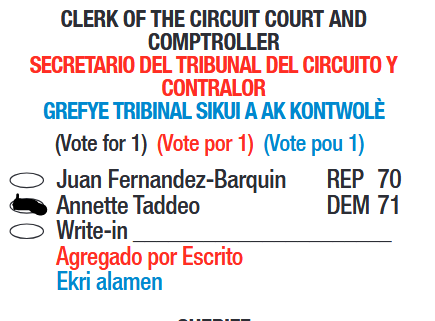
Clerk of Court: Annette Taddeo (Line 71)
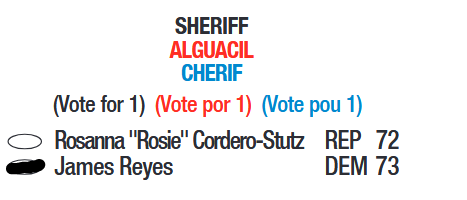
Sheriff: James Reys (Line 73)
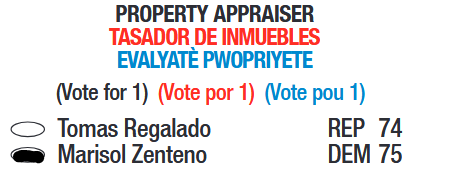
Property Appraiser: Marisol Zenteno (Line 75)
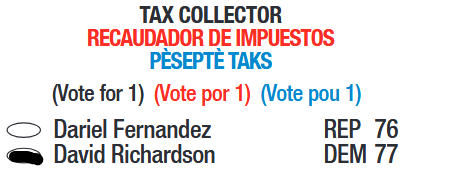
Tax Collector: David Richardson (Line 77)
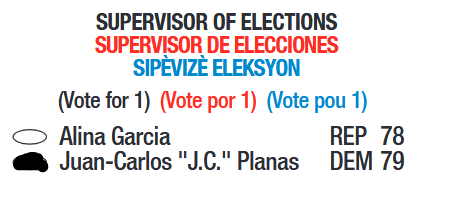
Supervisor of Elections: “J.C.” Planas (Line 79)

Judicial Retention Elections

Justices of the Supreme Court
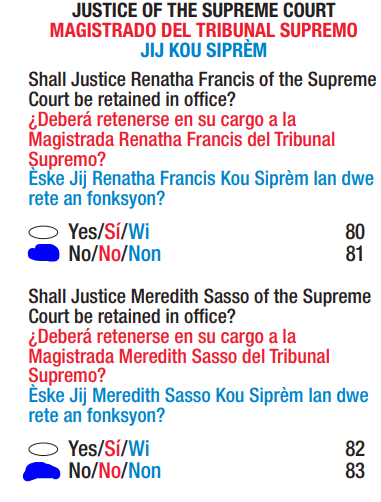
Justice Renatha Francis: NO (Line 81)
Justice Meredith Sasso: NO (Line 83)

3rd DCA
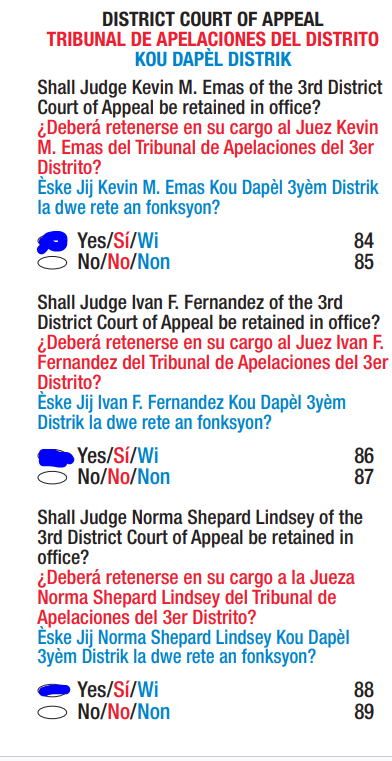
Judge Kevin Emas: YES (Line 84)
Judges Ivan Fernandez: YES (Line 86)
Judge Norma Shepard Lindsey: YES (Line 88)

County Court
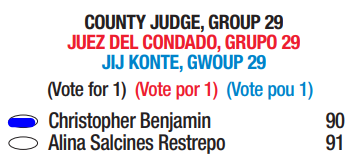
Christopher Benjamin (Line 90)

Miami-Dade Commission, District 7
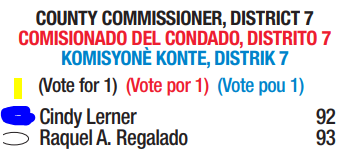
Cindy Lerner (Line 92)

Constitutional Amendments
NO on Amendment 1. (Line 251)
NO on Amendment 2. (Line 253)
YES on Amendment 3. (Line 254)
YES on Amendment 4. (Line 256)
YES on Amendment 5. (Line 258)
NO on Amendment 6. (Line 261)

Reasoned comments are always welcome.

Posted in 2024 Election, Florida, Miami | 1 Comment

Time to Show We Mean it About the Environment

In many ways Rachel Regalado, the incumbent District 7 Miami-Dade Commissioner, has not been as bad as I expected when she got elected. To give her her due, in some ways she’s even been good.

But in one way she has been absolutely terrible, and I think it’s important for voters to make it clear that some things are just not acceptable. As explained at FloridaPolitics.com,

Regalado … voted in November 2022 to override Miami-Dade Mayor Daniella Levine Cava’s veto of legislation expanding the Urban Development Boundary (UDB) so a 379-acre industrial complex could be built just west of Biscayne Bay near Homestead.

It marked the first expansion in nearly a decade of the UDB, which is meant to safeguard agricultural and vulnerable lands from residential and commercial encroachment. Regalado originally opposed the move, but switched her vote after developers increased the amount of wetlands they would buy and donate to offset the project’s impacts.

The UDB needs to be a bright line.  Some developer is always pushing to nibble a piece here, a piece there; pretty soon we don’t have any Everglades. It’s a really big deal to slice off even a small chunk as it sets a terrible precedent.

Regalado’s defenders might say that other than this blemish she has a decent environmental record. Not so. She also supported the attempt to build homes on top of de facto bird sanctuary at the Calusa Golf course. A court put a stop to that, although in typical Miami fashion the bulldozers rolled on for a bit longer.

I’m not quite a single-issue voter on the UDB, but I’m close. As we have a very qualified alternative, former Mayor of Pinecrest Cindy Lerner, I have no doubt that I’m voting Line 92 Cindy Lerner.

Posted in 2024 Election, Miami | Comments Off on Time to Show We Mean it About the Environment

Some Thoughts about the Downballot (Voters’ Guide Part II: Judicial Retention Elections)

This got long, so the Florida constitutional amendments will be in Part III. Previously: Some Thoughts about the Downballot (Voters’ Guide Part I: County-Wide Elected Offices).

As long-time readers know, unlike most law professors I know, I support the idea of judicial elections at the state level as a reasonable democratic check on what I believe should be the expansive power of judges to interpret the state and federal constitutions.

As I’ve often said before, if it were up to me, I’d have the executive branch pick judges with legislative confirmation, followed by a California-style retention election every few years in which there would be an up or down vote on the incumbent. If the vote was down, the executive would pick a new judge. It seems to me that the right question is “has this judge done a good (enough) job” — something voters might be able to figure out — rather than asking voters to try to guess from electoral statements which of two or more candidates might be the best judge.

Florida’s system uses appointment plus retention elections for Supreme Court Justices and District Court of Appeal Judges, but not for trial courts. The Governor can appoint judges to fill vacancies between elections, but otherwise those jobs are straight up elected.

This year we have two retention elections for (sadly, manifestly unqualified) Supreme Court Justices, three slots on the 3rd District Court of Appeals, and one County Judge. Both are trial courts, but the County Courts have a more limited jurisdiction.

For the Supreme Court Justices, I will give you my own views, based on reading key decisions and my more than thirty years teaching law.  As with the local judges, I do think that there should be a presumption of retention. But that presumption can be overcome for good cause.

For the local races, this year my recommendations are based on:

  • My personal view is that I will vote for an incumbent judge unless there’s reason to believe they’re doing a bad job and the challenger would do better.
  • After supporting incumbents, my other rule of thumb in sizing up candidates before even getting to the details of biography and practice experience is that in all but the rarest cases of other important life experience we ought to require at least ten years of legal experience from our lawyers before even considering them as judges. Fifteen years is better. I will very rarely support a judicial candidate fewer than ten years out of law school. It just isn’t enough to get the experience and practical wisdom it takes to be a judge.
  • I look to see if the candidate filed a voluntary self-disclosure form with the state. Many don’t.
  • I’ve become decreasingly reliant on third party sources. I used to rely a lot on the Dade County Bar Association Poll in which lawyers rate the candidates’ qualifications. But the response rate is low enough that I’ve come to wonder about it. Similarly, I’ve soured on the reliability of endorsements. Where once SAVE Dade seemed like a fairly reliable guide, now rebadged as SAVE, it doesn’t seem to me to be as reliable as I used to think it was, in light of a string of, I thought, erroneous endorsements.
  • The Miami Herald makes endorsements. In the case of elected officials, I think the decision-makers there are so terrified of annoying establishment candidates that their endorsement only means something if they buck an incumbent. And when did that last happen? But in the case of judicial races, I’ve come to think maybe they do a better job.

Justices of the Supreme Court

Once upon a time, not so very long ago in fact, the State of Florida had a Supreme Court it could be proud of. I would have easily placed it among the top ten nationally, and you could have made a case for top five. But those days have passed. Mandatory retirement created an opportunity for a near-complete turnover on the court.  Quality has suffered.  (The FLSCT is also much much more conservative. But that alone is no reason, I think, to vote not to retain a Justice (or a Judge). What matters is the quality of their work.)

This year we’re asked whether to retain Justice Renatha Francis and Justice Meredith Sasso. Both of the Justices up for retention this year are recent appointments by Gov. DeSantis. But even more than his earlier appointments these two Justices cross a line into partisanship that has produced judicial opinions that simply fail to meet a basic threshold of fairness and quality. Neither deserves to be retained.

Florida law sets out a process for the approval of ballot provisions seeking to amend the state constitution. In it, the Florida Supreme Courts gets to rule as to whether the amendment is limited to a single subject, and whether its ballot summary is fair or misleading. It does not get to opine on the merits. In the case of the two most contentious proposals this year, Amendment 3 decriminalizing marijuana, and Amendment 4 protecting some rights to abortion, Court majorities (5-2 and 4-3, respectively) approved the proposed summary ballot proposals.

Both Justice Renatha Francis and Justice Meredith Sasso were in the minority both times. In other words, they voted to keep both amendments off the ballot—something devoutly wished by Republicans who feared the inclusion of the amendments would bring Democratic voters to the polls.

What did they say was wrong with the amendments?  Brace yourself. (Full text of decisions on Amendment 3 and Amendment 4).

Justice Francis’s dissent called Amendment 4’s summary “overwhelmingly vague and ambiguous,” centering much of her criticism on the term “healthcare provider” a term she claimed would be unclear to voters.  Yes, really. [See p. 74.]

And she added that it was “highly unlikely that voters will understand the true ramifications of this amendment” because the “title fails to communicate to the voters that the purpose of the proposed amendment is ending (as opposed to “limiting”) legislative and executive action on abortion, while inviting limitless and protracted litigation in the courts because of its use of vague and undefined terms.” And, “the summary hides the ball as to the chief purpose of the proposed amendment: which, ultimately, is to—for the first time in Florida history—grant an almost unrestricted right to abortion.” [P..53].  Even the conservative majority couldn’t swallow that, holding that “the broad sweep of this proposed amendment is obvious in the language of the summary,” [p.19] and that “[t]he ballot title’s inclusion of the word ‘limit’ is . . . not misleading but accurately explains that the Legislature will retain authority to ‘interfere[] with’ abortions under certain circumstances. [P. 21.]

In addition to suggesting that voters would be fooled, Justice Sasso claimed that despite long-standing precedents to the contrary the Court had a right to object to the content of the proposed amendment: “our review in ballot initiative cases is narrow, [but] this case is different because abortion is different. Dobbs, 597 U.S. at 218 (Syllabus) (“Abortion is different because it destroys what Roe termed ‘potential life’ . . . . None of the other decisions cited by Roe and Casey involved the critical moral question posed by abortion.”).” [P. 59.] I take this to mean that basically no pro-choice amendment would ever pass muster with this Justice.  Ever.

I find that outrageous.

Similarly, Justice Sasso claimed that Amendment 4 was “a proposal with no readily discernable meaning.” [P. 66.] To get there, she had to deny that ““viability,” “healthcare provider,” and “patient’s health” all “have clear meanings that are obvious to voters” [P. 74.] but rather “[n]one of those terms have any sort of widely shared meaning.” [P. 74.] Again, even the conservative majority was unpersuaded.

This is, to my eye, results-oriented jurisprudence; when it comes in the context of the constitutional amendment process, it’s particularly inappropriate.

On Amendment 3, Justices Sasso and Francis were the only dissenters.

Justice Sasso complained that the amendment summary said it “allows” state-licensed entities to sell pot, when in fact all it did was remove legal obstacles to future legislation permitting those sales. [P. 43.]

Justice Francis alone agreed with Justice Sasso, but added that she thought Amendment 3 violated the single-subject rule because it not only decriminalized marijuana but also allowed for it to be commercialized (er, isn’t that what happens under capitalism when something is legal?).  No one else on the court bought into that.

I could go on, but this post is long enough.

(Incidentally, if you need more reasons to vote against Justice Francis, there are many reasons to think she was never qualified for the job to begin with. Indeed, the Florida Supreme Court found that Gov. DeSantis’s first attempt to appoint her was invalid because she had not been a member of the Florida Bar for the required ten years.  Didn’t stop him from trying again once she was.  In addition to her lack of legal experience, there is the ethics question….)

These Justices don’t deserve retention. Amazingly even the Miami Herald agrees.

Third DCA

One easy and two less easy ones. The easy one is to retain Judge Kevin Emas (Retain-Line 84). He was appointed by Governor Charlie Crist in 2010, back when Crist was a Republican, so he’s no liberal, but I have no reason to doubt he merits retention.

As to the others, Judges Ivan Fernandez and Norma Shepard Lindsey, I feel less-well informed. (Incidentally, here’s a nice profile of Judge Fernandez, showcasing his experience on SWAT teams before becoming a lawyer.) Third-party groups break on partisan lines: some local democratic clubs advise against retention; some local far-right groups endorse them (and oppose Emas).  Folks I know are a bit all over the map, but I’ve heard nothing specific enough to overcome my presumption that Judges should be retained unless there’s a clear reason not to.

County Court

I like Christopher Benjamin. Here’s a fun profile of Benjamin. Benjamin has been a lawyer for 22 years with quite varied experience (see the profile). FWIW the bar survey had him at 77% of “qualified” or “exceptionally qualified,” while only 57% said the same about his opponent, Alina Restrepo who has 25 years experience in private practice. Over 42% said Restropo was “unqualified”; only 23% rated Benjamin that poorly.  That said, the turnout was so low as to make the results rather dubious…

Coming up Real Soon Now™ the Constitutional Amendments.

Posted in 2024 Election, Law: Constitutional Law, Law: Elections, Miami | 2 Comments

Some Thoughts about the Downballot (Voters’ Guide Part I: County-Wide Elected Offices)

I assume that all readers of this blog have clear ideas about how to vote in the federal elections, and probably the state legislative elections as well. (If not, feel free to email me!) But much of the rest of our lengthy ballot can be murky even for generally well-informed people. So I offer you some I hope informed opinions, worth at least what you are paying for them.

This post will consider five County-wide elected offices.  My next post will discuss the judicial retention elections and the six proposed state constitutional amendments. If time permits I may tackle a few of the School Board and the County Commission races later.

I’ll take the ballot items in the order they appear….

Clerk of the Court.  This pits perennial candidate Annette Taddeo against Juan Fernandez-Barquin who Gov. Ron DeSantis appointed to fill out long-time Clerk Harvey Rubin’s term. I like Annette, so I’m not unbiased here, but there are good reasons to be nervous about Fernandez-Barquin in these polarized times. The Clerk should be a neutral; Fernandez-Barquin, a former State Representative, likely got DeSantis’s attention by sponsoring H.B.1 the notorious 2021 “anti-riot” law designed to make public protests much riskier by apparently making everyone at a protest a criminal if anyone was. Ultimately the 11th Circuit upheld the act, but only after Florida state courts issued a narrowing construction clarifying that – contrary to what its backers had seemed to want – the law would not criminalize attending a protest at which others engaged in violence. None of this, however, gives me much confidence in Fernandez-Barquin as a quasi-judicial officer. Annette Taddeo Line 71.

Sheriff.  I wrote about this the other day (see I Watched the Sheriff’s Debate).  My suggestion here is only based on what I saw, but I don’t want my Sheriff helping with mass roundups of my neighbors, so I suggest you vote for James Reys Line 73.

Property Appraiser.  If you think Tomás Regalado was a good Mayor of Miami, you might be happy with him as the Property Appraiser (but see this).  If you think relevant job experience matters, you might prefer Marisol Zenteno, who has ten years’ experience in the property appraiser’s office and is a certified property assessor to boot. As it happens I am not a great fan of the Regalado clan, nor of his tenure as Mayor, so even though I’m not awed by Zenteno, that’s the way I’m voting. Marisol Zenteno Line 75.

Tax Collector. This is one I do have a strong view about. I think David Richardson was a terrific state rep, who leveraged his accounting background to do important investigations when in the legislature. He’s not only a CPA but also was formerly an auditor at the department of defense. I consider Richardson one of the finer local elected officials. His opponent, Dariel Fernandez, has small-business private sector experience, but that’s of limited relevance.  This one is really a no-brainer: David Richardson Line 77.

Supervisor of Elections.  Tucked in the middle of the ballot is a race with potentially great consequences.  There is a national movement afoot to elect partisan election supervisors who will, if the opportunity presents (or in some cases even it does not!) impose MAGA restrictions on who can vote, how ballots are counted, and how the results are reported.

This race presents a stark choice between Juan Carlos “J.C.” Planas and State Rep. Alina Garcia.

Rep. Garcia is endorsed by no less than Donald Trump. For this sort of a job, that alone should be game over.  But wait! If ever there was a case for guilt by association then surely Garcia’s record as former chief of staff and senior policy adviser for Hialeah Mayor Esteban Bovo and former deputy chief of staff for Miami Commissioner Joe Carollo ought to raise multitudinous red flags.

Fortunately, we are not reduced to the least of two evils.  We have a genuinely qualified quality candidate in J.C. Planas (disclosure: I donated to his campaign).  Planas spent most of his career as a Republican, but left the party for obvious reasons. And Planas is an election law expert, who teaches it at St. Thomas University School of Law. I found him knowledgeable and charming in our one phone conversation, and other folks who know him better than I speak very highly of him. This one is not just a no-brainer but a potentially major race if we want to protect the integrity of the electoral system: Vote for “J.C” Planas line 79.

Part 2 is in progress…stay tuned.

Posted in 2024 Election, Miami | 1 Comment