
Yearly Archives: 2009

Good Advice for Law Exam Takers

In the course of an internal email exchange at the law school about advice for law exam takers, Professors Caroline Bradley and William Widen sent in the following sound and pithy advice which they have kindly allowed me to post here:

Caroline Bradley said,

I think that the advice I really would hope more people would take would involve:

1. reading the question carefully – you should answer the question the professor asks, not a different one you would prefer to answer;

2. thinking before beginning to write so the answer is organized and so you don't include irrelevant information;

3. answering the question rather than trying to show how much you know or how much work you have done – relevance is crucial;

4. not making assumptions or inventing facts in a hypothetical;

5. spelling out the analytical steps you are taking rather than merely writing down your conclusions.

William Widen said,

1. Just as a good advocate will take account of the judge who is presiding over the case, the student should take account of advice given and preferences expressed by the particular professor in the course. This does not mean that you must agree with the views expressed by the professor on open points or points of policy, but answers should, as appropriate, address matters focused on in the course.

2. Take the time to carefully read the instructions for each question. Some questions may ask you to write a response as if you were a judge or writing a memo for a client. To the extent possible, be mindful of any role you are asked to play or any context in which you are asked to place yourself. If the question asks you to adress three points in particular, address those three points clearly in your answer. Be responsive to the questions asked and provide responses in the appropriate format.

3. In a standard issue spotter/essay question, professors often want you to demonstrate both knowledge of particular legal doctrines and their parameters AND how those doctrines and parameters might apply to the facts in the question—including identification of alternative theories and ways of looking at the facts. A bald statement of legal doctrine (merely reciting boilerplate or treatise type language) is usually a bad idea. Don't make conclusory statements about doctrine like: there is a contract in this case because there was an offer, an acceptance and consideration. Rather, in addition to identifying the parameters of the doctrine, also identify the facts in the problem that constitute an offer, an acceptance and consideration, identifying why the particular facts fit the parameters of the doctrine as well as any problems with that application. Don't assume that the first doctrine that comes to mind is the only doctrine that is being tested. Take a few minutes to consider alternatives to your first impression—perhaps outlining an answer on scratch paper. Don't assume the professor will read your mind—if you cite to a case explain briefly why that case supports or does not support the position you are taking. Demonstrate on paper your thought process so the professor can evaluate it.

4. Avoid careless misstatements of doctrine. For example, in the UCC the staute of frauds applies to sales of goods with a price of $500 or more. Don't identify the rule as applying to goods with a “value” of $500 or more (when the correct term is “price”) or identify the rule as applying to goods with a price of “more than $500” when the correct formulation is “$500 or more.”

5. Be alert for chances to support your answer/choice of applicable doctrine by reference to the rationale or policy that supports the rule you are using.

6. Don't waste time telling the professor to have a nice summer.

7. Don't waste time telling the professor that you are now running out of time. Write a few more responsive words or sentences.

8. Budget your time so you do not get zero points on one question. Often it is very hard to make up for a zero on one question with a detailed answer to another question. If time is short, provide at least an outline of your answer to each question.

9. Do not waste a lot of time merely reciting the facts in the problem. The professor wrote the question and knows the facts. He or she wants you to apply the law to the facts not merely summarize the facts.

Personally, I always recommend reading Getting to Maybe — but the above is much much shorter!
Posted in Law School | 7 Comments

A Promise Kept

There's been a lot about this liberal Republican administration's economic and imperial policy that I have found hard to swallow, but credit where credit is due, they didn't promise to be any different, and in one important respect an important Democratic promise is being kept: CIA shuts down its secret prisons.

The US has stopped running its global network of secret prisons, CIA director Leon Panetta has announced.

“CIA no longer operates detention facilities or black sites,” Mr Panetta said in a letter to staff. Remaining sites would be decommissioned, he said.

The “black sites” were used to detain terrorism suspects, some of whom were subjected to interrogation methods described by many as torture.

Please don't tell me that the no-longer-very-secret secret prisons are going to be replaced by really secret prisons.

Posted in Torture | 7 Comments

Local Blogger Wins Case

Congratulations to David O. Marcus for this big win : Pain doctor trial: judge orders government to pay most of M.D.'s legal bills.

Calling the actions of prosecutors “profoundly disturbing,” a federal judge in Miami has ordered the U.S. government to pay sanctions topping $600,000 in the case of a South Florida physician charged with illegally prescribing painkillers.

U.S. District Judge Alan Gold is forcing the government to pay Dr. Ali Shaygan more than half the costs he incurred to defend himself at trial as punishment for secretly recording his defense team.

In a harshly-worded 50-page order, Gold said the “win-at-any-cost behavior” of federal prosecutors Sean Cronin and Andrea Hoffman raised “troubling issues about the integrity of those who wield enormous power over the people they prosecute.”

Kidding aside (I couldn't resist the headline, sorry David), this is a major verdict and an important victory, especially as it comes on the heels of the Stevens case. Two cases isn't a huge sample, but it at least raises the possibility that under the prior administration the Justice Department may have developed problems that go beyond partisanship and involve losing sight of their mission to do justice rather than win at all costs.

Posted in Law: Ethics | 2 Comments

Jon Stewart Tackles Obama Derangement Syndrome

Right-wing commentators, probably read by some of my trolls, are going loopy over what they claim is galloping Obama-inspired tyranny. Yes tyranny. Jon Stewart skewers this Obama Derangement Syndrome (he calls it 'Baracknophobia'):

The Daily Show With Jon Stewart M – Th 11p / 10c
Baracknophobia – Obey
comedycentral.com
Daily Show
Full Episodes
Economic Crisis Political Humor

This other riff, making fun of Obama's trip, is pretty wonderful too:

The Daily Show With Jon Stewart M – Th 11p / 10c
00Bama – International Man of History
comedycentral.com
Daily Show
Full Episodes
Economic Crisis Political Humor

After something of a fallow period, Stewart seems back in full form.

Posted in Politics: US | 4 Comments

Lessons from the Identity Trail Published Today

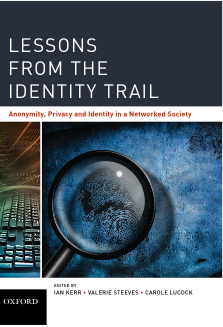
ID-trail-med.pngLessons from the Identity Trail (Ian Kerr, Valerie Steeves & Carole Lucock, eds.), a whale of a book, is being published today.

During the past decade, rapid developments in information and communications technology have transformed key social, commercial, and political realities. Within that same time period, working at something less than Internet speed, much of the academic and policy debate arising from these new and emerging technologies has been fragmented. There have been few examples of interdisciplinary dialogue about the importance and impact of anonymity and privacy in a networked society. Lessons from the Identity Trail: Anonymity, Privacy and Identity in a Networked Society fills that gap, and examines key questions about anonymity, privacy, and identity in an environment that increasingly automates the collection of personal information and relies upon surveillance to promote private and public sector goals.

This book has been informed by the results of a multi-million dollar research project that has brought together a distinguished array of philosophers, ethicists, feminists, cognitive scientists, lawyers, cryptographers, engineers, policy analysts, government policy makers, and privacy experts. Working collaboratively over a four-year period and participating in an iterative process designed to maximize the potential for interdisciplinary discussion and feedback through a series of workshops and peer review, the authors have integrated crucial public policy themes with the most recent research outcomes.

The book is available for download under a Creative Commons Attribution-Noncommercial-No Derivative Works 3.0 Canada License by chapter. Hard copies are available for purchase at Amazon & at Oxford University Press.

I've got two chapters in it, Identity Cards and Identity Romanticism and Anonymity and the Law in the United States. And I'm very pleased to be in such wonderful company — it was a valuable conference full of interesting people and the materials collected here are going to be of interest to people in many of the cross-cutting fields around the world. And the chapters are (painfully) short.

The full Table of Contents, with links to the online versions of the chapters is below. Some chapters won't be released for a few weeks, so keep an eye on the main site for updates.

Continue reading

Posted in ID Cards and Identification, Law: Constitutional Law, Law: International Law, Writings | 14 Comments

Of Koh, Johnsen … and Bork

Astonishingly, a group of Republican Senators is threatening to filibuster the nominations of Dean Harold Koh (for Legal Adviser to the Secretary of State) and Dawn Johnsen (for head of OLC). There appear to be two threads to this campaign. The overt thread is simply based on lies and the occasional irrelevancy. The covert campaign, if reports can be believed, is based on something even more disgusting.

The campaign against Koh is based on the scurrilous allegation that he supports the application of Sharia law in the US. The source for this is the New York Post's reporting of what someone seems to have misheard or misremembered from an alumni event a few years ago. It's bunk. But don't take my word for it, or that of his long-time colleagues, turn instead to well-known lefty Theodore Olson and to Tom Smith, of the Right Coast, who blogs Right wing nuts should not be nuts about Koh.

I do not believe that Professor Koh said let's enforce sharia in the US at some alumni gathering. Possibly some Yale Law Alum thought that was what he said. One of the things I like about having gone to a wealthy law school is that open bars are frequently present at alumni gatherings. But seriously, you don't get to be the dean of Yale Law School by saying stupid things, or at least not that sort of stupid thing.

… Speaking just for myself then, I will say that the right wing critics of Koh are doing an excellent job appearing to be nearly totally ignorant of the relevant areas of law and look like know-nothing attack puppies of anything liberal. As is their right, I suppose. Everyone has to make their own way down the right wing nut career path I suppose. But just maybe they should consider talking to some real conservative international law experts (of which I am not one, but there are some out there) before they shoot off their mouths. Just a thought.

More from Tom in a minute. But first, the Dawn Johnsen case. The ostensible case against Dawn is that she has misrepresented a position she took in litigation relating to abortion law. The charge is wholly false, as detailed in an open letter to Senator Specter from Andrew Koppelman which begins,

It has come to my attention that a footnote in my article, Forced Labor: A Thirteenth Amendment Defense of Abortion, 84 Northwestern U. L. Rev. 480 (1990), has been cited for the proposition that the brief that Dawn Johnsen wrote in Webster v. Reproductive Health Services claims that the Thirteenth Amendment guarantees a woman’s right to abortion. The Webster brief to which my article referred, however, was not the brief submitted by Dawn Johnsen but was an entirely different brief.

Another idea bruited about is that Prof. Johnson isn't up to the job somehow — even though she held the job in an acting capacity for some time in the Clinton administration.

So much for the overt cases. Stupid politics of destruction only somewhat worse and stupider than usual.

The alleged covert manoeuvrings, on the other hand, are much worse. Scott Horton reports,

Senate Republicans are now privately threatening to derail the confirmation of key Obama administration nominees for top legal positions by linking the votes to suppressing critical torture memos from the Bush era. A reliable Justice Department source advises me that Senate Republicans are planning to “go nuclear” over the nominations of Dawn Johnsen as chief of the Office of Legal Counsel in the Department of Justice and Yale Law School Dean Harold Koh as State Department legal counsel if the torture documents are made public. The source says these threats are the principal reason for the Obama administration’s abrupt pullback last week from a commitment to release some of the documents. A Republican Senate source confirms the strategy. It now appears that Republicans are seeking an Obama commitment to safeguard the Bush administration’s darkest secrets in exchange for letting these nominations go forward.

After being one of the first people online to dissect the first torture memos to be released, I've mostly stopped posting about the newer torture memos because so many others were doing it so well. But it bears repeating that there is no excuse for these memos to be kept secret (there might be a case for the occasional redaction, it's impossible to say in the abstract). It's not proved, but holding nominations hostage in order to either keep a cover up in place, or to protect the guilty from whatever consequences may be due for alleged war crimes, would be — if true — a sign of a the ultimate moral collapse on the part of the Senate GOP.

Even if the torture angle turns out to be a red herring, there's still some ugly politics going on here — in part to block Koh and Johnsen from any future court appointments, in part as the rollout of a general campaign of obstruction on all court appointees who don't belong to all-male country clubs or contribute to the Republican party.

The excuse commonly trotted out by saner and more moral Republicans for obstructionist behavior of the overt sort described is that it's simply payback for what they believe was done (unfairly) to Judge Bork (and sometimes Justice Thomas gets mentioned too). There's some of this in Tom Smith posting noted above. The claim is that somehow Judge Bork was subjected to a 'politics of destruction' and that changed the terms of the debate.

There are two major problems with this assertion. The first is that while the overt case against Koh and Johnsen is based on lies, the gravamen of the case against Judge Bork was based on his actual views: he didn't believe there is a right to privacy in the Constitution; this wasn't just about abortion, but also about cases like Griswold v. Connecticut (striking down a ban on condom sales, even to married people). That was a legitimate inquiry, and a perfectly sound reason to turn down his nomination. The howls of rage it produced on the right were because, but for their reframing, the Bork case would have stood for the proposition that right-wing extremists are not welcome on the Supreme Court. In the event we ended up with four of them.

The second major problem with the “Koh is payback for Bork” thesis is that the cases are not parallel. There's much more scope for considering a nominee's views who is up for a judgeship than there is for an executive branch job. Judges have life tenure. Supreme Court Justices have independent power. The people in the executive branch work for the President. (Independent agency officials occupy a middle ground.) I'm not saying there is no scope for inquiring into an executive branch nominee's views. On the contrary, sometimes it's a good way to get the nominee to make promises of future action. Second, there are views or histories that do disqualify someone from having an executive post, and not just the obvious ones like racism, sexism, violent temper (think “John Bolton”), criminal past, tax evasion (yes), or the like. I'd also include people who had committed themselves in their speech or writing to views inimical to the agency's mission. None of this, however, remotely applies here, and none of it justifies even the threat of a filibuster. (I'm not against filibusters – I do think we should go back to the old-fashioned kind where people actually have to hold the floor, though.)

[Note: I was a student of Harold Koh's when he started teaching at Yale. Great course. And Dawn Johnsen was, I think, a year ahead of me in law school. I've stayed vaguely in touch with Professor and then Dean Koh since graduation, but haven't seen Dawn in a very long time.]

Posted in Politics: US | 4 Comments