
Al Gore's opening statement to his congressional testimony on global warming:
Bonus video: Boxer Tells Sen. Inhofe “An Inconvenient Truth”.
Al Gore's opening statement to his congressional testimony on global warming:
Bonus video: Boxer Tells Sen. Inhofe “An Inconvenient Truth”.
 New Scientist, Table-top fusion, back with a pop:
Reports that the bubble had burst for a form of cheap, table-top nuclear fusion may have been premature. Rusi Taleyarkhan, the physicist at the centre of a furore surrounding so-called bubble fusion, was last week cleared of scientific misconduct.
In 2002, Taleyarkhan, then at Oak Ridge National Laboratory in Tennessee and now at Purdue University in West Lafayette, Indiana, published a paper in Science claiming that bombarding a solvent with neutrons and sound waves produced tiny bubbles that triggered nuclear fusion reactions. Then in March 2006, Purdue began investigating allegations of misconduct against Taleyarkhan, amid accusations that the evidence of fusion he reported was actually caused by a radioactive isotope of californium.
However, on 7 February, Purdue absolved Taleyarkhan's group of any misconduct. The verdict follows independent verification of Taleyarkhan's results by Edward Forringer of LeTourneau University in Texas and his colleagues last November (Transactions of the American Nuclear Society, vol 95, p 736).
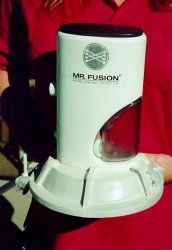
I want my “Mr. Fusion”!
Could it be that the Universe is “only” 43 billion-light years in diameter at its smallest? And that it is shaped like a soccer ball — or rather, like a Poincaré dodecahedron? And that when you get to an edge, you just reappear at the other side, rotated 36 degrees?
Apparently, current information about the background radiation of the universe is sufficiently consistent with this hypothesis so that we can't rule it out. The full explanation is in A cosmic hall of mirrors. It's a little complex, but here's a slice of it,
We found that the smallest dimension of the Poincaré dodecahedron space is 43 billion light-years, compared with 53 billion light-years for the “horizon radius” of the observable universe. Moreover, the volume of this universe is about 20% smaller than the volume of the observable universe. (There is a common misconception that the horizon radius of a flat universe is 13.7 billion light-years, since that is the age of the universe multiplied by the speed of light. However, the horizon radius is actually much larger because photons from the horizon that are reaching us now have had to cross a much larger distance due to the expansion of the universe.)
If so,
A rocket leaving the dodecahedron through a given face immediately re-enters through the opposite face, and light propagates such that any observer whose line-of-sight intercepts one face has the illusion of seeing a slightly rotated copy of their own dodecahedron. This means that some photons from the cosmic microwave background, for example, would appear twice in the sky.
There's a lot more packed into this relatively short article, and it's fairly accessible to people like me without any knowledge of advanced cosmology. And I really like that this hypothesis generates testable (if rather hard to test) hypotheses.
This sounds like a fairly major discovery if it pans out, Diabetes breakthrough: Toronto scientists cure disease in mice.
The Bush administration may claim that climate change is a myth, but the market believes in it. And insurance carriers are adjusting their rates, and even their willingness to write policies accordingly.
Today, it’s mostly hurricanes and coastal flooding. Tomorrow it will be higher sea levels (more flooding) and changes in crop patterns.
Not that one expects this administration to pay any more attention to market signals than any others.
Here’s a cool(ing) idea from Nick Szabo.
 Recent Bluessky Posts
 Jotwell Blenderlaw