Category Archives: Science/Medicine

More on the Theory of Everything

Dr. Garrett Lisi has a wiki where he posts about his theories.

There's also an extended discussion with critics/questioners on this thread from a physics blog. It's over my head, though.

Previous post: Can the Underlying Structure of the Universe Be Represented as an E8?

Update: Giant quicktime movie of an E8 being rotated.

Posted in Science/Medicine | Comments Off on More on the Theory of Everything

Can the Underlying Structure of the Universe Be Represented as an E8?

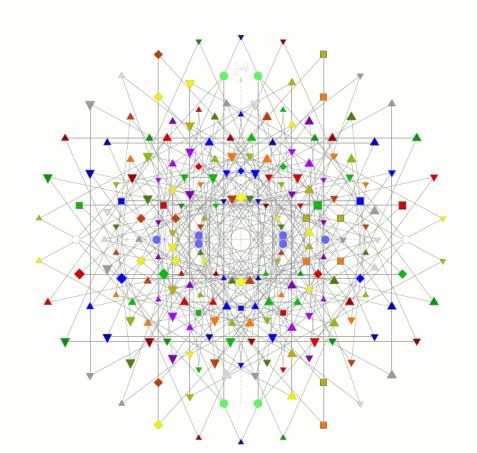
Lisi-figure2.gifIt's either all wrong, or it is one of the most important theoretical physics discoveries in history, a major step in the direction of a unified field theory.

In An Exceptionally Simple Theory of Everything, one Garrett Lisi, physics Ph.D and, yes, nearly-homeless surfer dude, suggests that E8 (described by the UK Daily Telegraph as an “eight-dimensional mathematical pattern with 248 points first found in 1887, but only fully understood by mathematicians this year after workings, that, if written out in tiny print, would cover an area the size of Manhattan”) has this amazing property: E8, says, Dr. Lisi, contains the Standard Model, plus the symmetries belonging to gravity.

And, oh yes, the model makes the testable hypothesis that there are 20 more standard particles waiting to be found by supercolliders. (Twenty seems like rather a lot?)

Here's the abstract of the paper,

Abstract: All fields of the standard model and gravity are unified as an E8 principal bundle connection. A non-compact real form of the E8 Lie algebra has G2 and F4 subalgebras which break down to strong su(3), electroweak su(2) x u(1), gravitational so(3,1), the frame-Higgs, and three generations of fermions related by triality. The interactions and dynamics of these 1-form and Grassmann valued parts of an E8 superconnection are described by the curvature and action over a four dimensional base manifold.

This representation, to the very limited extent I follow it, doesn't tell us anything directly about the shape of the universe; rather it threatens to tell us something fundamental about the relationships between the particles and forces that make up and that shape the universe. While the “exceptionally simple” part of the paper title is — or had better be — a joke, the 248 dimensions of E8 are needed only for representation of relationships; the universe it describes has only the three dimensions we know, plus time, distinguishing this theory from string theory, which requires many more (even if some are very tiny).

Dr. Lisi's theory also makes pretty pictures.

Pictured above: figure 2 of Dr. Lisi's paper, “The E8 root system, with each root assigned to an elementary particle field.” There's also a cute movie of an E8 being rotated.

As noted above, there are already critics. Super-string advocate (and politically weird) Luboš Motl will have none of it.

Continue reading

Posted in Science/Medicine | Comments Off on Can the Underlying Structure of the Universe Be Represented as an E8?

It’ll Never Roll, Wilbur

Talk about articles that seem to confirm all of one's prejudices: In Doing what Detroit says is impossible, Daily Kos points to an amazing article about a guy who builds powerful fuel-efficient cars — the sort Detroit says can't exist with current technology.

There are some issues: price, availability of alternate and more efficient fuels, but still…

Posted in Science/Medicine | 1 Comment

A Finding With Many Implications

Is a photo worth a thousand votes?:

People asked to rate the competence of an individual based on a quick glance at a photo predicted the outcome of elections more than two-thirds of the time.

Nearly 300 students at Princeton University were asked to look at pairs of photographs for as little as one-tenth of a second and pick the individual they felt was more competent, psychologist Alexander Todorov reports in Tuesday's issue of Proceedings of the National Academy of Sciences.

The participants were shown photos of leading candidates for governor or senator in other parts of the country, but they were not told they were evaluating candidates. Those who recognized any of the photos were not counted.

When the elections took place two weeks later, the researchers found that the competency snap judgments predicted the winners in 72.4 percent of the senatorial races and 68.6 percent of the gubernatorial races.

It seems to me that this finding, if valid, has many implications.

  • National political parties should focus group photos before deciding who to recruit or support in primaries
  • I'll bet it's a very sexist test — this may explain part of how elections disadvantage female candidates.
  • I wonder if this works for law schools? Would student satisfaction be higher when taught by professors whose looks signaled competence? Can we focus group potential hires via their photos? Can we do it without disadvantaging anyone who's not a white male of a certain age?
  • Might it be that dress sends signals of competence? If so, is it important to dress up (or down?) for the first day of class?
  • “Lookist” takes on a new meaning
  • Do I sense the makings of a new suspect class? Are people who don't look competent to others a “discrete and insular minority”? Certainly their disability affect electability, thus undermining their political power, which is one of the tests….

And, how do I look?

Posted in Law School, Politics: US, Science/Medicine | 3 Comments

New Way to Prevent Alzheimers?

Protein that removes plaque holds promise for Alzheimer's patients

Using a protein as a sponge to absorb the toxic plaque that builds up in the brains of Alzheimer's patients can halt symptoms and improve brain function, U.S. researchers suggest.

Scientists from the University of Rochester Medical Centre in Rochester, N.Y., performed studies on mice with a buildup of amyloid-beta, a toxic plaque that builds up in the brains of Alzheimer's sufferers and damages them.

I'm not so clear if this is a cure that reverses Alzheimer's, or “only” a preventative — a way to stop Alzheimer's from getting worse once one is identified as susceptible. Even so, it sounds like a major advance.

Posted in Science/Medicine | 1 Comment

7 Million Years and We’re Toast

So the sun has an orbit, or an oscillation, relative to the galactic plane, and when it gets to one of the extremes, we get fried with muons. Could this explain why every 62 million years, there's a huge die-off of species, about ten percent, in our biosphere?

Of Cosmic Rays and Dangerous Days: Now, researchers from the University of Kansas in Lawrence think they have found a possible answer. Physicist and co-author Adrian Melott says that he began suspecting a galactic cause after noticing a 2005 paper that calculated that the drop in species diversity occurs regularly on a time scale of tens of millions of years, which—for a cyclical event—is too long for something happening within the solar system. So he and Kansas colleague Mikhail Medvedev began examining the possibilities. At about the same time as the drops in biodiversity, the researchers determined, the sun reaches the highest point in its orbit relative to the galactic plane, where most Milky Way stars reside. At that point, the scientists report in the 1 August Astrophysical Journal, the solar system is closest to an incoming source of potentially lethal cosmic rays created by interactions between the Milky Way's magnetic field and radiation generated by a cluster of nearby galaxies.

These galaxies are located in the direction of the constellation Virgo, and the radiation consists of particles called muons, which are so powerful they can penetrate about 2.5 kilometers of sea water or 900 meters of rock—enough to reach just about every living thing on Earth and damage its DNA. Because the zenith of the Sun's oscillations match almost exactly with the times of the dips in the fossil record, the researchers found, “we've noticed an incredible coincidence,” Melott says.

Be sure to mark your calendar to give you plenty of warning, as the next one is due in just seven million years.

Posted in Science/Medicine | 4 Comments