Category Archives: Politics

2026 Miami-Dade Voter Guide to the Judicial Elections

The first round of Miami’s elections have early voting Aug 3-13, and the actual elections are Aug. 18. But the absentee ballots have already gone out, so here are my recommendations for the Judicial part of your ballot (the lowest bit).

Personally, I’d advise you not to trust to the mails with your ballot this year, but instead put it in a dropbox during early voting, but you do you.

General Intro

Unlike most law professors I know, I support the idea of judicial elections at the state level as a reasonable democratic check on what I believe should be the expansive power of judges to interpret the state and federal constitutions.

As I’ve often said before, if it were up to me, I’d have the executive branch pick judges with legislative confirmation, followed by a California-style retention election every few years in which there would be an up or down vote on the incumbent. If the vote was down, the executive would pick a new judge. It seems to me that the right question is “has this judge done a good (enough) job” — something voters might be able to figure out — rather than asking voters to try to guess from electoral statements which of two or more candidates might be the best judge.

Florida’s system uses appointment plus retention elections for Supreme Court Justices and District Court of Appeal Judges, but not for trial courts. The Governor can appoint judges to fill vacancies between elections, but otherwise those jobs are straight up elected, so a judicial election pits one or more challengers against the incumbent unless, lacking opposition, the incumbent wins reelection automatically; many trial judges were indeed unopposed this year. There are also open seats when the incumbent retires.

My recommendations are based on:

  • My personal view that I will vote for an incumbent judge unless there’s reason to believe he/she is doing a bad job.
  • After supporting incumbents, my other rule of thumb in sizing up candidates before even getting to the details of biography and practice experience is that in all but the rarest cases of other important life experience we ought to require at least ten years of legal experience from our lawyers before even considering them as judges. Fifteen years is better. I will very rarely support a judicial candidate fewer than ten years out of law school. It just isn’t long enough to get the experience and practical wisdom it takes to be a judge.
  • I look for endorsements, including the Miami Herald. The Miami Herald is not 100% reliable, but this year I found I agreed with them in most cases.
  • And oh yes, I read local blogs and listen to gossip too. Except this year, gossip is scarce, since I’m not leaving the house much due to immunocompromise.

All registered voters in Miami-Dade County get to vote on these judges, regardless of party affiliation.

This post is mercifully short compared to some past years because an astounding number of elections for Judge (27, I think) are unopposed this year. Maybe we don’t pay them enough? In fact, there are only six contested races: five for Circuit Judge and one for County Judge. Two of the Circuit Judge races have qualified incumbents and underqualified challengers, so these are easy cases. Ditto for the County Court race.

Here are my thoughts about how to vote in the August 18, 2020 judicial elections:

Circuit Judges

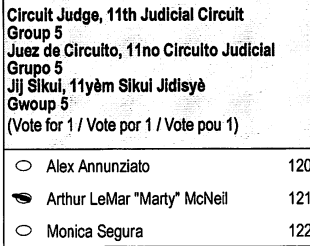
Group 5
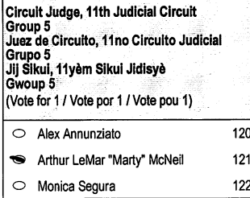
Open seat. There are three candidates. Alex Annunziato, Arthur LeMar “Marty” McNeil and Monica Segura. Alexander Annunziato is an in-house counsel at Ascendant Commercial Insurance. He has 21 years’ experience. Arthur McNeil is an Assistant Public Defender with 19 years’ experience. Monica Segura is Senior Managing Associate General Counsel for Universal Property & Casualty and has 20 years’ experience.

This isn’t a terribly hard call. McNeil has the most relevant experience, including 56 criminal jury trials and an unblemished record. Annunziato is a bit of an intriguing case as he was arrested for buying $20 worth of heroin from an undercover cop eight years ago. He didn’t contest the charge, and says he’s turned his life around. I don’t know him, and am prepared to believe it, but even so McNeil has the best bio.

(Segura, by the way, has almost no jury trial experience. Her biggest claim to fame is being married to Coral Gables Commissioner Ariel Fernandez. It would probably be wrong to hold that against her. Just don’t vote for her.)

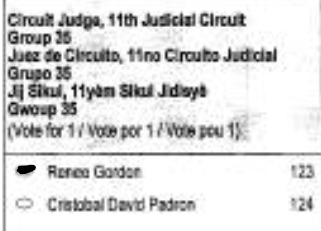
Group 35
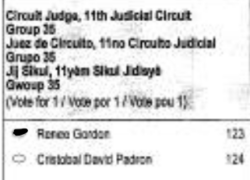
Open seat, easy case. Two candidates: Renee Gordon is an Assistant Public Defender with 30 years’ experience. Cristobal Padron is a family lawyer in private practice with 14 years’ experience. Both have run before and both lost by six and four percent margins respectively. I have endorsed Renee Gordon in both of her close losses, and I do it again. As I keep saying, she “has a long resume of working with troubled children in various managerial and legal capacities. This is a great background for a Judge – in the trenches and there for a long time.”

Christobal Padron has much less experience; Renee Gordon’s background is really top-notch. Maybe third time is the charm?

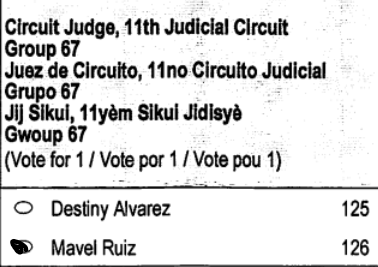
Group 67
Not a slam dunk, but even so…

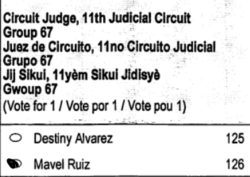
The incumbent is Judge Mavel Ruiz. Conservatives hate her because she initially blocked the transfer of valuable downtown Miami land from Miami-Dade College to the planned Trump library. Ruiz later dismissed the case when the College complied with its legal obligation to hold a public hearing on the giveaway. Having the spine to hold authorities to their duties in a high-profile case is a plus in my book. That said, Judge Ruiz does not have an unblemished record. As clumsy attack texts hitting my phone (headed, if you can believe it, “this is not an attack ad”!) like to remind me, Judge Ruiz ran into trouble for hugging a litigant in a high-profile case, And, Judge Ruiz received a written reprimand from the Florida Supreme Court because of a letter she and four other judges signed a letter to the Florida Department of Children and Families endorsing Our Kids of Miami-Dade & Monroe. As the court noted, none of the five judges who signed that letter did it for any personal gain. So while not nothing, it’s also not that much.

Unfortunately for sticklers, the challenger, DBA Destiny Goede Alvarez, has only has only five years’ experience as lawyer (way too little, IMHO), and now works as a partner at her father’s law firm after two years at GrayRobinson. She also changed her name to her husband’s shortly before filing, more than two years after being married, no doubt aware that women with Hispanic names tend to overperform in Miami-Dade judicial elections. She has a golden c.v., with Federalist Society chops, and links to the DeSantis administration, (Could that explain the anti-Ruiz text offensive?) She is raising money hand over fist. If she loses, as she deserves to, but which is far from a sure thing, I’m sure she will land on her feet.

Ruiz unseated Judge Fleur Lobree in 2014 when Lobree deserved to be re-elected, which might in some eyes create an opportunity for karmic justice. (Ruiz was re-elected in 2020.) I don’t care how good or smart Alvarez may be, but five years’ experience is nowhere near enough for a judge.

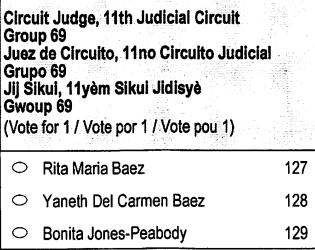
GROUP 69
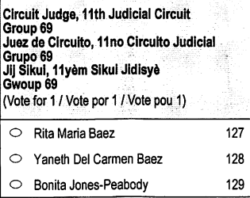
Open seat, confused by two Baez’s in the race. There are three candidates, and probably all are plausible.

Rita Baez is a personal injury lawyer in private practice with 30 years’ experience, nine as an Assistant States Attorney.

Yaneth Del Carmen Baez is an Assistant State Attorney with just 9 years’ experience in the State Attorney’s office, but the Herald endorsed her anyway based on the “intensity” of her caseload as an assistant state’s attorney, currently in the Human Trafficking Unit.  I suspect that the fact that the Judicial Nominating Commission has nominated her for a judgeship four times (which suggests that top lawyers think very highly of her), but DeSantis never picked her, might have something to do with it.

Bonita Jones-Peabody, now in private practice, was formerly an Assistant Public Defender, and has 35 years’ experience. Jones-Peabody is an experienced criminal defense lawyer with over 200 jury trials in her resume, which includes many years at the Miami-Dade Public Defender’s Office before going into a varied private practice.

Rita Baez also has 80 jury trials, but on the civil side. She currently represents plaintiffs in auto accidents and slip-and-fall cases.  A credible candidate, but I think the other two are stronger.

On experience I tend to favor Jones-Peabody. The fact that the JNC repeatedly thinks so highly of Yaneth Del Carmen Baez is something to weigh against a relatively short career as a lawyer, which makes this a harder case than I would like.

GROUP 76
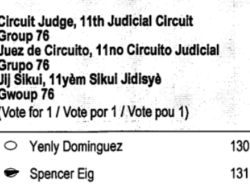
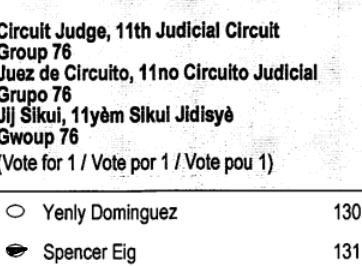
The incumbent is Judge Spencer Eig, a judge with 20 years on the bench, and I know of no reason to unseat him.

His challenger is Yenly Dominguez, a real estate & estate planning attorney with only 7 (!) years’ experience. Even if it was three times that much I’d vote to retain Eig.

Easy case.

County Judge
Group 25
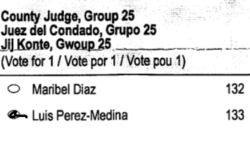
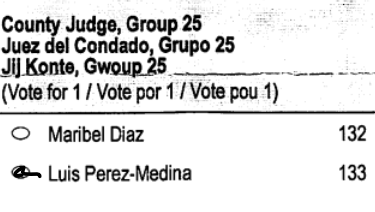
Just one contest for Circuit Judge, pitting incumbent (since 2018) Luis Perez-Medina, challenged by attorney Maribel Diaz, the director of legal services for the Miami-Dade County Tax Collector’s office. It sounds like Diaz, who has experience with foreclosures, collections, and property tax disputes, might make a good judge. But I can see no reason at all to turf out Perez-Medina who appears to be doing a fine job.

Posted in 2026 Elections, Miami | 1 Comment

Trump’s Proclamation Setting a $100,000 Fee for the Entry of H1-B Visa Holders to the U.S. rests on Debatable Foundations

The claimed authority in the Proclamation on “Restriction On Entry Of Certain Nonimmigrant Workers” for the $100,000 immigration fee on H1-B visa holders is 8 U.S.C. § 1182(f) and 8 U.S.C. § 1182(f).  Here are the relevant bits of those two code sections:

8 U.S.C. § 1182(f)

(f) Suspension of entry or imposition of restrictions by President

Whenever the President finds that the entry of any aliens or of any class of aliens into the United States would be detrimental to the interests of the United States, he may by proclamation, and for such period as he shall deem necessary, suspend the entry of all aliens or any class of aliens as immigrants or nonimmigrants, or impose on the entry of aliens any restrictions he may deem to be appropriate. …

8 U.S.C. § 1185

(a) Restrictions and prohibitions

Unless otherwise ordered by the President, it shall be unlawful—

(1) for any alien to depart from or enter or attempt to depart from or enter the United States except under such reasonable rules, regulations, and orders, and subject to such limitations and exceptions as the President may prescribe; ….

I see three legal issues:

First whether 8 U.S.C. § 1182(f) has an “intelligible principle” defining the President’s authority; if not, 8 U.S.C. § 1182(f) would be an unconstitutional delegation of power. Here the purported principle is whether “the entry of any aliens or of any class of aliens into the United States would be detrimental to the interests of the United States”.  That may seem vague and general, and it is, but probably not more so than other things that have been held to be an intelligible principle. A slightly harder question is whether the imposition of a $100,000 fee on H1-B entry to the US exceeds that delegation?  Alternately, are aliens incapable of paying the $100,000 fee the sort of group that constitutes a “class of aliens” as contemplated by the statute? They may be a social class but that doesn’t seem to be what the statute contemplates…

Second, is this a lightly disguised tax as opposed to something contemplated by the statute? This is akin to the claim now before the Supreme Court in the appeal of the Federal Circuit’s decision in VOS Selections Inc v Trump as to whether IEEPA empowers the President to set tariffs where it nowhere mentions them.

Third, is the $100,000 per entry or re-entry a “reasonable rule” under 8 U.S.C. § 1185(a)?

I think this is very doubtful. But even if it is reasonable, one still would need to explain why a lack of authority under § 1185(a) would limit the argued authority in § 1182(f). I think this could be an occasion for application of the General/Specific Canon (approved by Justice Scalia, no less): “If there is a conflict between a general provision and a specific provision, the specific provision prevails (generalia specialibus non derogant),” but I’d defer to people who know more about immigration law than I do.

Posted in Law: Constitutional Law, Law: Everything Else, Trump | Comments Off on Trump’s Proclamation Setting a $100,000 Fee for the Entry of H1-B Visa Holders to the U.S. rests on Debatable Foundations

Looking Back, and Forward

On this day back in 2003 I decided to start blogging. I though thefore today would be a good time to repost the first serious blog post I ever made, even though it only appeared after about a week. “Rose Burawoy, Political Scientist” was written in the shadow of the Bush administration’s decision to create and populate the prison camp at Guantanamo Bay put an American citizen accused of terrorism in solitary confinement a Navy Brig with a trial or even access to a lawyer. Even so, those were somewhat more innocent times, but I think the post has resonance today.  Here it is:

Lately, I have been thinking a great deal about something grandmother once said.

Rose Burawoy was born in Bialystock, then a thriving metropolis with a substantial Jewish population. She told me once — exactly once, as she never mentioned it again — that she remembered ‘the Cossacks’ running through and killing people in a pogrom when she was a child. She described it as something that had happened to other people, perhaps not far away, not as an eyewitness. (And, indeed, there was a pogrom in Bialystock in 1903, more killings in the area in 1920, and a pattern of killings and other anti-Semitic incidents in the 1930s ). In the retelling at least, my grandmother seems to have been as bothered by what she saw as provincialism, and was happy to escape to the bright lights of Berlin. Her life, and marriages, would later take her to Paris, and London, where she lived when World War II began, and finally to New York, where I think she was happy to be.

This geography explains something my grandmother once said that I find myself thinking of fairly often these days. I vividly recall my grandmother — alone in the family — objecting when I first said I wanted to become a lawyer. Don’t do that, she said. Why not be a doctor? Or a businessman, or anything else that involves a portable skill. A lawyer can only work in one country, and you can’t take your skill with you if you have to leave. ‘What’s wrong with that?’ I asked, ‘I like it here.’ And my grandmother, who usually treated me like a child, and who rarely said anything terribly grave about anything, much less the war — tending to limit her political commentary to how bad it was that old people had to worry about being mugged by the hooligans on the Manhattan streets, and how /insert-conservative-politician/ was good for the Jews because he was strong on defense — gave me a knowing, wise, slightly sad, very grownup look, that said she knew I, the American grandson, was not going to understand, and said, ‘When the Nazis come to America, what will you do then?’.

I laughed, of course. The Nazis were not going to take over America. And she said, quite seriously, ‘That’s what we said in Germany. Germany was the freest most democratic country in the world before Hitler. You’ll see.’

I still don’t think the Nazis are coming. But my grandmother’s question is a galling reminder that in politics, like in the securities markets, past performance is no guarantee of future results.

The people who founded this country called it a great experiment. As a citizen, a lawyer, and especially as a law professor, I have the luxury to think about the rules we use to govern ourselves and each other. Periods of stress do not bring out the best in most people, and current times provide ample evidence of that.

In the past two years, our government has embarked on a course of conduct, and legal argument attempting to justify that conduct, that I find simply horrifying. According to the current Administration, our government can:

  • Hold detainees in Guantanamo indefinitely without trial. Hold some of them, including children, in what amounts to solitary confinement for years. Hold them abroad, because the Administration hasn’t the guts or the decency to bring them to the US, where they would have rights to a hearing, to a trial, to judicial supervision of the conditions of their confinement. The government argues it can hold them during “wartime” — and as this war is against an ism, it could go on for ever.
  • Try some detainees in Guantanamo — the lucky ones? — under rules of court which, while not barbaric, are sufficiently tilted against the defendants to cast doubt on the fairness of the proceeding. To subject them to a possible death penalty in a non-jury trial — and to cut off any chance of appeal to the Article III courts we usually expect to be the defenders of liberty and justice.
  • Perhaps you think that this is wartime, and the nation must protect itself. While it’s possible, I suppose, to imagine a circumstance in which we could not afford fair trials, it’s impossible for me to believe we are anywhere near that stage.
  • Or perhaps you think, as a number of recent judicial decisions suggest, that our government’s constitutional obligation to act decently applies only to its dealings with US citizens and non-citizens in the US itself. I disagree — I think our government has only the powers that emanate from the Constitution, and I don’t find the power to act unjustly to be among them. (Even if I’m wrong about that, I’m saddened that this Administration is willing to so cavalierly drain our moral capital on bad trials, rather than demonstrating that we will give a fair hearing to even those we believe to be our enemies. But that’s another issue, for another day.)
  • Whatever you may think, this Administration clearly believes it has the legal right to treat US citizens as badly as it treats the “detainees” in Guantanamo. And not just US citizens the government thinks its local allies captured during a foreign war. No, this Administration, this Attorney General, this occupant of the White House, argue that they have the right to scoop up any US citizen, on any street anywhere in this country, and lock them up indefinitely. We have rules about how long an arrested person can be held without charges, and without lawyers. In the case of Jose Padilla, this Administration has violated all those rules. What it did was shockingly simple: when the time came to either charge Padilla with a crime, or let him go, the government removed him from the criminal justice system and tossed him in a Navy brig. And there he sits, while the lawyers fight about whether he’s entitled to be charged, and to have assistance defending himself.

I wish I were being over-dramatic here. Yes, the country has been attacked in a vicious and terrible way, by bad people. No doubt there are more people out there who wish us harm for both real and imagined ills. It is good to be careful. It is not good to trash our own values. Benjamin’s Franklin’s line — that “They that can give up essential liberty to obtain a little temporary safety deserve neither liberty nor safety” — is quoted so often that it risks losing its power and fading into cliché. But it is still true after almost 250 years.

When a government claims the power to grab anyone off the street and lock them up indefinitely without trial, watch out.

I still think my grandmother was wrong about the Nazis taking over in America. But I’m reluctantly coming around to believing that she was right about my complacency. Our liberty is not now something we can take for granted. While we face somewhat amorphous threats from abroad — threats I am confident we can endure and overcome — we face increasingly concrete threats to our liberty at home. If we do not face the Gestapo, we nonetheless face a security apparatus that has claimed the right to methods that until recently we would have called Gestapo tactics. I am not predicting a pogrom, and solitary confinement, however unpleasant is not the Final Solution.

But I do not feel safer, nor even all that safe, when anyone — no matter how well-intentioned — claims that they can put me in a Navy brig, incommunicado, indefinitely, without charges or trial, just because they can satisfy themselves — and no one else — that I deserve it.

Today I am somewhat less optimistic about the future of civil rights in this country, and indeed about the brightness of the country’s future given the multiple ways in which the Trump administration seeks to impoverish us, divide us internally, abandon our allies, and undermine science, medicine, and education.

My appetite for, and ability to handle the blogging form has waxed and waned: At some point although I had tens of thousands of regular readers, I decided it was taking too much time and crowding out some scholarship–and I preferred scholarship.  Traffic cratered, but I was happier.

Later, various extended bouts of hospitalization also got in the way of bloggin. Most recently, although now healthier, I moved my center of social medial gravity to @mfroomkin at Bluesky.  See you there?


Posted in Discourse.net, Law: Constitutional Law, Trump | Comments Off on Looking Back, and Forward

MiamiLaw Constitutional Crisis Seminar

I am proud to announce the University of Miami Constitutional Crisis Seminar Series. The series includes thirteen lectures, almost all of which will be available on line, with new ones appearing weekly. Select University of Miami Law School students will also have a private seminar-style discussion with the speakers, but these will not be published.  I have organized this program because I think the issues are urgent and important.

The United States currently faces widespread and intense challenges to our constitutional system, particularly what remained of our checks and balances: While courts and scholars have wrestled with the expansion of executive powers and worried about Congressional delegation of its legislative powers, the current administration – with the assistance of both Congress and the Supreme Court — has taken these challenges to new levels.

Today we see unprecedented assertions of executive power, including powers to ignore statutes, impound funds, cancel signed contracts, shutter executive departments, fire independent officials, and make highly creative invocations of emergency authority. Behind many of these are Constitutional claims for the power of the “unitary executive” and (although much remains to be seen) an alleged executive authority to ignore federal judicial orders. Complicating matters is Congressional silence, if not paralysis, in the face of executive power grabs, and an historic dependence on often unwritten constitutional and statutory norms that have been cast aside.

As lawyers and potential lawyers, we face particular responsibilities to understand the nature of what is fairly termed a constitutional crisis, and to think about whether and how to respond to it.

This seminar series will look at the legal system’s ongoing reaction to this massive reordering of federal power and individual constitutional rights, with a focus on the legal system’s reaction to current controversies. In addition to placing current events in historical context, we will look at the theoretical and structural constitutional causes of the crisis and what we might to do prevent a repetition or undo its most malign effects. We will examine how the legal system, primarily the courts but also other institutions such as the bar, have reacted to these new challenges, and what law and legal theory has to offer as to their causes and perhaps cures.

We are fortunate to have a stellar group of legal scholars, legal practitioners, and public intellectuals who have each agreed to speak on an aspect of the evolving situation.

With one exception, all of the lectures in the Constitutional Crisis Seminar series will be published online, on a weekly basis.

1

Intro: What is a Constitutional Crisis?
Speaker: Kim Lane Scheppele

2

The Unitary Executive & Its Critics
Speaker: Peter Shane

3

Constitutional Hardball
Speaker: Mark Tushnet

4

Tariffs
Speaker: Ilya Somin

5

Assertions of Emergency Power
Speaker: Harold Hongju Koh

6

Immigration Control / Rendition
Speaker: Cody Wofsy
At the speaker’s request, this lecture will not be published online

7

Removals of Officers & Inferior Officers, Bureaucratic Control (Schedules F & G), Vacancies Act
Speaker: Thomas Berry 

8

Impoundments & Other Fiscal Control Strategies
Speaker:  Zachary Price 

9

Attacks on Civil Society (Law Firms, Universities, NGOs)
Speaker:  Genevieve Lakier

10

Role of Courts / Attacks on Courts
Speaker: Stephen Vladeck 

11

Reserved for late-breaking developments

12

Formal Correctives Including Constitutional Reform
Speaker: Sanford Levinson 

13

Life During a Constitutional Crisis
Speaker: Bernard Harcourt  
Posted in Law: Reading the Constitution, Trump, U.Miami | Comments Off on MiamiLaw Constitutional Crisis Seminar

John Lithgow Reads Timothy Synder’s 20 Lessons On Tyrrany

Twenty Lessons, read by John Lithgow by Timothy Snyder

Key selections from On Tyranny, for viewing and sharing

Read on Substack

Shared by permission:

  1. Do not obey in advance. Most of the power of authoritarianism is freely given. In times like these, individuals think ahead about what a more repressive government will want, and then offer themselves without being asked. A citizen who adapts in this way is teaching power what it can do.

  2. Defend institutions. It is institutions that help us to preserve decency. They need our help as well. Do not speak of “our institutions” unless you make them yours by acting on their behalf. Institutions do not protect themselves. They fall one after the other unless each is defended from the beginning. So choose an institution you care about — a court, a newspaper, a law, a labor union — and take its side.

  3. Beware the one-party state. The parties that remade states and suppressed rivals were not omnipotent from the start. They exploited a historic moment to make political life impossible for their opponents. So support the multiple-party system and defend the rules of democratic elections. Vote in local and state elections while you can. Consider running for office.

  4. Take responsibility for the face of the world. The symbols of today enable the reality of tomorrow. Notice the swastikas and the other signs of hate. Do not look away, and do not get used to them. Remove them yourself and set an example for others to do so.

  5. Remember professional ethics. When political leaders set a negative example, professional commitments to just practice become more important. It is hard to subvert a rule-of-law state without lawyers, or to hold show trials without judges. Authoritarians need obedient civil servants, and concentration camp directors seek businessmen interested in cheap labor.

  6. Be wary of paramilitaries. When the men with guns who have always claimed to be against the system start wearing uniforms and marching with torches and pictures of a leader, the end is nigh. When the pro-leader paramilitary and the official police and military intermingle, the end has come.

  7. Be reflective if you must be armed. If you carry a weapon in public service, may God bless you and keep you. But know that evils of the past involved policemen and soldiers finding themselves, one day, doing irregular things. Be ready to say no.

  8. Stand out. Someone has to. It is easy to follow along. It can feel strange to do or say something different. But without that unease, there is no freedom. Remember Rosa Parks. The moment you set an example, the spell of the status quo is broken, and others will follow.

  9. Be kind to our language. Avoid pronouncing the phrases everyone else does. Think up your own way of speaking, even if only to convey that thing you think everyone is saying. Make an effort to separate yourself from the internet. Read books.

  10. Believe in truth. To abandon facts is to abandon freedom. If nothing is true, then no one can criticize power, because there is no basis upon which to do so. If nothing is true, then all is spectacle. The biggest wallet pays for the most blinding lights.

  11. Investigate. Figure things out for yourself. Spend more time with long articles. Subsidize investigative journalism by subscribing to print media. Realize that some of what is on the internet is there to harm you. Learn about sites that investigate propaganda campaigns (some of which come from abroad). Take responsibility for what you communicate with others.

  12. Make eye contact and small talk. This is not just polite. It is part of being a citizen and a responsible member of society. It is also a way to stay in touch with your surroundings, break down social barriers, and understand whom you should and should not trust. If we enter a culture of denunciation, you will want to know the psychological landscape of your daily life.

  13. Practice corporeal politics. Power wants your body softening in your chair and your emotions dissipating on the screen. Get outside. Put your body in unfamiliar places with unfamiliar people. Make new friends and march with them.

  14. Establish a private life. Nastier rulers will use what they know about you to push you around. Scrub your computer of malware on a regular basis. Remember that email is skywriting. Consider using alternative forms of the internet, or simply using it less. Have personal exchanges in person. For the same reason, resolve any legal trouble. Tyrants seek the hook on which to hang you. Try not to have hooks.

  15. Contribute to good causes. Be active in organizations, political or not, that express your own view of life. Pick a charity or two and set up autopay. Then you will have made a free choice that supports civil society and helps others to do good.

  16. Learn from peers in other countries. Keep up your friendships abroad, or make new friends in other countries. The present difficulties in the United States are an element of a larger trend. And no country is going to find a solution by itself. Make sure you and your family have passports.

  17. Listen for dangerous words. Be alert to use of the words “extremism” and “terrorism.” Be alive to the fatal notions of “emergency” and “exception.” Be angry about the treacherous use of patriotic vocabulary.

  18. Be calm when the unthinkable arrives. Modern tyranny is terror management. When the terrorist attack comes, remember that authoritarians exploit such events in order to consolidate power. The sudden disaster that requires the end of checks and balances, the dissolution of opposition parties, the suspension of freedom of expression, the right to a fair trial, and so on, is the oldest trick in the Hitlerian book. Do not fall for it.

  19. Be a patriot. Set a good example of what America means for the generations to come. They will need it.

  20. Be as courageous as you can. If none of us is prepared to die for freedom, then all of us will die under tyranny.

Posted in Civil Rights, Politics: US, Trump | 1 Comment

You Should Subscribe to ‘Heads Up News’

My brother’s new project is Heads Up News, a weekly newsletter summarizing landmarks of the resistance.

There’s only so much there that will be new to doomscrollers, but even for them the totality of the content has value. For other people, those with lives, there’s a lot there they may want to know.

Posted in Dan Froomkin, The Resistance | Comments Off on You Should Subscribe to ‘Heads Up News’