Category Archives: National Security

War On Foreign Journalists Continues

The United States is telling foreign journalists they have to go home to renew their passports.

It looks as though a lot of foreign journalists will have to go to through some new, tougher hoops to report on the United States.

Citing homeland security issues, the State Department will no longer allow foreign journalists visiting the U.S. or stationed here semi-permanently to easily renew their Visa's in-country.

That means 20,000 journalists who have been able to renew their visas without too much hassle will now be faced with a lot of additional time—from 4-6 weeks to up to six months—and some extra expense to renew them.

As of July 16, holders of class I Visas (foreign media representatives), as well as several other classes of nonimmigrant visas, will be required to reapply at a U.S. Embassy or Consulate abroad when those visas expire.

I've mentioned before that the US is treating foreign reporters badly. No doubt many of them will attribute this latest madness to the mauling that Bush got from an Irish interviewer.

In fact, however, it's a logical outgrowth of the requirement for biometric passports a requirement that is going to kill the Florida tourist industry in an election year unless Congress delays it.

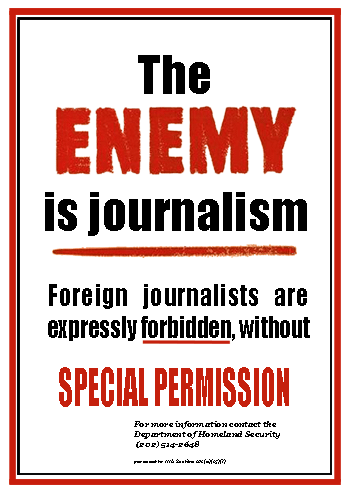
As a closing thought, have a look at this great post by Alex Halavais in which he proposes we post appropriate notices at the border:

The Enemy is Journalism

Posted in National Security | Comments Off on War On Foreign Journalists Continues

Intelligence: the Raw and the Cooked

It makes a great headline, C.I.A. Held Back Iraqi Arms Data, U.S. Officials Say, and the first paragraph is a powerful one:

The Central Intelligence Agency was told by relatives of Iraqi scientists before the war that Baghdad's programs to develop unconventional weapons had been abandoned, but the C.I.A. failed to give that information to President Bush, even as he publicly warned of the threat posed by Saddam Hussein's illicit weapons, according to government officials.

The New York Times article, however, fails to mention one little thing, and that failure makes me slightly skeptical about the rest. The interviews with the relatives of Iraqi scientists are so-called 'raw intelligence'; the CIA is not expected to give policy makers the text of every interview it conducts, nor even mention them all. It's supposed to triage, draw conclusions, weigh and summarize…fairly, without 'cooking' the results. Indeed, it's precisely the failure to distinguish between raw intelligence and nuanced thinking that is the chief rap against Undersecretary of Defense Douglas J. Feith, and his neocon band of intelligence amateurs in the Defense Department's Office of Special Plans.

That said, I don't exclude the possibility that the CIA cooked the reports it fed higher-ups. And if it did, it's possible that the reason was incompetence, or it may have been pressure from the White House. But the existence of contrary raw intelligence, alone, is not a smoking gun—although it certainly raises questions about why the CIA chose to believe the people who lied to it.

If it turns out that the CIA's decision not to credit the people who said there were no WMD's was pivotal to the decision to go to war, does that make the Iraq War all the CIA's fault? Clearly not, since there was enormous pressure to attack Iraq from Cheney, Bush, and especially the neoconservative crazies at the Defense Department. But in light of George Tenet's quoted statement that the case for Iraqi WMD's was a 'slam dunk', it doesn't look good.

If it does turn out that the CIA got it wrong without reason, will anyone revive the late Daniel Patrick Moynihan's peacetime suggestion that we abolish the C.I.A. and start over?

Update: Talking Points Memo sees this as a cynical leak, another round in the CIA vs. White House war. I'm sure that's right. But even so, I'm not sure the CIA is covered in virtue here. In other words, sure it's an evil partisan leak. Yes, the article is poor journalism as it lacks both relevant contextual information and also any reaction from neutrals (and little from CIA partisans). But that, even plus the ample evidence of Admnistration misdeads, doesn't prove there's also nothing to worry about in how the CIA behaved.

Posted in National Security | 1 Comment

Why Lawyers Are a Lousy Attack Weapon

Being

  • late to the party
  • many time zones away
  • seriously jet-lagged
  • somewhat inebriated (2 beers will do that to me on an empty stomach when jet lagged)

it is probably unwise to post anything at all, but I'm so happy with the quality of the free wireless link in at the waag here in Amsterdam, provided by the waag society, I can't resist joining in to the debate over Eugene Volokh's suggestion

Say that we're fighting a World War II-like war, but against insurgent forces in various allied countries, and not against national governments. (You'll see in a moment why this proviso is important). We capture 50,000 alleged enemy soldiers, partly because some of the enemy forces have surrendered en masse; apparently we had captured millions that way towards the end of World War II. The allied countries don't have strong enough militaries to effectively detain these people themselves (think France in early 1945), so we detain them instead. This is actually quite normal for large-scale wars, consider again World War II, except that the war is a modern war against insurgents and not a traditional war against governments.

Now, the detainees file 50,000 petitions for habeas corpus, all claiming that they aren't actually enemy soldiers. This means civilian courts would have to process all those cases, and the military would have to respond to all the petitions, and get affidavits or even live testimony from various soldiers in the field whose testimony is relevant for this purpose.

Would this tactic be allowed? Well, let's consider this under the four elements (see below) that the Court pointed to when it distinguished the Guantanamo detainees (who get their habeas petitions considered) from the German detainees in Johnson v. Eisentrager (who didn't get their petitions considered).

Like the detainees at Guantanamo, our hypothetical detainees (1) “are not nationals of countries at war with the United States” — our war isn't with their countries, but with insurgencies in those countries. They (2) “deny that they have engaged in or plotted acts of aggression against the United States”; it costs them nothing to deny that. They (3) haven't “been afforded access to any tribunal, much less charged with and convicted of wrongdoing,” partly because there's nothing to charge them with or convict them — we just want to detain them as enemy combatants, not try them for unlawful combat. They are held (4) “in territory over which the United States exercises exclusive jurisdiction and control” — imagine that for security reasons, we need to keep them at a base that's at least as controlled by us as Guantanamo is.

It sounds like they'll probably get to file their petitions, strain our courts, impose more burdens on our soldiers, and possibly even risk the disclosure of secret material.

Litigation will become a tactic of warfare.

First off, the hypo is highly unrealistic. The opinions do not say that foreign soldiers being held as POWs have a right to habeas relief. To my reading, they don't say anything about classic POWs. POWs' rights during a conflict are covered by the Geneva Conventions, and I do not see anything in the current court's opinions that would require additional judicial intervention during the war with the possible exception of a violation of jus cogens (eg. torture)…although that's just my gloss on it, since of course the opinions don't deal with that issue. Indeed, that is one of the critical distinction between the current cases and past ones. [I'm hazier on what happens after the war ends. Could a POW bring a claim alleging unduly delayed repatriation? To answer that I'd need to know how post-war repatriation usually works.]

What this week's opinions say that people whom the administration alleges are connected with hostilities but nonetheless LACK Geneva Convention rights (i.e. the so-called “enemy combatants”), and whom it then wishes to lock up without process or recourse, have a right to some kind of hearing to adjudicate their status and in which they can make the claim that they are being held wrongly. This seems to me like an essential element of basic deceny: if the Red Cross is not there to ensure humane treatment, someone, the courts, has to be. Given recent events, I'm somewhat mystified that this even needs to be said.

It seems to me there is so much less here than meets the eye. As Eugene notes in his third response to his own hypo, in most cases involving people who are not being held either as POWs or as criminal in conformity with the law of the jurisdiction in which they were captured (a class the should include most people who actually commit a violent act), the requirement of a hearing will be met by a military tribunal holding the very status hearing required by the Geneva Conventions themselves, hearings that the Administration has, inexplicably to my mind, refused to hold for the Guantanamo detainees. Once this tribunal reaches a result, we can deal with subsequent attempts to litigate much like we deal with prisoner habeas today—and that's not real friendly to the petitioners.

The US routinely held in-the-field initial hearings during both the Vietnam War and the first Iraqi war, and I have yet to read a single suggestion that doing so impacted the war effort. These hearings were not held in Iraq II, presumably because the muscular Bush faction didn't want any of that namby-pamby lawyer stuff. That was an error.

Congress has a role here too. In the unlikely event that a future administration feels a need to hold 50,000 people as “enemy combatants” and we think that this alone isn't a sign that the executive has gone nuts, then Congress can provide a system by which any cases they might bring will be adjudicated.

Last, although I hate making this argument, I have to note that the Mathews test that the Supreme Court relied in the Hamdi case itself supplies an inelegant answer to the mass-litigation-as-war-tactic hypo. The Mathews test explicitly considers the cost of providing additional process. If there is a danger that there will be mass recourse, swamping the hearing-provider, this itself weighs against the additional process. (Which is why Mathews has no place being used to define the extent of human rights — it's too weighted by its nature in favor of the government interest, too willing to buy into the idea that “the government” has independent interests other than its role as agent of “We, the People”, and that those government interests can be asserted against the People, but that's a different debate…).

I trust if the beer and the time shift has addled my wits, the wonderful commenters who have recently frequented this blog will set things straight.

Posted in National Security | 2 Comments

Subtext of Bush Overture to Korea

The Bush administration has made an offer to North Korea on the nuclear issue that sounds suspiciously, no exactly, like the offers they derided Clinton for making. See The Poor Man: Steady Leadership Watch for details, necessary flip-flop comments, general and earned snark.

I want to highlight a slightly different aspect of this development. The Bush offer is likely to be seen by N. Korea — more importantly, by other US adversaries (think, “militant Iraqis”) — as a sign of weakness: the Bush administration, sagging in the polls, goes shopping for foreign policy deals that can be marketed domestically as “victories'.

A foreign perception of a weak, anxious, maybe desperate, Administration eager to make deals for short term political gain means that our adversaries will drive the hardest bargains they can, thinking that the deals on offer will never be this good again. As a general matter, that's bad for the US whether this foreign perception is right or not, as we'll either have to give up more, or won't be able to come to agreement.

It's not just strong Presidents who are dangerous; weak Presidents are dangerous too, just in different ways.

Posted in National Security | 6 Comments

Imagine if This Had Happened in the Clinton Administration

Since it is Clinton nostalgia week in the US, join me in a little game. (Before tenure we called these “thought experiments”.) Imagine how the press would have played it if this story had broken during the Clinton administration:

How secure is the Department of Homeland Security?:

The policy director for the Department of Homeland Security's intelligence division was briefly removed from his job in March when the Federal Bureau of Investigation discovered he had failed to disclose his association with Abdurahman Alamoudi, a jailed American Muslim leader. Alamoudi was indicted last year on terrorism-related money-laundering charges and now claims to have been part of a plot to assassinate Saudi Arabia's Crown Prince Abdullah.

After a flurry of interagency meetings, however, Homeland Security decided to leave the policy director, Faisal Gill, in place, according to two government officials with knowledge of the Alamoudi investigation. A White House political appointee with close ties to Republican power broker Grover Norquist and no apparent background in intelligence, Gill has access to top-secret information on the vulnerability of America's seaports, aviation facilities and nuclear power plants to terrorist attacks.

I bet the rest is good too, but you have to register or watch ads or something to read it.

Posted in National Security | 4 Comments

An Account of an NSA Job Application

Via Majikthise (nice blog), I find Interviewing with the National Security Agency, which purports to be an inside account of the lengthy process required to get hired by the NSA.

While my opinion of the CIA is pretyy low, my opinion of the NSA is much higher. It's not just that they have good taste in lawyers or that the folks they send to meetings seem smart and sensible, but that from what one hears their work contributes to US security, and maybe even world peace. (Unlike the CIA, for which I have my doubts about both.)

Posted in National Security | 1 Comment