Category Archives: Law School

First-Year Dinner Report

One of the self-imposed duties that comes with the job is attending the dinner we give to welcome first-year students. If that sentence sounds as if the dinner isn’t something I look forward to, well consider these facts:

  1. The dinner consumes scarce and expensive baby-sitting resources (my wife and I both teach at UM; we both feel we have to go)
  2. The preprandial cocktail party is held outdoors at one of the most oppressive and sweltering times of the year
  3. I am always the designated driver and thus the open bar is just adding insult to injury
  4. I have to smile a lot
  5. I don’t teach any first year classes, so many students seem disappointed to meet me, focused as they are on what they fear is an upcoming first-year ordeal .

This year was no exception as to points 1-4, but very different on point 5: a surprising number of incoming students had found this blog, so they seemed happy to put a face to the rants.

And I happened to sit with some extraordinary students at dinner.

  • A Romanian (from Transylvania, no less), with a philosophy Ph.D from Stanford, supervised by Richard Rorty
  • An American fresh back from working in Niger
  • A Polish-born American who recently resigned a commission in US Army intelligence (in part, he said, because the failure to prosecute commanders for recent atrocities — an absence of command responsibility — suggested a failure among our leaders to hew to the ideals he had been taught he was serving).
  • A Khazakstani Kazakhstani national here on a Fullbright whose English is flawless

And these were not our international LL.M. students, who are always wonderfully experienced and diverse. These are a random sample of our J.D. students.

One could have quite a bit of fun teaching in a place full of students like that…

Posted in Law School, U.Miami | 6 Comments

Wow, Law Students are Mean Out West

According to PrawfsBlawg: Things to ask (or not to ask) your new prawfs, someone actually asked newly minted Prof. Leib,

“Professor Leib, many of us are concerned that you’ve never taught a day in your life. What do you have to say about that?”

It’s a really dumb question. First, because it’s too late to do anything about it. Second, because new teachers are sometimes at their best — fresh with new ideas from practice or the academy, full of energy, innocent of the mind-numbing horrors of faculty meetings.

Then, again, some of us improve. I think (hope) I probably teach better now than when I started (and I had a tiny amount of pre-law school teaching experience), in part because I have a slightly more realistic sense of how much (little) can be accomplished in a semester. Perhaps it’s all reversion towards the mean.

Posted in Law School | 2 Comments

LawFool Explains How to Take Law School Exams

No fool he. UM's LawFool gives very sound Exam Advice.

It's not an accident that in every exam talk I give I tell students that the most common error is failure to answer the question.

Here's the “advice” section from a recent exam of mine:

Some Advice. Read the questions carefully and think about your answer before beginning to write. Organization will count in your favor. Unless the question directs otherwise, don’t forget to explain why you reject seemingly sensible options as well as why you select them.

Make sure that each of your answers focuses upon the specific question(s) posed. Take the time to organize your answers around a discussion of the most relevant issues of law raised by those questions. Don’t just state your conclusions. You should attempt to make the reasoning behind your answer as transparent as possible, and demonstrate your knowledge of the assigned readings (and where appropriate the approaches and viewpoints they represent.) And, when you make any but the most obvious general statement, it's often good to include a specific example. But don’t waste time quoting more than a few words from the relevant materials – just cite to them when they are relevant.

If you need to make an assumption, identify it clearly, and state why you are making it. If you need more facts to answer the question, clearly explain why each missing fact is important, and what turns on it. And remember, whatever you do, remember to give reasons for your answers…ideally reasons that demonstrate a mastery of the assigned readings,

Don't use abbreviations not found in a standard dictionary unless you define them on first use.

Posted in Law School | 4 Comments

Classroom Perils — and Reliefs

I've had the rare sleeping student but not, thank goodness, the Phantom Professor's starved and fainting student, nor the regularly scheduled sleeper.

And that intelligent woman who regularly scowled at me from the front row for a good chunk of the semester (what could I possibly have said to offend her, I used to fret) — turns out she wasn't scowling at me at all: she was fighting morning sickness.

Posted in Law School | 4 Comments

Teaching and Grading (Bark v. Bite)

I run a tough classroom, take attendance. I think of the classroom as a formal place: I wear a tie, and sometimes a jacket (I used to wear suits; I've mellowed along with the times, as today — unlike ten years ago — many of my male colleagues probably teach in open collar; some even in shorts and sandals). I call students by their last names, and although in most upper-level classes I lecture rather than attempt to teach Socratically, I do question aggressively and expect a certain degree of preparation. Pronouns — IMHO one of lawyers' worst enemies — are banned in my classroom. In recent years, though, I have very rarely called on people unless they are on notice or volunteer (I'll return to that issue in a later post). I am told I have a reputation as a hard case. Certainly when I suggest to my students that I'm really just a pussy cat, the reaction — nervous laughter and incomprehension — suggests they don't exactly agree. I would say I'm just being precise and lawyerly, and expecting my students to do the same. They apparently think I'm being tough or even (not too often I hope) mean.

My in-class affect translates into a set of beliefs about my grades: It is a widespread article of faith among the students that I am a tough grader. Indeed, my research assistant, who should know me better than that, told me so several times. So at last I challenged him to go and collect all my grades for the last three years (all professors' grade distributions are public information, available to all students in a book in our library) and compare them to the recommended curve for upper class courses. I told him that if I was noticeably below the curve I'd consider reforming. He took the challenge happily, crunched the numbers…and then told me I didn't really want to see the results. Because, of course, I am in fact something of an easy grader, and have been for all my teaching career.

I do try to write exams that will pose challenging problems: working through them is part of the education, after all. But that doesn't mean I expect every student to find every subtlety. Here's this year's grade distribution in administrative law.
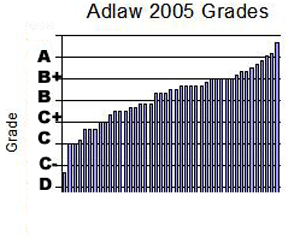
AD05-grades-2.png (Note that because I give so much credit for class participation, I round the total grade down. Thus, a grade that meets or crosses the B+ line, but doesn't reach the A line is a B+.)

Of course, it could be that the demeanor frightens people into working harder and this translates into good exams; sitting where I do, there's no way to know. I don't curve, so it's true that on rare occasions there has been a class that did very badly. For example, my first-ever Internet Law class, some ten years ago, was full of people who I think had expected to play computer games all semester (hey, in film and law you watch films, so in Internet and the Law you…) and were appalled to find that they were expected to do legal analysis. But it's hard to believe that these rare cases set a reputation that overwhelms the norm.

Contrast this experience to that of Donna Coker. Donna is an extremely nice person, with a very pleasant demeanor. Donna tells me that she starts off each semester with a little announcement to the class about how she wants the classroom to be a pleasant place, and doesn't think law school needs artificial stress. But she warns students that they shouldn't mistake her classroom style for her grading style: she will be tough on their exams. But, Donna tells me, and encouraged me to blog, the students don't take this in. They believe that because she is laid-back in class, she'll be an easy grader. And by all accounts, Donna runs a friendly classroom. She has a reputation, deservedly, as a very nice teacher. And she grades much tougher than I do.

But just try getting students to believe it.

I don't know why this is. Is it student sexism: a nice woman is surely going to grade more easily than an aggressive guy, right? Or is it just a reflexive form of stereotyping, in which classroom behavior is presumed to translate to grading behavior? You might think it is self-selection, and that the students who couldn't hack it avoid me while still taking Donna's courses (which are either required or on the bar exam); that's plausible, although I'd note that in most years I don't get a lot of the students who get magnas or summas — I think they avoid me to protect their grade averages. Whatever it is, it's very persistent, even in the face of years of evidence.

Update: On reflection, the above account of my teaching style is not as accurate as it could be. It may describe how I taught Civil Procedure, and how I teach Administrative Law (although I'd take issue with the claim that “tough” equals “not fun” — what about all the jokes?), but it certainly doesn't describe my seminars, and actually doesn't describe courses like Jurisprudence or Internet Law particularly well either. Administrative Law is dominated by my perception of a need to cover a certain defined and rather substantial set of material. Leave out any part of the heavily seamed web, and the edifice collapses. Internet Law is different — there's no need to hew to a syllabus: if the class wants to go haring off in an unexpected direction, I'm happy to go there. So in smaller courses and especially in courses with a flexible syllabus, there's much more discussion and the entire atmosphere is much more informal. But I still use last names until after students graduate.

Posted in Law School | 7 Comments

Grading

Now is the dreadful time of year when I have to grade exams. I like to think that I am good or better at most parts of my job, and competent at the rest. But even hubris would not suffice to make me think I am an efficient grader. I am slow.

No, I am very slow. I agonize. I get upset at the weak exams — I want the students to do well, and the reality is that they don't all do well. Among the worst parts is seeing common errors float up: could so many people have sat through a semester of my class and not learned that? Did I somehow say something that unintentionally misled half the class? Or is it some commercial outline somewhere that led them astray? There is no way to know.

I used to get really upset about the disasters, the D's and the (rare) F's. Now, perhaps my heart is hardened. Or, more likely, I've come to understand that not everyone is cut out to be a lawyer. Those are not my fault.

It also helps that today's students at UM are better than they were over a decade ago. There are far fewer disasters, and some of the students are very very good. Even so, there are a lot of mushy waffly exams. C+'s dragged down lower by blatant errors, or pushed up by an insight. B's listing under the weight of distractors or unspotted issues.

The A's are the best. Quick to read, easy to grade. They got it! I smile. I wish there were more of them. For the very best I'll be writing them a note, asking them to drop by so I can congratulate them in person, offering to write them recommendations. Most come by, not all take me up on the offer; some already have their futures mapped out, others I never learn the second act much less the third.

Grading is serious business. It matters enormously to the students; they think it determines their prospects. They are not entirely wrong, although for most careers it will affect the first job more than any other, and in five or ten years will be much less relevant than what they have been doing since. I have all sorts of strategies to try to be as fair as I can be. I split the exams up into piles of questions to increase consistency and so that performance on one question won't subconsciously affect the grade of the next. I grade each question in a different order so no blind grading number always comes first. I read every very low grade twice to make sure I gave it every consideration. I have certain issues in mind which, unless you see them and deal with them properly, you cannot get a top grade.

I am fairly confident that if you gave me the same pile of exams to mark last year or next year, almost all the grades would be the same. Certainly the A's, the B+'s, they're quite clear. So too with the C's on down. We don't have a B- grade. The high B's and the low C+'s are very different exams. But right at the margin between the B and C+…there I always suspect that on a different day things might have fallen a little differently. You can only do the best you can.

Grading is serious business. I spend hours and hours at it, while only a few rooms away, my wife grades twice as many exams — she's justly a more popular teacher and also teaches the business subjects that more students think they want or need — nearby, my wife grades twice as many exams in about half the time. She's a grading machine. I find my mind has wandered, and I have to start reading the essay all over again. Grading is serious and important and requires attention. But it's just not that interesting to read the fortieth essay on the same subject.

This year may be different. Normally when I'm not grading I have the alternative of doing something more interesting — usually research. But this year, when I'm not grading what I should be doing is unpacking boxes: our nearly endless home remodeling project is near enough to completion that we've taken back the half of our worldly goods that we had stuffed into a 10×15 container. (“Thank you for staying with us” said the man at the storage facility, as if I were checking out of 3-star hotel…) Now the boxes are in piles on the floor. And it's not all obvious where it all goes.

It's time to start grading today.

Or maybe tomorrow.

Posted in Law School | 7 Comments