Category Archives: Econ & Money

Why is Spam of Such Low Quality?

W. David Stephenson blogs on homeland security et al. — and under “et al.” asks why is there no attention to detail by spammers?

This is something I wonder about every day while I hold down the delete key to kill off several hundred spams. I can see the argument that some foreign spammers can't do better as their English is too poor (but can't they find something to copy?). I can see the argument that even cheap spam makes a buck, so that there's a quality/effort sweet spot. What I can't understand is why that's the only point or why it so dominates the (mythical) quality-spam solution point.

Posted in Econ & Money, Internet | 4 Comments

I Wish Robert Waldmann Had Been My Freshman Economics Teacher

What do you think the world would look like if freshman micro-economics students were routinely taught by Robert Waldmann? Instead of carrying around an Austrian model in their heads in which we assume total selfishness, zero transactions costs, and conclude that transfer payments are suspect, they'd be hearing about Possible efficiency gains due to taxes and transfers,

A little bit of altruism changes everything. If people care about their own physical well being (pleasure minus pain) plus that of those they love plus 0.00001 times the well being of strangers redistribution can be Pareto improving. Non poor agent A doesn't need taxes and transfers to give his money to the poor. However, after he has chosen my level of private giving, he doesn't want to give any more via taxes. However he wants to give rich agent B's money to the poor. He cares a tiny bit about the small cost (in pleasure minus pain) to B and the same tiny bit about the large benefit to the poor. Increasing taxes and transfers from zero will make everyone happier if the population is large enough so that taxing one me is more than balanced by taxing lots of you

I'm pretty sure I had to wait until sophomore year to hear this stuff, and even then it was said with much less enthusiasm, as an embarrassing exception to an otherwise tidy result.

(Or course, Robert couldn't have been my freshman economics teacher, we graduated the same year from different universities, but you know what I mean.)

Posted in Econ & Money | Comments Off on I Wish Robert Waldmann Had Been My Freshman Economics Teacher

Call Me a Churl If You Like

I remember getting really excited about the idea of Heifer International, giving donations that would buy need people around the world cows and goats. Until, that is, I read the (very) fine print and discovered that my gift would not in fact buy someone an actual cow or goat, but would go into the charity’s general fund.

The prices in this catalog represent the complete livestock gift of a quality animal, technical assistance and training. Each purchase is symbolic and represents a contribution to the entire mission of Heifer International. Donations will be used where needed most to help struggling people.

How many actual cows or goats emerged at the other end was uncertain.

How unfortunate therefore to see a great group like Oxfam stoop to the same tactic. If you read their online pitch for Oxfam America Unwrapped you could easily come to believe that your gift of $75 would actually buy someone an actual cow.

But that’s not how it works:

In technical terms (what the lawyers tell us we need to explain):
Oxfam America works in 26 countries around the world. This catalog contains gift items that symbolically represent our work. The items selected represent project goals from grants disbursed by our seven offices around the world. The purchase of each gift item is a contribution toward Oxfam America’s many programs, not a donation to a specific project or goal. Your donation will be used where it is needed the most–to help people living in poverty throughout the world.

Or, as the FAQ says:

Am I really buying a camel?
First off, let’s be clear: Neither you nor your gift recipient will receive a camel (other than the handsome photo on the gift card). When you buy a camel from Oxfam America Unwrapped, you are actually giving much more. The impact of your donation will have far-reaching effects. In each case, your donation will be used where it is most needed. For more information, click on the “How it Works” tab (at the top of the page).


Does a camel really cost $175?
Since our gifts are symbolic, these prices represent a suggested donation. We have drawn from a range of gifts so that you can make a donation that is meaningful—and fits your budget!

Good causes, especially Oxfam, but I don’t like the tricksy marketing.

I’m not sure what the going rate is for a camel, but I suspect that when you “give a camel” you are not giving a camel, not to mention “so much more” — the going rate for a camel seems to be £300 to £2,000. If so, that $175 will thus buy at most half of one of the mangiest variety.

[If all went according to plan, I’m just back from Italy now, but very jet lagged. And I am leaving for my next trip … tonight. So I’ve queued up some more posts to cover for me. This is one of them.]

Posted in Econ & Money | 4 Comments

Today’s Economics Puzzle

TMI a little place to whine: How come…?:

At the corner of 107 and Quail Roost Rd. when 107 become Marlin Dr. There is a U-gas station, where I purchased unleaded regular gas for $3.05 a gallon today.

In South Miami, just before the main shopping dictrict, there is Chevron gas station that has unleaded regular gas for $3.64 a gallon.

Most gas stations are averaging $3.16 a gallon.

Locational utility, imperfect information, or Walrasian tatonnement in slow motion?

Posted in Econ & Money | 4 Comments

Bad For Butlers

Robert Waldmann — who's been on a roll lately — writes about Democratic proposals to shift the AMT burden to the richest 1% of taxpayers. A winning argument both politically and economically. And one opposed by the plutocrat party, who call it “class warfare.” Waldmann quotes Wisconsin Rep. Paul D. Ryan, the senior Republican on the House Budget Committee, as saying that raising taxes for the wealthiest Americans is a “job killer.”

To which Waldmann replies,

I wonder if Ryan has an actual argument behind his claim that shifting taxes to the rich kills jobs.

I don't know what Ryan would say, but I imagine that at some point raising AMT for the very rich reduces the demand for butlers. So, yes, it is a “job killer” — of a very special sort.

(Yes, yes, I am aware that when taxes become confiscatory there are undesirable economic effects — but we're nowhere near there and no one is proposing we go there.)

Posted in Econ & Money | Comments Off on Bad For Butlers

The Economy

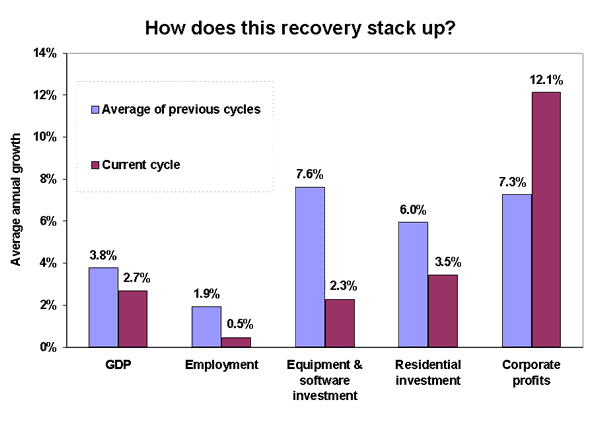
At The Agonist Bonddad asks, “So, are you better off now than you were 7 years ago?”

click for clearer image

Incidentally, the Bonddad Blog is worth a look too.

Posted in Econ & Money | Comments Off on The Economy