Category Archives: Econ & Money

Back to Basics

Someone doing good writes about the basics.

Posted in Econ & Money | Comments Off on Back to Basics

Another Great Capitalist Moment

At the conclusion of a scary, at times rebarbative, summary of the 'Values Voter' (what are the rest of us? valueless? devalued?) summit entitled I go to the 'Values Voter Summit' so you don't have to, we find this gem:

I'd like to give a shout-out to Lambda Rising, an iconic gay bookstore not far from the Hilton Washington, where the Values Voter Summit took place. Walking by the store during a break Saturday afternoon, I was amused to see a sign in the window reading, “Attention, Values Voters! Show your badge and get 20 percent off.” I's good to know that the entrepreneurial spirit lives, and my guess is that most of the guys from the 'ex-gay' ministry booth were down there the minute the conference ended.

Posted in Econ & Money | 1 Comment

What the Market Will Bear

Strange item by one Shankar Vedantam in the Washington Post today, which apparently ran on page A03: When Immigration Goes Up, Prices Go Down.

Seeing that headline, I expected to read about the labor market. All other things being equal, more immigration means more workers, means more competition for jobs, means lower wages, which in turn may mean lower prices too.

But no. Not at all. Here's how it starts:

Last week, a gallon of gas at an Exxon station in the tony suburb of Bethesda cost $2.99.

At an Exxon station in the less affluent suburb of Wheaton, a gallon cost $2.63 — 36 cents less.

Both Exxon stations are located near a subway line that goes to downtown Washington. Both are in the same county: Montgomery.

Why would the same company charge you 14 percent more for an identical product in one location?

Because it can.

The article goes on to suggest that concentrations of immigrants lower prices. Yes, it's presented as cause and effect:

Immigration, economist Saul Lach recently found, plays a powerful role in holding down prices. For every 1 percent increase in the ratio of immigrants to natives, prices go down by about 0.5 percent, according to Lach's new study about the effects of 200,000 Jews immigrating to Israel from the former Soviet Union in 1990.

It may be that recent immigrants are poorer, and thus are cannier shoppers, and that this causes a downward pressure on prices. But note that the article itself gives as its major example the willingness of immigrants to drive out of their way for cheaper gas (which would suggest the effect might not in fact be localized).

Whatever the circumstances were in Israel, it seems passing strange to assume that direction of causality in Maryland when there's so much reason to suspect it works the other way: low prices attract immigrants more than immigrants cause low prices.

I would have thought that poor people tend to live in neighborhoods where property prices are lower because they can't afford the homes in expensive neighborhoods. And I would have thought that commodity prices like gasoline are lower in poor neighborhoods in part because fixed costs, like rent or property taxes, are lower.

A correlation, even a strong one, is not causation.

(And let's not even start on all the evidence that food prices are higher in very poor neighborhoods because low-cost chain stores won't open there.)

Posted in Econ & Money | 2 Comments

Straussian Economics?

Walter J. “John” Williams is an economist with a website called Shadow Government Statistics..

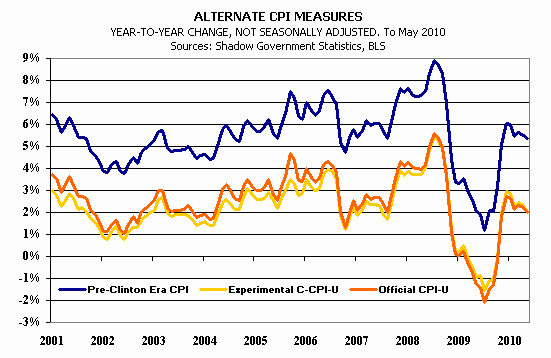
It leads off with an arresting graph claiming to show a big gap between the true rate of inflation and the official Consumer Price Index (CPI):

I don't know if I am qualified to opine as to how accurate this chart is, and to be honest I haven't delved deep enough into the supporting materials to form a view.

But the bones of the argument are simple: the revised official Consumer Price Index (CPI) is a lie, since it leaves out food and energy, and these goods are a major part of household purchases. As the prices of these goods are rising much faster than the items in the basket tracked by the CPI, the series fails to capture the real measure of inflation.

A corollary of this conclusion is that most workers' wages, which were barely keeping up with the CPI if that, have in fact been eroding in real terms (while the richest get much richer).

Why might a government design a misleading CPI in this fashion? The answer is overdetermined. There may be some technical advantages to ignoring cyclical commodities (those pesky 'seasonal adjustments') and manipulated foreign / exogenous commodities, but surely these must pale in the face of the importance of food and fuel?

One cynical reason is that the rate of increase of lots of federal transfer payments are based on the CPI. Keep the CPI down and the feds don't have to pay beneficiaries as much. Should payments to social security beneficiaries be much higher?

Another reason that I can imagine (and this is just my idea, not one I found at Shadow Government Statistics) is sort of Straussian. Inflation has a psychological element: people raise prices (or wage demands) in an effort to at least keep pace with inflation, thus spurring more of it. If inflation gets out of control, especially if coupled with lousy monetary and fiscal policy, this competition to stay ahead/stay even can even lead to hyperinflation. One way to keep inflation lower than it might otherwise be is to persuasively mislead people as to extent. If people believe the CPI is a good measure of inflation, and they are therefore deluded into believing that inflation is 2-3% lower than it actually is, that must surely have a significant anti-inflationary effect.

At least until it is found out. Note that Williams also argues that if inflation is measured right, the GDP deflater grows too, shrinking the true measure of GDP…. Do we have national money illusion too?

Posted in Econ & Money | 7 Comments

Two Questions About the GM Strike Settlement

The news of the proposed GM Strike settlement leaves me with two questions, one political, one legal, both about the part of the deal in which GM sheds its long-term obligation to provide health care for retired workers.

The political question is whether GM getting off the hook for long-term care will reduce its political will for national health insurance. Only the intervention of the big corporations will provide the sort of political coalition that makes a worthwhile reform possible — and until now it looked as if we were on track to get it due to the ever-increasing costs being shouldered by big firms. Will their remaining obligations for their existing workers suffice to motivate the GMs of the world? I hope so.

The legal question stems from ignorance due to the fact that I never took labor law. Ordinary labor contracts are between worker and employer. Collective bargaining agreements introduce the the union as bargaining agent for the workers. When there are 'givebacks' as in the current deal, workers get a new contract in consideration for whatever the union gives away. But existing (as opposed to future) retirees are in a different position. The firm's obligation to them to provide retirement benefits has matured, has vested, and they are not getting much in exchange — unless one has reason to believe that the new entity being created has a better chance of long-term solvency than GM (could that possibly be true? I'm pretty dubious.). So my no doubt very basic legal question is, why are the retired GM workers bound by this agreement? Are they in the bargaining unit forever? And, secondarily, what happens in so-called “right-to-work” states: If there are nonunion workers, are they in or out of this deal? Wouldn't it be ironic if the very right-to-work laws that firms championed for so long as a union-busting device were to turn out to be a shield against corporate attempts to shed liabilities to former workers that those firms had voluntarily undertaken but now wish to abandon.

Posted in Econ & Money | 6 Comments

Penny Dreadful

I know we don't expect much from spammers, even the pump & dump crowd, but surely this email I got today is a new low?

09/11/2007 – Traded over 4 million shares with a 100% INCREASE
09/12/2007 – Traded over 6 million shares with another HUGE INCREASE

TOMORROW THIS STOCK IS EXPECTED TO DOUBLE WHAT IT HAS DONE IN THE PAST 2 DAYS! GET IN ON IT NOW WHILE THE PRICE IS LOW! FRESHLY RELEASED PRESS RELEASE!

Current: $.02
Expected: $.57

Kinda self-defeating, isn't it? Or can you really have listed prices above zero but under one cent?

Posted in Econ & Money | 6 Comments