Yearly Archives: 2003

[Fill In The Blank] Should Run Our Paper Because…

How do you define the criteria for selecting who should run a law school newspaper? Although it has potential for both fun and service, editing the monthly, or maybe tri-weekly, paper for the school doesn't seem to be a dream job for the average law student, perhaps because does less for the resume than does a genuinely legal job. It's a fair amount of work, and what there is in the way of financial compensation isn't much for anyone except maybe the editor in chief, who gets a partial tuition waiver.

I have to write some up some criteria we can select a new staff for the law school newspaper. Why me? Because intelligent academic administrators have a way of dealing with faculty who complain about something: they make them fix it.

Continue reading

Posted in Law School | Comments Off on [Fill In The Blank] Should Run Our Paper Because…

The Secret Attack on the Right to an Open Court

The Christian Science Monitor reports that the Supreme Court will soon consider whether to review a lower court procedure that allowed the government to conduct a secret habeas corpus proceeding. Not only was the trial closed to the public, but all information about it was kept off the public record. Officially, it was a non-event.

A secret trial. A SECRET TRIAL. In the US. IN THE USA. Ok. Ok. I refuse to panic until the Supreme Court approves this. That means I have a few weeks at least.

If you had asked me two years ago, I would have said that secret trials were impossible in the USA. While there are special procedures for judges to consider especially sensitive evidence in camera these have historically been designed as a way of deciding whether the evidence belongs in open court; if the judges decide the evidence is important, the government must either make it public, or forgo using it — which, if the evidence is exculpatory, means forgoing the prosecution.

The idea that the government would attempt to hold entire secret star chamber-like trials, closed to the public, trials whose very existence was a secret, is repugnant to this nations's traditions and fundamental values. And if history teaches us anything about abuses of power, it is that secret trials are dangerous. This is never more true than in a habeas corpus action, the 'Great Writ' (the “highest safeguard of liberty,” Smith v. Bennett, 365 U.S. 708, 712 (1961)) which is designed to force the government to justify its detention of a person.

The government's — successful! — attempt to inaugurate a regime of secret trials and secret detentions is a really lousy signal about the state of panic among our ruling class — and about the brittle state of our liberties. What really boggles the mind is that two courts have allowed this to happen — now only the Supreme Court stands between us and a country with secret trials into which suspects (recall – they're innocent until proven guilty!) just vanish into the system.

Before you say 'terrorism is different' or 'we're at war now', note that the government says they want to use this tactic in drug cases too. Worry. Really worry about this one. We're one step closer to the day when this might not be a joke.

And in fact, the subject of this secret trial isn't some super-ninja terrorist from beyond the deep. He's an Algerian waiter. And he is obviously not that dangerous, since he's been out on a $10,000 bond since March 2002.

Secret 9/11 case before high court| By Warren Richey | Staff writer of The Christian Science Monitor

MIAMI – It's the case that doesn't exist. Even though two different federal courts have conducted hearings and issued rulings, there has been no public record of any action. No documents are available. No files. No lawyer is allowed to speak about it. Period.

Yet this seemingly phantom case does exist – and is now headed to the US Supreme Court in what could produce a significant test of a question as old as the Star Chamber, abolished in 17th-century England: How far should a policy of total secrecy extend into a system of justice?

Yet this highly unusual petition to the high court arising from a Miami case brings into sharp focus the tension between America's long tradition of open courts and the need for security in times of national peril. At issue is whether certain cases may be conducted entirely behind closed doors under a secret arrangement among prosecutors, judges, and docket clerks.

While secret trial tactics have reportedly been used by federal prosecutors to shield cooperating drug dealers, it's unclear whether the high court has ever directly confronted the issue. But that may change if they take up MKB v. Warden (No. 03-6747).

Continue reading

Posted in Civil Liberties | 11 Comments

Lies And the People Who Ignore Them

Mark Kleiman has assembled what he calls a very partial list of Bush lies. And while it's a good list, it is a very partial list, mixing the deadly and the trivial. The problem is that there are so very many, many lies to choose from. (Other compilations include Bushwatch, Bush-lies, Caught on Film, and Bushlies.net .)

Every so often, I get a feeling of disconnect from the body politic. I recall being stunned to discover in college (during the Iranian hostage crisis) that friends of mine, people I considered basically sensible, had taken a trip down to Washington DC in order to throw rocks at the Iranian Embassy.

I have a similar feeling of disconnect now. How can it be that about half of the voters in this country tell pollsters that they are basically happy with an administration that lies like a rug? This is surely one of the central questions of the day.

Continue reading

Posted in Politics: US | 3 Comments

A Visual Joke And Also A Decent Exam Question

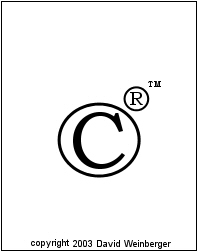
Here's a fun visual joke from David Weinberg that he calls Trademark Registered Copyright (and which he has placed in the public domain, thereby preventing the hypo from becoming a realo). I suspect that with only a little effort, it could be turned into a nice exam question in Trademark law. Which I'm not teaching this semseter.

What I need is exam questions for Administrative Law and especially International Law, which I'm teaching for the first time.

Posted in Law: Trademark Law | 4 Comments

Does Hackerdom Need an Emblem?

If there were to be a hacker emblem, Eric Raymond, author of How To Become A Hacker, The Cathedral and the Bazaar, and the original Jargon File, is surely as good a choice as anyone to pick it.

And if someone were going to pick an emblem, what better than a symbol from the Game of Life. Some might vote for the blinker, the most-seen object in Life, others for the glider gun, block, the beehive, or the integral sign, but the glider is fine.

But really, even keeping in mind the more comlex and nuanced way that Eric Raymond uses “hacker,” as opposed to the USA Today cartoon version— are hackers the sort of group that need a logo? (See the Slashdot thread. I particularly liked the suggestion that hackers are defined by the color of their hat.)

Actually, yes. Hackers require a small but constant supply of new T-shirts. For some it is because the old ones wear out from being worn and laundered day after day. For others it is because the old shirts get too tight round the waist. Still others find that their old T-shirts get up and walk off after months of not being washed.

And this will look nice on a T-shirt.

Posted in Internet | Comments Off on Does Hackerdom Need an Emblem?

US Export Control Rules Applied to Prevent Editing of Scholarly Articles

The US Government's Office of Foreign Assets Control has told the IEEE, publishers of engineering journals that it cannot edit contributions from persons in Cuba, Iran, Libya, or Sudan. This is very hard to understand as anything but a First Amendment violation. Unfortunately, I can't find the primary sources online, and the secondary sources are not as clear as I'd like.

IEEE Web Only News:

On 30 September, the U.S. Treasury Department (Washington, D.C.) informed the Institute of Electrical and Electronics Engineers (IEEE) that it must continue to limit members’ rights in four countries embargoed by the United States: Cuba, Iran, Libya, and Sudan. The ruling means, among other things, that the IEEE, the world’s largest engineering association (and the publisher of this magazine), cannot edit articles submitted by authors in those countries, making it effectively impossible for most such work to appear in IEEE publications.

If IEEE wishes to edit and publish the work, the Treasury Department informed IEEE, it will need to apply for a special license. That ruling could in turn have far-reaching consequences for hundreds of other U.S.-based scholarly publishers and professional organizations.

In the meantime, however, IEEE members in the four affected countries are prohibited from being elevated to a higher-grade membership; using IEEE e-mail alias and Web accounts; accessing online job listings; and conducting conferences under the IEEE name [see “Services in Dispute,” p. 15]. They still receive printed journals and other publications. In January 2002, when the IEEE first imposed its restrictions, it had over 1700 members in the embargoed countries, nearly all of them in Iran; only about 200 are still members. IEEE has about 380 000 members worldwide.

We’ve been working with OFAC to better understand what services we can still provide,” Adler says. “But [OFAC] drew the line very explicitly on editing.” In his letter to IEEE, OFAC director R. Richard Newcomb stated that “U.S. persons may not provide the Iranian author substantive or artistic alterations or enhancement of the manuscript, and IEEE may not facilitate the provision of such alterations or enhancements.” Such enhancements include “reordering of paragraphs or sentences, correction of syntax or grammar, and replacement of inappropriate words.”

Foreign asset controls are designed in part to stop money and services from going to 'bad' regimes. The statutes and regulations I am familar with all contain exemptions for “publications”. From what I can see, the government argues that editing is some sort of prohibited service (or technology export? If so that would open a nice can of worms — a perfect topic for a student's law review note…). Whatever they may call it, I have a lot of trouble imagining a regime that requires journals to get a license to allow them to edit foreigners' submissions as anything other than a classic prior restraint on speech.

Continue reading

Posted in Civil Liberties | 6 Comments